Pagans, Christians & Wrens
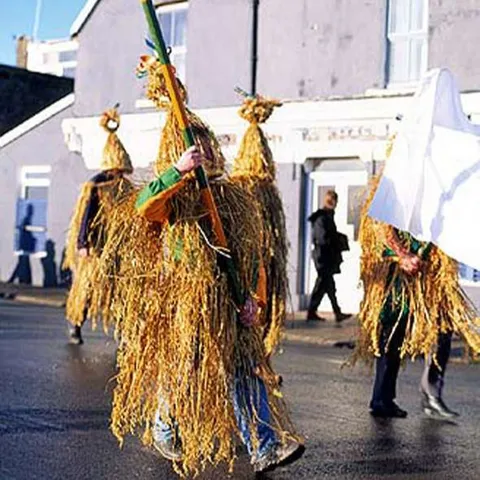
Did someone say special Christmas episode? In a fortuitous coincidence it's the 26th episode on the 26th of December, which happens to be Wren Day! So we're taking a break from the War of Independence and exploring the weird semi pagan world of Wran Boys!
Support The History of Ireland by donating to their Tip Jar: https://tips.pinecast.com/jar/historyofireland
Transcript
Welcome to the History of Ireland. Merry Christmas! It’s St. Stephen’s Day. And for this, the 26th of December, on our 26th episode, we’re going to take a quick break from our regular programming and dive into a little bit of Irish Christmas history. Namely, the very strange, long-standing tradition of the Wren boys. And then, I know we said we’d answer some listener questions, but this episode goes on longer than I thought and I got more questions than I thought. So I’m going to split them up into two mini-episodes. Enjoy!
So yeah, it’s the day after Christmas. If you’re not from Ireland, you call it Boxing Day. That’s fine, weird and wrong, but fine. To everyone in Ireland, it’s known as St. Stephen’s Day. Now regardless of what you call it, you’re most likely sitting, enjoying a lazy day, eating leftover turkey sandwiches, getting very competitive over board games and just enjoying the festive haze.
But, if you live in Ireland, around Kerry or Dingle, you’re going to hear a knock at the door. You’re going to open it to a large group of people dressed like something out of The Wicker Man. They’ll be singing, dancing, waving a fake bird in your face and asking for money. They did this last year. They did it the year before that. And in fact, they’ve been doing something like this literally for centuries. You or a bunch of lads were on the ran. They go from door to door, similar to like Halloween or something, singing and dancing. And then at the end of the day, they throw a huge party.
I’m not from Kerry and I didn’t grow up with this tradition, so I had a lot of questions. Mainly, what the hell is this thing and where did it originate from. Apparently, Ren Day, or going on the ran, is an old Irish tradition, which in the middle of the century was carried out around most of the country. Nowadays, it’s generally confined to rural areas, or especially Dingle in Kerry. It’s a very weird mix of Irish, pagan rituals and Christian beliefs and it’s pretty difficult to definitively unpack its origins. But hey, let’s give it a try, shall we.
Originally Ren boys would parade a ran around the town. While doing this they would dress up in bits of clothing and just generally weird masks. Haven’t really been able to figure out why they dress that way, but anyway, they ask for money from everyone in town and throw a Ren party later that night. It would be held somewhere public and everyone would be invited. At each house, they’d stop and recite a song slash poem. An example of that goes something along the lines of this.
The ran, the ran, the king of all birds. St. Stephen’s Day was caught in her furs. Her clothes were all torn, her shoes were all worn. Up with the kettle and down with the pan. Give us a penny to bury the ran. If you haven’t a penny, a half penny will do. If you haven’t a half penny, God bless you.
Here’s a description from 1841. The whole thing. The professional artists used by some means to secure a live Ren and fasten it by a string to the twig of an ivy or holly bush and enlivened by the strains of ear-piercing Fife, invade the quiet of a strong farmer’s house and dance and shout and sing the well-known legend. The poem I just recited. Then hands were taken and steps were formed around the boucle de drolines. The Ren boys who capered away in his best style shaking the bush and the poor prisoner in unison. They then generally succeeded in extracting drink or money.
In that description, they simply tie a Ren to a twig. But often the Rens were not that lucky. Here’s another one from 1867. For some weeks presiding Christmas, crowds of village boys may be seen peering into the hedges in search of the tiny Ren. And when one is discovered the whole assemble and give eager chase to until they have slain the little bird. In the hunt the utmost excitement prevails, shouting, screeching and rushing. All sorts of missiles are flung at the puny mark and not unfrequently they light upon the head of some less innocent being. From bush to bush, from bush to hedge is the Ren pursued, until bagged with as much pride and pleasure as in cock of the woods by the more ambitious sportsman. End quote. Poor little Ren.
Which I guess brings us to the question of why the hell are they picking on the little bird. This is where things get a little messy but also very interesting. The story told in various iterations is that a group of Irish fighters were sneaking up on some sleeping invaders. But at the last minute a Ren woke them up. And the Irish, losing the element of surprise, were defeated. I’ve heard this as the English, the Vikings and well everyone in between. But the earliest iteration I could find was from John Obery’s Miscellanies, written in 1696.
The piety of the Protestants would have been surprised sleeping by the popish Irish, were it not for several Rens that it just wakened them by dancing and pecking on the drums as the enemy were approaching. For this reason, the wild Irish mortally hate these little birds to this day. Calling them the devil’s servant and killing them wherever they catch them. They teach their children to thrust them full of thorns. And you’ll see them sometimes on holidays a whole parish running like madmen from hedge to hedge, a Ren hunting. End quote.
But then there’s another story told in which Saint Stephen was hiding in a bush when a Ren flapped its wings and alerted those chasing him that he was hiding there. They promptly caught Saint Stephen and gave him the honour of becoming the first Christian martyr. Lucky Steve. Similar kind of story but totally different setting. Basically the Ren was seen as the devil’s bird and the Ren hunt was a way to ensure good luck for the following year.
But things get a little messy and there’s a completely different theory for why people hunt and kill the Ren around Christmas. You see, the Ren had a long standing tradition among Celts. In Irish the word for Ren is Drayleen, which some interpret as being derived from Dray-Ain. Ain being the Irish word for bird and Dray being the Irish word for druid. So the Ren was the druid’s bird. This is because it was believed that the Ren was the most cunning and the wisest of all birds. And they were actually used by druids to tell the future. The druids would listen to the Ren sing and predict the future from it, in a form of Augury. Much kind of better than the Roman tradition of examining entrails if you ask me.
On top of this, the Ren had a deep connection with winter. They were one of the few birds who sang all year round. This has led people to think that part of the Ren day was a cold midwinter ceremony, something similar to Halloween as I said. And as well as all this, folklore describes the Ren as king of the birds.
Do we want to quickly hear the story why? Well the old folktale goes that all the birds wanted to figure out who should be king. And so they settled on a competition to see who could fly higher. All the birds started to fly into the sky. Ravens, ducks, crows, and of course leading the way was an eagle. The eagle kept flying and flying, higher and higher, while all the other birds grew tired. Finally the eagle was higher than any other bird and he began to congratulate himself. He was king. But suddenly he heard a small voice exclaim, I did it, I did it, I am king.
The tiny Ren had hidden in the eagle’s feathers and hitched a ride. Once the eagle was as high as he could go, the Ren hopped out and flew higher still. The eagle was furious, but too tired to fly any further. Once all the birds had gathered on a tree, the eagle angrily claimed the Ren had cheated. You only use cunning and trickery he cried. The Ren replied, you eagle would have won through strength and brawn. Why is that any better than cunning. And that’s how the Ren became king of the birds.
So yeah, traditionally Rens were pretty well respected. And as far back as Celtic times they were revered. Some argue that it was because of this that Christians started telling stories to discredit the bird. Basically clerics in the middle ages were trying to fight druidic beliefs and used stories like the one about Saint Stephen to paint the Ren as an agent of the devil. And it seems it only kind of half worked. Yes the Ren was chased and buried on Ren day. But the festivities themselves retained much of their pagan traditions. And these days no one even kills or kidnaps a poor bird. They either use a toy or just ignore that aspect altogether. Nowadays there’s usually a big parade, the money goes to charity and there’s still a party at the end of the day.
The Ren day then becomes a perfect example of the various forces that have been bouncing around Ireland for thousands of years. It’s part Christian, part Celtic, part folk tradition, part an excuse to go out and get drunk after Christmas. In fact when you think about it, it’s much like Christmas itself, a mix of pagan and Christian rituals. Though now we’ve added a whole bunch of consumerism on top. But that’s a topic for a whole other podcast.
What I love about it all is that to this day people are celebrating something that most likely had its origins in pre-Christian Ireland. It’s a tradition that contains elements from thousands of years ago. And hopefully it will continue on well into the future. So that’s the Ren day. Have fun.
So I’m going to take a quick break over Christmas. But in the new year we’ll continue our story of the war of independence. It’s been just over six months since I started this thing, and it’s been amazing how many people have supported the show. Thank you so much. Over the last year I’ve had a few questions, and even more sent in since my call out from the last episode. So the next episode, as a Christmas gift to you guys, will be a quick Q&A session. So we’ll do that next time. Have a great Christmas. See you lads.
The history of Ireland was written and produced by me Kevin Dolan. Additional research and fact checking by Robert Babington. Music by Liam Doyle and production help from Aoife Murphy. This podcast was recorded on the lands of the Wurundjeri people of the Kulin Nation. Sovereignty was never ceded.