Episodes Irish Mythology Season 3 — The Mythology
The Unique Oddness of Irish Mythology
Transcript
Welcome to the History of Ireland. In the last episode, we explored the life of St. Patrick. Now, we’re getting back into one of the strangest stories in Irish mythology, where Aideen has been turned into, of all things, a beautiful fly.
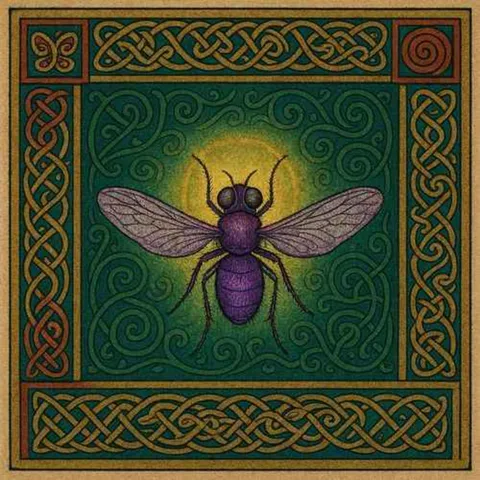
Aideen had been turned into a fly, but she was no ordinary fly. This fly was as big as the head of the handsomest man in the country, and the sound of her voice and the hum of her wings was sweeter than pipes and harps and horns, and the fragrance and the bloom of her would turn away hunger and thirst from anyone around. The drops she shed from her wings would cure all sickness and disease and plague. To listen to her and gaze upon her would nourish hosts in gatherings and assemblies in camps. If Aideen had been the fairest woman in all the land, it’s safe to say that she was most definitely the fairest fly in any story you might ever hear.
Once she had turned from a puddle of water to a worm to a fly, Aideen flew off to find Midir. As soon as he saw her, even in her fly form, Midir recognized Aideen. And so long as the fly was attending to him, he never took himself another lover, and the sight of her made him happy. In fact, he would fall asleep with her humming, and whenever anyone approached who did not love him, she would wake him up.
One day, Piumnoc, Midir’s old wife, came to visit Midir, bringing along with her Lug, the Dagda, and Ogma. Midir was furious with Piumnoc, reproaching her and declaring that if it was not for the presence of the three, then he would lock her up and never let her leave. Piumnoc shrugged, saying, I regret nothing and care not for your complaining. I would rather do good for myself than to another, and wherever in Ireland Aideen finds herself, I will do not put harm for her as long as the girl lives and whatever shape she might be in.
Now, Piumnoc was no fool and could see this strange large fly who delighted Midir greatly. Whenever he saw the scarlet fly, Midir loved no other woman, and he found no pleasure in music or in drink or eating when he did not see her or hear her music or her voice. Knowing this, and using powerful magic she had been given by the wizard Ressil, Piumnoc banished and warned off Aideen from Midir.
She stirred up a wind of assault and magic, blowing Aideen from Midir’s home, and for seven years Aideen could not find a summit or a tree or a hill or a height in Ireland on which she could settle. But only the rocks of the sea and the ocean waves, and she floated through the air. Until seven years from that day she landed on the breast of Angus Mac Ock in Newgrange.
I’ll pause here for a moment to point out that this is another prime example of why some academics reckon this story is a metaphor for the moon’s movements. During the 19-year metatonic cycle there is a seven-year span where, seen from Newgrange, the moon floats over the sea, not on the land, never making it back to the mountains of Morn, to Maginnis. This is reflected in Aideen’s journey here. Pretty cool right? Now back to the story, and when we think about this next section, remember that Angus is sometimes associated with the sun, and this could reflect a period when the full moon hangs in the sky along with the sun.
In Newgrange Angus made the girl, or that is to say the purple fly, welcome, and gathered her in his bosom in the fleece of his coat, and wherever he went Angus took the fly with him and slept beside her each night. Angus filled his home with fragrant and wondrous herbs, and Aideen the fly thrived on the fragrance and bloom of those precious herbs. Soon, with Angus comforting her, gladness and colour came back to Aideen again.
Back in Midr’s home, Yumnok was told of the love and honour that Angus Ogh had bestowed on Aideen, and when she heard of this she paused for a moment, thinking to herself. Then Yumnok called out to Midr, saying, Summon your old foster son Angus, and I will make peace with both of you. After a messenger was sent to Angus, he left Newgrange and headed off to meet with Midr.
Angus went to speak to Midr, planning to make peace with Yumnok, as she had suggested. But when Angus arrived, Midr rushed towards him, saying, Yumnok has lied to us, and if she hears that Aideen is in Ireland, she will do her harm. Do not worry, foster father. Aideen has been at home in Newgrange for a while now, in the form in which she was blown away from you. Angus then returned home to find Aideen was gone.
While he had been away, Yumnok sneaked into the mound from another entrance to find Aideen. Fierce and long-lasting is the anger of an Irish woman, and Yumnok was still furious at this young girl who had stolen her husband. Aideen would never rest while Yumnok lived. Yumnok unleashed the same magical wind against Aideen, and sent her on the very flight she had been on before for seven years throughout Ireland. Angus then chased Yumnok down until he found her at the house of her druid master. There, Angus attacked her and struck off her head and took it back to Newgrange.
Meanwhile, the wind drove Aideen along in misery and weakness for thousands of years until she arrived on the roof tree of a house in Ulster where folk were drinking. Aideen, still a fly remember, landed in the golden beaker of the Wife of Itar and was swallowed whole. In this way, she was taken into the woman’s womb and soon was born again. A thousand and twelve years after being born to the Wife of Eileal, she was born again to the Wife of Itar.
After this, Aideen was raised by Itar in Inver Kirkmain, hopefully that pronunciation is vaguely right, alongside fifty chieftain’s daughters who were fed and clothed so that they could attend to Aideen at all times. But know this, Aideen had no memory of her past life as a fly or as the Wife of Itar.
One day, all the girls were bathing in the estuary when they saw a horseman ride out of the water. He was mounted on a broad brown pantsing steed with a curly mane. The man had bright yellow hair and wore a green cloak of the She, a red embroidered tunic and a golden brooch. A silver shield with a rim of gold was slung over his back and in his hand he held a five-pronged spear. He then recited this poem.
This is Aideen here to-day, at She-Ban-Find, west of the Alve. Among little boys is She, on the brink of Inver Kirkmain. She it is who healed the King’s eye from the well of Loch-da-Lig. She it is that was swallowed in a drink from a beaker by Itar’s Wife. Because of her the King shall chase the birds from Tespa, and drown his two steeds in the pool of Loch-da-Eirbach. Full many a war shall be on Yuckig of Meath because of Thee. There shall be destruction of Elf-mounds and battles against many thousands. To She that was sung of in the land, to She that strives to win the King, to She who is called to be Finn, She is our Aideen afterwards.
And with this strange poem recited, the young warrior rode away, and I imagine the women looked to each other rather confused. We’ll stop there for today, and next episode, explore the island Aideen finds herself 1,012 years after she was first born. A world where humans are very much in control, and it seems that to-a-day have gone off to live in a parallel world.
Thanks for listening. Subscribe wherever you get your podcasts, and if you’re enjoying it, give us a review on Apple Podcasts, or tell your friends. It really helps. If you want to go further, you can support the show, get ad-free listening, and bonus content on our Patreon page. Simply follow the Patreon link in the show notes, or visit our website, thehistoryofireland.com. You can also get in touch through the website, or in Facebook and Twitter. It’s always great hearing from you guys, and if I’ve made a mistake, please do let me know.
The History of Ireland was written and produced by me, Kevin Dolan, with music by Liam Doyle, and additional help from assistant producer Aoife Murphy. This podcast was recorded on the lands of the Wurundjeri people of the Kulin Nation. Sovereignty was never ceded.