Episodes Irish Mythology Season 3 — The Mythology
The Kings of Early Medieval Ireland Meet Étain
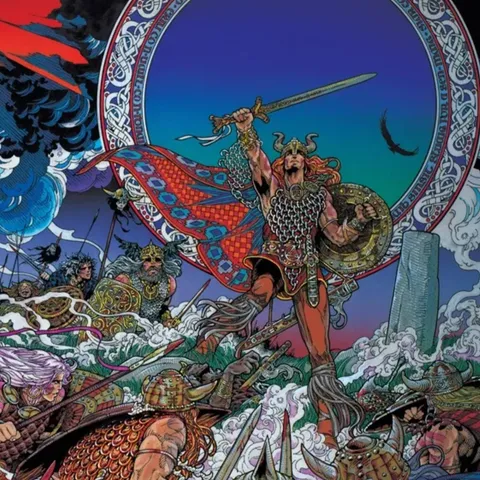
In this episode we look at how early medieval Ireland was ruled through a series of different kings and over kings, as well as continue our story of Etain, who is now living in early medieval Ireland with no memory of her time with the Tuatha Dé.
Image, used with permission, is Nuada the High King by Jim Fitzpatrick.
Transcript
Welcome to the History of Ireland. In the last episode, we followed Aideen as she struggled through her life as a fly, only to be reborn 1,000 years later in a very different Ireland. And in this episode, the wooing of Aideen gives us an insight into the politics and structure of this different Ireland, one that is no longer the mythical land of the Tuath Dé, and instead much closer to the real early medieval Gaelic Ireland.
And it’s important to understand how Ireland was ruled in this early medieval period. It was about 400 to 1180 or thereabouts. Basically, everything was built from the Tuath. And yes, you’ll recognize the word from Tuath Dé. We’ve been talking about the gods people a lot. And Tuath roughly does mean people. It also translates into tribe, petty kingdom, country or territory. The Tuath was the building block of Gaelic-Irish society. It was quote, the basic territorial unit to which every individual belonged.
Between the 5th and 12th century, it’s estimated that there were around 5,000 Tuath. Each of them had about 1,000 people, and maybe would have been similar in size to parishes today. Now, each Tuath had a re or a king. Everyone owed him loyalty. He was a representative of the Tuath, and it was his job to organize an army to defend the group.
Over the centuries, they developed what was described as overkings, who would have been in charge of several Tuaths, with each underking reporting to him. In this way, the country was sort of, though it’s an oversimplification, split into Cuaghead, which is the middle Irish word for 5th. This is why the modern Irish word for province is Cuaghe, which also means 5th.
Usually, there were actually more than 5 areas, but generally, these were the 4 that we know, Leinster, Connacht, Munster and Ulster, and then Meath, which was seen as its own separate entity, but very important. It housed the hill of Tarra and Newgrange, and was basically the power centre of Ireland for much of this time.
So, each Tuath had a re. Then, Tuaths could be gathered together and ruled by an overking, or a Rury. Then, these kings were ruled by a Re-Cuaghead, king of the 5th. And then, finally, you could have the Ordry, or the High King, who was said to be king of all of Ireland, and who this story is sort of about. Though, admittedly, there were actually very rarely High Kings like this in real life. The title existed, but was more often than not contested, and we’ll see in the story that it was not guaranteed that people would listen to the High King. It also should be noted that the reason these stories were being told was to cement Meath as the power centre of Ireland, and to suggest that, you know, the king of that area was the High King of all of Ireland.
Then, finally, there’s one last thing I will touch on, because it’s important throughout the ruling of Aedín, and especially in this section that we’re about to tell. The power of the king, his sovereignty, was said to come through his marriage to a goddess, or to the land. Again, at the beginning of the story, there’s mention of a Fesh. This ritual was known as Ban Fesh Riggi, literally the king’s wedding feast, or sleeping with a woman, and often was referred simply to as the Fesh. This was originally a sort of festival where the king would quote-unquote marry the land.
The success of his reign, including the fertility of the land and the prosperity of his people, was believed to be linked to this union. This pagan concept of kingship being bound up with fate, taboo, luck and disaster persisted long into the Christian period. And it’s something that will become even more important in the next episode. Throughout the ruling of Aedín, Aedín can very much be taken to represent that sovereignty goddess. Marrying her, or sleeping with her at least, gives kings the right to rule. And it’s important to consider that subtext as we get into the story.
So without much further ado, let’s dive into how Aedín was ruled for a second time. In the thousand years since Midr had fallen in love with Aedín and Fiumnach had turned her into a fly, Ireland had changed dramatically. The Tuath Dé had faded into their sheathed mounds, those hollow hills humming with power, leaving Ireland to men.
One of those men was Iochagarram, not a god, not a Tuath Dé, simply a man. But it’s safe to say an important one. Iochagarram was the High King of Ireland who ruled over the five provinces. Each province had its own king and they all submitted to Iochag, most of the time. A year after becoming king, Iochag commanded the men of Ireland to hold the Feshub Tower so that he could assess their taxes for five years. But the other kings refused. You couldn’t be High King without a queen, they argued. No queen meant no festival could take place. And they were right.
So Iochag sent envoys to each fifth of Ireland to seek out the fairest woman in the country. And who did they find? Of course, it was Aedín. Except she was no longer a fly, she’d been born again as the daughter of Étaer. She had no memory of the Tuath Dé, but the time spent with Angus, with her years spent stuck out at sea as a fly, she was just a normal woman. And so, Iochag and Aedín were married and the High King was well pleased. The Fesh was held and everything looked like it was going to plan. Except, not quite.
You see, Iochag had a brother, Eileal Anguia. And while at dinner, this brother found himself gazing upon Aedín constantly. And such gazing, it is said, is a sign of love. But Eileal was a good brother and reproached himself for what he was doing. He would not dishonor Aedín. He could not help but fall in love. Many people can’t. He refused to speak to Aedín but soon felt deathly ill.
The doctor was brought and knew exactly what was wrong with the man. You have one of two pains that can kill a man which no physician can heal, the doctor said. Pain of love or the pain of jealousy. Eileal, the loyal, royal brother that he was, said nothing and so was left to die.
His brother, Iochag, duty bound, had to make a royal tour of the kingdom. He left, instructing Aedín with a heavy heart to oversee Eileal’s last rites. His grave dug, his lamentations made, his cattle slain. So while Eileal lay dying, every day Aedín would come to visit him. And of course, these visits cured him. As long as Aedín was with him, the man’s sickness disappeared.
Now Aedín noticed this and it left her wondering. What is it, she asked him one day, smoothing his pillow, that makes you ill? It is my love for you, Eileal admitted. Thinking that he was going to die anyway. Aedín probably blinked. Pity you didn’t say so sooner, she replied, ever practical. If we had known, you could have been healed long ago.
I would be whole again if you were willing to lie with me, Eileal said, sitting up from his sickbed. Aedín must have thought to herself that this was a tricky situation. She did not want to dishonor her husband, but neither could she let his brother die. And so, she made a decision. I’m willing to help, Aedín replied.
For the next nine days, Aedín came and bathed Eileal’s head in cabbage’s meat and poured water in his hands. Soon he was healed, but Eileal knew it would not be enough. When will you give me what I truly need to be whole, Eileal asked. Tomorrow, Aedín decided. But not in the High King’s home, or he shall be put to shame. Come to me tomorrow night on the hill above the court.
The next night, Eileal stayed up, ready to meet Aedín on the hill in question. But as the appointed hour struck, a profound drowsiness swept over him. He fell asleep, dead to the world, and did not wake until morning. Aedín, meanwhile, went to the hill and found a man waiting for her. He looked just like Eileal, and he spoke just like Eileal, but was not the king’s brother.
In fact, when Aedín came back to Eileal the next day, she found the man distraught. Why so sad? she asked. Because I slept through our meeting, he groaned, and it is clear I am still not well. No matter, Aedín said, one day follows another. And so, the next night, the two tried to meet again. But again, Aedín met a man who looked just like Eileal, while Eileal himself slept through the night. Three times this happened. Each night Eileal failed to meet Aedín, and instead, she met the doppelganger.
You’re not who I’m to meet, she said one night. I come not to hurt or sin against the man I am to meet, I come to heal the king’s brother. The man smiled, and we can imagine it was a smile that didn’t quite belong on Eileal’s face. It would make more sense for you to come with me, the man disguised as Eileal said. For when you were Aedín Eccard, daughter of Eileal, a different Eileal from long ago, I was your lover. I paid a huge bribe price for you, by making the great plains and rivers of Ireland, and paid your weight in gold and silver.
Aedín stared. Maybe something deep inside her stirred. Who are you? What is your name? Aedín asked. It is no hard matter. My name is Midr a brílaith. What parted us? she whispered. It’s no hard matter, Midr said, with a little bitterness maybe. It was the sorcery of Fionnach. Will you come with me now?
No, Aedín shook her head, grounding herself in the present. I will not leave the king of Ireland for a man whose race I no longer know. But it was me who made Eileal fall in love with you, so that his flesh and blood fell from him. It was I who cast sleep upon him these past nights, so he would not dishonor you, nor you him. I, Midr, arranged all of this. Let me ask you another way. Will you come with me? The King Yuccadc himself bids you to go. Willingly, Aedín said. King’s command was different, after all.
Satisfied for now, Midr vanished, and Aedín returned home to Eileal, who’s feeling much healthier and happier. We are now well met, said Eileal, relieved. Now that I am healed, then your honor has not suffered. It is wonderful, Aedín replied, though we can imagine that she was a little worried and a little unsure as to what would happen next.
Soon after, King Yuccadc returned from his tour and rejoiced to find his brother alive. Aedín was praised for what she had done to help the King’s brother. But Yuccadc was not told of the nights Aedín had spent speaking to Midr, her old lover. Little did Yuccadc know that Midr was still chasing Aedín, and would do anything he could to woo her once more.
Thanks for listening. Subscribe wherever you get your podcasts, and if you’re enjoying it, give us a review on Apple Podcasts or tell your friends. It really helps. If you want to go further, you can support the show, get ad-free listening, and bonus content on our Patreon page. Simply follow the Patreon link in the show notes, or visit our website, thehistoryofireland.com. You can also get in touch through the website, or on Facebook and Twitter. It’s always great hearing from you guys, and if I’ve made a mistake, please do let me know.
The History of Ireland was written and produced by me, Kevin Doyle, with music by Liam Doyle, and additional help from assistant producer Aoife Murphy. This podcast was recorded on the lands of the Wurundjeri people of the Kulin Nation. Sovereignty was never ceded.