Episodes Irish Mythology Season 3 — The Mythology
The Coming of the Tuatha Dé
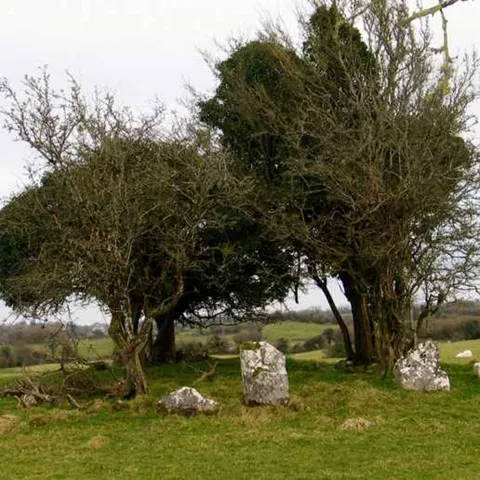
In this episode we dive into the First Battle of Moytura, telling the story of how the Tuatha Dé came to Ireland.
If you'd like to dive into the originals, check out UCC's CELT resource.
The image is one of the Cong Stone Circles in Mayo, which is said to be linked to the Battle of Moytura.
Transcript
Welcome to the History of Ireland. In the last two episodes, we’ve jumped across a whole lot of history, from Neolithic Newgrange all the way to the monasteries of Medieval Ireland. That’s because the stories we want to tell really are like archaeological ruins, layers upon layers of additions and revisions that have taken place over centuries. With that in mind, I’m not going to give you a literal translation of the stories. My middle Irish, and my regular Irish for that matter, isn’t quite up to it.
Instead, taking a leaf out of Neil Gaiman or Stephen Fry’s books, I’m going to tell these stories in a way that I imagine they would have been told by the filly and poets of ancient Ireland. In a way that’s accessible and hopefully enjoyable, but in a way that keeps as much of the essence of the Irish original as possible. And to do this, I’ll be leaning a lot on an amazing resource by University College Cork called the Corpus of Electronic Texts, or CELT, which gathers together digitised versions of these old stories in Irish and with English translations. So I won’t go as far as say Stephen Fry, people have retold the Greek myths enough that he can do what he wants. But I will maybe simplify things a little bit and clarify things where possible.
Now I can already hear the academics loudly complaining about this, and yes, a lot of nuance and the beauty of the original might be lost. But I think we can gain a lot as well. And anyone who really wants to can go online and read the originals. I’ll link to CELT in the show notes. Of course, this is a bit of an experiment, so I’m keen to hear what you think, and I’d love to hear any feedback. But without further ado, Here is the first battle of Moitura, or the coming of the Tuath Dé.
They came in dark clouds the Tuath Dé, onto the shores of Connacht on the first day of Bealtaine. And with them they brought a darkness that covered the sun for three days and three nights. It’s said they came from the north, from four great cities, Thalleus, Gorius, Phineus, and Murius. And with them they brought four great treasures. The sword of Nuida, no one ever escaped it. The spear of Lug, no battle was ever won against it. The Dagda’s cauldron, no company ever went from it unthankful. And the Leofol, the stone of destiny, which roared under every king that would take the realm of Ireland. But those who lived in Ireland already, they saw nothing but mist. Whether this was the Tuath Dé’s magic, or because they burnt their own boats so there would be no thought of retreating, the people of Ireland could not tell.
You see, the country was already inhabited by the Fear of Olgs, the Bag People, who had lived in Ireland for centuries since escaping from the Greeks. Messengers rushed to Tyre from Connacht to tell Yoki, King of the Fear of Olgs, about this new race of people who came to Ireland, not knowing whether they had come from the earth, or the skies, or the wind. They thought there would be wonder on Yoki when he heard the news. But there was no wonder on him, for a dream had come to him in the night. When he asked his druids the meaning of the dream, they told him it would not be long till there would be a strong enemy come against him.
And so, a great fighting man of the Fear of Olg, Sreng, was sent out to meet these new strangers. He was armed to the teeth with a red-brown shield, two spears, a sword, a thick iron club, and a helmet. But the Tuath Dé quickly spotted Sreng coming and sent out their own champion, Bress the Beautiful, to meet him. Bress was the son of Eru, who would later give her name to Ere, and though no one knew who his father was, Bress was the most beautiful of all the Tuath Dé’s young men. So much so that if someone wanted to praise any beautiful thing, whether it was a field, or an ale, or a flame, a woman, a man, or a horse, they would say it is as beautiful as Bress.
As Bress arrived to meet Sreng, the two men approached each other slowly, keeping a good watch and wandering at one another’s arms. Once they got close enough to speak, they struck their shields hard into the ground and stared over the rims. Bress spoke first. Because he spoke Irish, Sreng drew nearer, feeling a little less uneasy. “‘The o’Gwit,’ Bress said. “‘The o’smore o’Gwit,’ Sreng answered. “‘I am in dread of your thin, sharp spear.’ “‘Well, myself,’ Bress replied. “‘I am in dread of your thick-handled spear. Are all the arms of the Firbolg like this?’ “‘These spears are called crossax,’ Sreng explained. “‘And they would break through shields and crush flesh and bones, causing wounds that never heal.’
Bress and Sreng then swapped spears so that fighters on each side could see the weapons the others were to use. Then Bress gave a message to Sreng for the Firbolgs. “‘Give up one half of Ireland and my people will be content with peace. But if you do not give up that much, there should be a battle. But whatever happens, you and I, Sreng, will be friends.’ Sreng agreed and took the message and the spear back to Tar. He pleaded with Yoki to share the country and not go into battle with a people whose weapons were so much better than their own. But Yoki was having none of it. “‘We will not give up half of the country to these strangers, for if we do, they will soon take the whole.’
Meanwhile, Bress returned to the two a day and showed them the heavy spear and told them of Sreng, the fierce, strong man he had got it from. Hearing how sturdy he was and how well-armed, the two a day knew battle would come soon. Before the fighting proper took place, the two a day sent their three queens, Bav, Mokka, and the Morrigan, to Tar, where the Firbolgs were ruled from. And with the power of their enchantments, they brought mists and clouds of darkness over the whole place, sending showers of fire and blood, so no one could see or speak until three days later, when the druids of the Firbolgs broke the enchantment.
Then the Firbolgs gathered their men together and came with their eleven battalions and took their stand at the eastern end of the plain of Mag Nia, near where the two a day were gathered. The king of the two a day, Nuada, looked out at the host and sent his poets to again make the same offer made before. He would be content with half of the country if it was given up to him. King Yoki turned the offer down and so the messengers asked when they would begin the battle. You must delay, Yoki said, for we want time to put our spears and our armor in order, and to brighten our helmets and sharpen our swords and to have spears made like the ones you have. And, you yourselves, you will be wanting to have spears like our Crassacs made for you. So it was agreed to delay for a quarter of a year and battle did not begin until midsummer’s day.
The first battle took place as eighteen hurlers of the two a day went out against eighteen hurlers of the Firbolgs. If the Firbolgs were beaten, every one of them killed. After this King Yoki sent a messenger to ask if they would battle every day or every second day. King Nuada replied, saying they would fight every day, but that there should be just the same number of men fighting on each side. Yoki agreed but he was not well pleased as the Firbolgs quite outnumbered the two a day.
So the battle went on for four days and there were great feats done on each side and a great many champions came to their death. But for those that were alive in the evening, the physicians on each side used to make them a bath of healing, with every sort of healing plant or herb in it. That way they would be strong and sound for the next day’s fight. On the fourth day, the two a day got the upper hand, driving back the Firbolgs. And as this happened a great thirst came on Yoki and he went off looking for a drink with one hundred and fifty men protecting him. But one hundred and fifty two a day chased him to a beach in Sligo called Tra Yol Tal. A bitter fight was fought and King Yoki died. There on Tra Yol Tal he was buried and a great heap of stones was raised over his grave.
Soon there were only three hundred men left of the eleven battalions of the Firbolgs, all led by Shreng, who had never wanted battle in the first place. But in the fighting Shreng sliced off Nuida’s hand and before more bloodshed could occur, Nuida offered peace. Shreng of the Firbolgs, you fought well, Nuida said, holding the stub of his arm. I offer you your choice among the five provinces of Ireland. Since we’re here, we’ll take Connacht, Shreng said. He and his people live there and his children after them. But as victors, the two a day took position of chower that was sometimes called Tara and Drumconn, the Beautiful Ridge, the Leardrum, the Grey Ridge and Drumnadisconn, the Ridge of the Outlook. All those names were given to Tara.
The fact that Shreng had chopped off Nuida’s arm caused a lot of trouble for the king and his people. You see, there was contention between the two a day and their wives, as the wives pointed out, that the law said that no man that was not in perfect shape could be king. Because of this, after Nuida lost his arm, he lost his crown. Poor lad. In his place, Bress the Beautiful became king, but Bress’s beauty brought no great luck to his people.
This is because the Fomorians, who lived under the sea to the west of Ireland, began demanding tribute of the two a day. The Fomorians were a monstrous race, having but one foot or one hand. And they had been friendly with the Firbolgs, happy to leave Ireland to them. But they were jealous of the Beautiful two a day, and so it was a hard tax the Fomorians put on the two a day. They took a third of their corn, a third of their milk, and worst of all, a third of their children. The Beautiful Bress made no stand against them, so there was not a smoke rising from a roof in Ireland that wasn’t taxed by the monstrous Fomorians.
Worse again, Bress put his own tax on every house, as well as demanding the milk of homeless dun cows, enough for one hundred men. Now a dun cow is one who is grey, and so one cute two a day man singed all the cows of Ireland in a fire of fern, and then smeared them with ashes of flaxseed, so that they would be brown. And I assume that’s why most Irish cows are now brown and not grey. And when Bress went to drink their milk, it was bog stuff that was squeezed out, and he was not the better for it for a long, long time.
This was typical of Bress. He was selfish and in no way open-handed. The two a day grumbled against him, for their knives were never greased in his house, and however often they might visit him there was no smell of ale on their breath. There was no sort of pleasure or merriment in his house either, no call for their poets or singers or harpers or pipers or hornblowers or jugglers or fools. And as for the trials of strength they were used to seeing between their champions, the only use the champions of the two a day’s strength was put to now was to work for King Bress the Beautiful.
And that is where we’ll close our tale for today, as Bress the Beautiful, who had started as the champion of the two a day when they arrived, has now become an evil despot. In the next episode we’ll explore who Bress’s father was, and see what happens as the two a day remove him from his new found throne. My plan is to jump in between the history of these stories and the stories themselves as we go through some of the most important Irish myths. But this is a bit of an experiment for us, something new, so please do let me know what you think. The listener feedback has helped drive this podcast from the very beginning and as we get into these myths I’m really keen to hear what you think of them.
Thanks for listening, subscribe wherever you get your podcasts and if you’re enjoying it give us a review on Apple Podcasts or tell your friends, it really helps. If you want to go further you can support the show, get ad-free listening and bonus content on our Patreon page. Simply follow the Patreon link in the show notes or visit our website thehistoryofireland.com. You can also get in touch through the website or on Facebook and Twitter. It’s always great hearing from you guys and if I’ve made a mistake please do let me know.
The History of Ireland was written and produced by me, Kevin Doyle, with music by Liam Doyle and additional help from assistant producer Aoife Murphy. This podcast was recorded in the lands of the Wurundjeri people of the Kulin Nation. Sovereignty was never ceded.