Episodes Irish Mythology Season 3 — The Mythology
How Bres the Beautiful came to be
In this episode we look at life in Ireland under the rulership of Bres the Beautiful and learn who is father was, as well as explore what a story of Dian Cecht can tell us about ancient Irish writers.
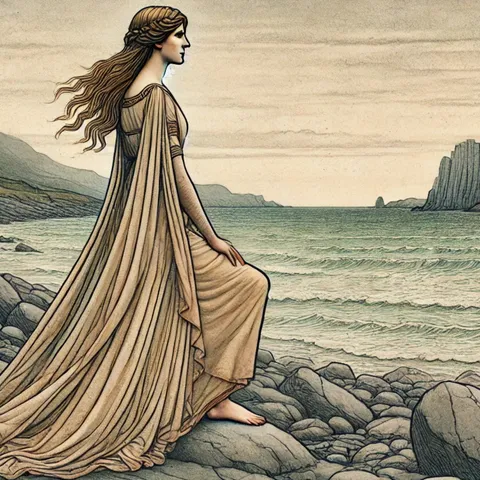
Cover image is an AI created image of Eriu staring out to sea. What do we think of something like this? I'm struggling to find good cover imagery for these stories so this feels a nice solution, but I'm also unsure and keen on to hear ye're thoughts.
Transcript
Welcome to the History of Ireland. In the last episode, we looked at the coming of the Tuath Dé and the First Battle of Moitúr. And when we left things off, it wasn’t too great. Brest the Beautiful was ruling the Tuath Dé, they were being taxed by the Fomorians, and things weren’t going particularly well for the new inhabitants of Ireland. Today, we’re going to see what happens next. And then explore a little bit of the history behind the story. This is the Second Battle of Moitúr, part one.
One morning, Irú, a woman of the Tuath Dé, was looking out at the sea and the land. The sea was perfectly calm, as if it was a level board. As she watched out to sea, she saw a vessel of silver riding the current right up onto the beach. In this boat was a man of fairest form. He had long, golden-yellow hair to his shoulders. His shirt had trimmings of golden thread. Around his neck, he wore a golden brooch. He had two shining silver spears with riveted shafts of bronze, five circlets of gold on his neck, and a golden-hilted sword with inlays of silver.
The man said to her, Shall we make love for an hour? Excuse me? I don’t even know who you are, Irú replied. Come, lie with me, he said. And apparently, that was all the convincing she needed. He was pretty beautiful, after all. The two stretched themselves down together, and when the man rose, the woman wept. Why do you cry? he asked. I have two reasons to lament, Irú explained. First of all, you’re going to leave me now. And second, the youths of Tara have been chasing me for years, and I’ve turned them down. Turns out, my desire was always for you, and how you’ve had me.
Your worry will be taken away, he said. Then he took a golden ring from his middle finger and put it on her hand. Keep this to remember me by, and do not part with it, by sale or by gift, save to one whose finger it should fit. I have another sorrow, Irú admitted. I do not know who you are. Well, I can help you there, I suppose, he said. I’m Elitha Macdelbeth, a Fomorian, and from our meeting you shall bear a boy, and no name will be given to him other than Bress the Beautiful. And this was how Bress the Beautiful, now king of the Tuath Dé, was conceived.
Irú went home from meeting this mysterious Elitha and soon gave birth to Bress. After a week, the boy had grown a fortnight. By the time he was seven, he had grown to be fourteen. No one knew, not even Bress, that his father was one of the Fomorians, the very monsters who taxed the Tuath Dé and ruled over them. No surprise, then, that Bress was not a good king, and the champions of the Tuath Dé were reduced to his service.
Even the Dagda, the good god and the father of the Tuath Dé, was forced to build trenches and a wrath for Bress, a wrath being a round fortress made of earth. The Dagda had a broad face, with a heavy black brow and smiling white teeth. Each of his limbs were as stout as a large man, and he wore simple clothes, nothing but a grey-brown tunic and horse-hired shoes. But do not let his clothes fool you. The Dagda was very powerful indeed. But despite his strength, all the work Bress had the Dagda doing left him weary.
So, every night, the Dagda would retreat to the house of the blind man Crindabel, whose mouth grew out of his breast. Crindabel thought his dinner small and the Dagda’s large, and so asked, Old Dagda, honour me with the best bits of your meal. Okay then, the Dagda said, being the generous type. And every night, the Dagda would give him the three best bits of his dinner. But Crindabel, a satirist, would take the size of a good pig, and the Dagda was left hungry and tired.
One day, the Dagda was hard at work digging a trench when his son, Mac Ock, known as Angus Ogg, came towards him. What makes you look so ill, Mac Ock asked. Every evening, Crindabel the lampooner takes the three best bits of my dinner. I have an idea, Mac Ock said, putting his hand in his pocket and taking out three crowns of gold. Put these three crowns into three bits of your dinner, and then give them to Crindabel. And so, the Dagda listened to his son, and no sooner than Crindabel had eaten his three portions, through the mouth and his breast, we must remember, the gold turned his belly and he died.
People rushed to King Bress and cried that the Dagda has poisoned Crindabel with a deadly herb. The king believed them, and there was anger on him, and so he gave the order for the Dagda to be put to death. The Dagda said, What you say, O king, is not a prince’s truth. Crindabel asked for the best bits of my portion. And on this night, the three pieces of gold were the best things before me, and I gave them to him, and he died. Hmm, Bress said, I suppose there’s only one thing to do. Let the satirist’s belly be cut open to know the gold we found within. If not, you’ll die. If, however, it’s found, we’ll let you live.
The king gave the orders to have the body cut open, and they found the gold inside it, and they knew it was the truth that the Dagda had told. Then the Dagda brought his work to an end, and Bress asked him what he would take as wages for his labor. The Dagda answered, I require that you gather the cattle of Ireland in one place. The king did as he asked, and the Dagda chose one single heifer from among them. This he had been told to do by Mac Ock. That seemed foolish to Bress. The king thought the Dagda would have chosen something more.
Meanwhile, Núadha, the old king who had lost his arm in battle, went to Dheancac, the healer, and Dheancac gave him a hand of silver with movement in every finger. But Míoc, son of Dheancac, though some do not count him, thought this was not good enough. Míoc took Núadha’s hand and said, joint to joint of it and sinew to sinew, and he healed Núadha three times in three days and nights. The first seventy-two hours he put the hand by Núadha’s side, and it became covered with skin. The second seventy-two hours he put it on his breast. The third seventy-two hours he covered it in bulrushes blackened by fire, and by the end the old king’s arm was fully healed.
What is this evil cure, Dheancac said when he found out? It’s impressive, isn’t it? Míoc replied. Dheancac frowned and flung his sword at his son’s head, cutting the skin down to the flesh. But Míoc healed the wound himself. So Dheancac hit him again till he hit bone. The lad healed himself a second time. Next, Dheancac hit him again and came to the membrane of his brain. But again the lad healed himself. Finally, Dheancac, the healing god, cut out his son’s brain and so Míoc died. No one could heal you of that blow, Dheancac said. He then buried his son Míoc, and at the grave three hundred and sixty-five herbs grew, the same number of his joints and sinews. Dheancac confused the herbs so that no one knows their proper cures unless the Holy Spirit should teach them afterwards.
So it should be clear that under King Bress, Ireland was in chaos. The Dagda dug trenches, Dheancac killed instead of healed, and even Ogma, the Tuath Dé’s shining poet, was forced to carry fuel to Bress’s wrath, carrying a bundle every day from Clew Bay in mail. But he was weak from want of food, and the sea would sweep away two-thirds of his bundle every trip. One day Ogma came to Bress’s house and was given a cabin to stay in that was black and dark, with no fire or furniture or bed. All there was to eat were three dry cakes brought to him on a little dish. The next day he woke up and, feeling very unthankful, he recited a poem. Without food quickly on a dish, without cow’s milk on which a calf grows, without a man’s home after darkness remains, without paying a company of storytellers, let that be Bress’s condition. That was the first air or satire made in Ireland, and it marked the beginning of the end for Bress. There was nothing but decay on him from that hour onwards.
And we’ll leave our story there for the day, but I do want to dive into that incident with Dheancac. Some academics argue that this whole story of Dheancac and Míocasún is a late addition, not based in any pre-Christian mythology. Mark Williams, in fact, argues it was an invention of whoever wrote down the Second Battle of Moitura. And this is fascinating. It shows that whoever was writing the Second Battle of Moitura was happy to make changes where it suited them. For example, Bress, in other stories, is a good, quote, card-carrying member of the Tuath Dé. But here he’s made into the villain. And Bress’s father is not even Fomorian in some versions. As Williams puts it, this was a result of the fact that these gods were objects of representation in a culture in which they were no longer worshipped. And so the author can take a little bit of creative license to put their own lens on the story. It’s similar to how Thor is brought into the Marvel Cinematic Universe or how Disney can retell the story of Hercules. These are not real gods or heroes in our culture, but they are a great way to tell a story. And looking at how they use these characters can really help us understand the period.
So let’s have a think about this. To become a filly, you had to be very intelligent and very well learned. But paternal ancestry was also important. And you can imagine a world where, in a society where the filly were abandoning ancient beliefs in favor of Christian ones, you might have some intergenerational conflict. So maybe you’d want to mirror that in your telling of the story. And as a good Christian writer, you would want to set up the son as the more progressive, better healer, and the father as a barbaric and jealous old pagan. And we’ll see throughout the story, humility and unselfishness are seen as the height of virtue. Note how the Dagda gives away his food until it makes him too weak to work. But Dan Cact acts with spite and pride and with violence. The very opposite of how a virtuous healer of the God’s people should in fact act. As Williams puts it, the murder of Míoch makes nonsense of Dan Cact’s role as the exemplar of the profession of medicine.
And it’s safe to say that Dan Cact would have been very important to the healing class of medieval Ireland. The Breton law book that focuses on compensation due to personal injury is literally called Breta Dan Cact, or the judgments of Dan Cact. Now, for anyone who doesn’t know, the Breton laws are a wide-ranging and very litigious set of laws that were used in ancient Ireland and used for centuries. But the fact that Dan Cact doesn’t act like a proper healing god isn’t really enough to say that this whole story of the murder of Míoch is a late invention. Maybe Dan Cact really was just a bit of a dick, or maybe it was being used to highlight how much Bress had upended the natural order of things. But there’s a lot more backing up the argument.
First, there’s Míoch, Dan Cact’s son. In genealogies of the two of the Dan, Dan Cact is said to have three sons, and quote, Míoch was his fourth son, although many do not count him. So that’s a bit odd, why isn’t Míoch counted? Then there are a bunch of other medieval accounts of Núidh’s healing, and none mention Dan Cact killing his son. In fact, Míoch is often not mentioned at all. And there are no repercussions for this murder in the story, even though in the scene before, we have the Dagda pulled up for something a lot less brutal. Plus, there’s an added confusion that Míoch is alive later on in later sagas, proving that maybe this little aside was not all that well considered.
And then finally, the fact that 365 herbs grow from Míoch’s grave is taken from a grammatical handbook, The Scholar’s Primer, which is where the idea that the body is made up of 365 bones and sinews comes from. Dan Cact wants to destroy this knowledge, because he’s an old pagan, and it’s only through the, quote, Holy Spirit, that anyone can learn how to be a true healer. That, very literally, doesn’t feel pre-Christian.
To sum up, I’ll quote Williams again. As he puts it, it is difficult to imagine that Irish physicians could have told this sordid story about their own professional exemplar, because in a sense, it is an origin legend for pharmacological ignorance. And finally, there’s the argument that the story mirrors another one that is believed to be a lot older, although technically the text it’s from is written at a later date. Williams calls this out, and he highlights the complicated nature of Irish myth. You can’t just assume that because it was written first, that it is closest to pre-Christian tradition. And instead, all we can do is make our best educated guesses.
And so, I want to tell you this story, which comes from the Dinshankas, the history of place names, so that we can see how it may have influenced the story of Míoch’s murder, but also because it paints Dan Cact in a much better light. And I feel like the second battle of Moitura does him a little dirty. It should be noted here, there are two versions of this story, a poem and a short explanatory piece of prose. We’ll piece together the story based on both, because the Dinshankas can be a bit esoteric. So here is the story of how the river Barrow in Kilkenny, the Bebra, got its name.
The Morrigan, the war goddess of the Tuath Dé, had a son named Míoch. The poor infant had a heart which contained three serpents. And it was said if these three serpents were to grow, they would lay waste to Ireland, bursting from Míoch’s chest. So Dan Cact came and removed Míoch’s heart, killing the infant in the process. He then took the heart and burnt it on the Maglua, the plain of ashes. He then cast the ashes of the snakes into the stream, whereupon the rapids of the river churned and burned, and every creature therein died and boiled. And that’s why the river is known as the Seething One, the Boiling One, or the Bebra.
Now, it’s still a pretty brutal story in which Dan Cact kills his son, but here it’s the classic story of a healer making the hard choice for the greater good. There’s actually a really interesting idea of putting the life of the mother, the Morrigan, and the rest of Ireland before the life of the child. And you can imagine ancient medical experts sharing this story, thinking about childbirth, to ask when is it right to kill in order to save. While the battle of Moitura is very Christian, the story of the Bebra is much more mythological. And Williams argues that this story may have influenced the one in Moitura. Míoch becomes Míoch, and removing a heart becomes removing a brain. But in one story Dan Cact is saving the country, in the other he’s annoyed at being bested. Regardless, it’s a great example of the intertextuality of these stories, of the layers and layers built up around them, and how it’s really difficult to unpack the quote-unquote authentic pre-Christian mythology of ancient Ireland. And I don’t think the fact that it may not be pre-Christian makes the story of Dan Cact killing his son any less of a great little addition. It’s one that uses the role of the god of medicine to highlight the horribleness of Ireland under Bress.
Next episode, we’ll dive into what happened to Bress after he was cursed by Ogham’s heir, and we’ll meet the man who’ll take Bress down. Thanks for listening. Subscribe wherever you get your podcasts, and if you’re enjoying it, give us a review on Apple Podcasts, or tell your friends. It really helps. If you want to go further, you can support the show, get ad-free listening, and bonus content on our Patreon page. Simply follow the Patreon link in the show notes, or visit our website, thehistoryofireland.com. You can also get in touch through the website, or on Facebook and Twitter. It’s always great hearing from you guys, and if I’ve made a mistake, please do let me know.
The History of Ireland was written and produced by me, Kevin Doyle, music by Liam Doyle, and additional help from assistant producer Aoife Murphy. This podcast was recorded on the lands of the Wurundjeri people of the Kulin Nation. Sovereignty was never ceded.