Episodes Irish Mythology Season 3 — The Mythology
Why is Ireland's Father Deity So Different?
Transcript
Welcome to the History of Ireland. In the last episode, we explored the differences between breast and lug, and we watched as both sides, the Tuath Dé and the Fomorians, prepared for battle. But before the two sides can meet, we have a wonderful kind of aside as we watch the Dagda, the good god, get himself ready for battle. So, let’s explore a day in the life of the Dagda, and afterwards unpack a little bit about this strange, strange god.
Before any battle could be fought, the Dagda had to meet the Morrigan privately. And so, around Halloween, or all Hallows’ Eve, he found her washing in the River Unchin in Thraigo, with one foot at Agna, south of the water, and the other at Lisconi, north of the water. Good to see you, Morrigan, the Dagda said with a smile. Bowl tidings bring us together, the Morrigan purred as she washed herself in the river. The Dagda could not help but feel his eyes wander over her pale, beautiful body. I’ve seen that the Fomorians will land at Mag Caedna, the Morrigan explained. It’s time to summon the two a day here at this ford, ready for battle.
The Dagda declared he would do just that, but before he left, he climbed into the river beside the Morrigan, took her light frame in his stout arms, and the two made love right there in the river. Now, that place, the ford of the River Unchin, is known as the bed of the couple. When they were done, the Morrigan stood up and said softly, Now I will go to Indok Magdachtán, king of the Fomorians, and take the blood from his heart and the valour from his testicles. The Morrigan was always saying strange things like this, and the Dagda did not pay it much mind. Instead, he probably lay back, smiled, and washed himself in the river, waiting for the army of the two a day to arrive.
The night before Halloween, the men of Ireland came together, about 18,000 men. As they arrived, Lug sent the Dagda to spy on the Fomorians, to delay them until the men of Ireland were ready to battle. So the Dagda went to the Fomorian camp and asked them for a truce. This was granted, and the Fomorians made porridge for him in a bid to mock the Dagda, because he really, really loved porridge. They filled for him the king’s cauldron and poured 80 gallons of new milk, oats, and fat into it. Then they decided to ruin the porridge by putting goats and sheep and pigs into it, boiling them all together. Then they poured it into a hole in the ground.
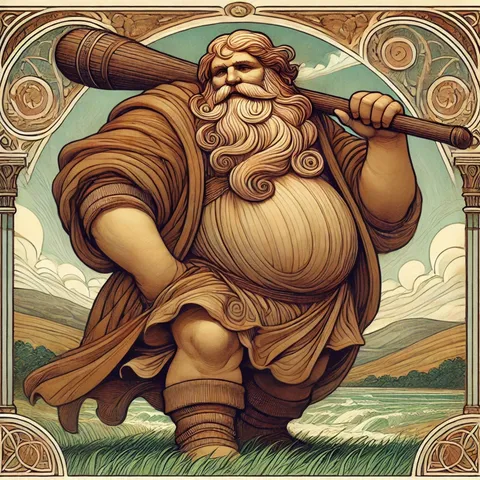
Eat up, said Indok, the Fomorian king, or else we’ll have you killed. Sure, why not, said the Dagda, not wanting to insult the Fomorians. He took his ladle, a ladle so big a man and a woman could happily lie in the middle of it, and took a scoop, saying, this is good food if it tastes as good as it looks. But as he tasted it, it was clear that this was disgusting porridge. For the Dagda, ever the optimist, shrugged his shoulders and added, do not let the good bits spoil the bad, says the wise old man. Then he tucked into the porridge, eating the whole thing until his belly was as big as a cauldron. He fell asleep, well fed, to the sound of the Fomorians laughing at him.
Unfazed, the next day the Dagda woke up and went off to draw Ava. It was not easy for the Dagda to move due to the size of his stomach, but he managed, and as he walked his long penis hung uncovered and behind him he dragged a huge club that would have taken eight men to carry. Either his penis or his club was big enough that it left a huge ditch behind him all around the border of the province of Connacht, which became known as the tract of the Dagda’s club. As he walked along he saw a good looking young woman with an excellent figure, her hair in beautiful dresses. The Dagda desired her, but was too full to get it up and to do the deed. The girl began to mock him, and then started to wrestle with him. She threw him to the ground and his arse sank deep into the dirt.
The Dagda looked up at her angrily and said, What business do you have, girl, of heaving me out of my right way? This business, she declared, to get you to carry me on your back to my father’s house. Who is your father? he asked. I am the daughter of Indon Macdacdown, king of the Fomorians. She fell upon him again and beat him so hard that he emptied his bowels into the hole in the ground he had made when falling. Then she satirized him three times that he would carry her on his back. He says it wasn’t on for him to carry anyone who would not call him by his name. What is your name? she asked. Fear Ben, he said. That name is too much, she added. Get up, carry me on your back, Fear Ben. That’s not my name, he laughed. What is? she asked. Fear Ben Mac, he answered. Get up, carry me on your back, Fear Ben Mac, she said. That is not my name, he said. What is your name? she asked.
Then he told her the whole thing. She replied immediately and said, Get up, carry me on your back, Fear Ben Bruick Brogill Brometide Curbide Cack Rollag Bullock Blower Kirk Dee Brigg Older Thar Both Askin Methay Brethyr Tree Carbid Roth Ramir Reog Skov Avna Olafa Get up, carry me away from here. I’m sorry if I’ve mispronounced any of those, but there’s a lot of them. Do not mock me anymore, girl, he said. I can try, but it’ll be hard not to, she said with a smirk.
Then he climbed out of the hole, took the girl on his back, and put three stones into his belt. Each stone fell from it and it’s been said that they were his testicles which fell. As the girl mounted the dagda, her curly pubic hair was revealed. Then the dagda gained a mistress and they made love. The mark where they lay still remains a belchless strand.
Afterwards, the girl said, you will not go to battle by any means. Sure, I certainly will go, says the dagda. You will not, because I will be a stone at the mouth of every ford you cross. That might be true, but you will not keep me from it. I will tread heavily on every stone and the trace of my heel will remain on every stone forever. That will be true, but they will be turned over so that you may not see them. You will not go past me until I summon the sons of tar from the sheath mounds, because I will be a giant oak in every ford and every pass you will cross, she said. I will indeed go past, said the dagda, and the mark of my axe will remain in every oak forever. However, after thinking a while, she said, allow the Fomorians to enter the land, because the men of Ireland have all come together in one place. She said that she would hinder the Fomorians and sing spells against them and practice the deadly art of the wand against them, and she alone would take on a ninth part of the host.
And there, after that hectic insight into the dagda’s life, we’ll stop and unpack a little of the story. Previously, with Dancact, we see how the Christian writers altered the story to reshape our view of this god. A spot where they may have done it again is with the Dagda, one of the most striking characters in the second battle of Moitur. He really doesn’t come across as your usual father deity. He feels much more down to earth and at times it’s hard to tell if we’re meant to be impressed by him or whether he’s being used as a punchline. We meet him and he’s digging trenches, he’s laughed at by the enemy, he defecates, he’s initially impotent, it’s all a bit strange. But we’ve already seen that he is the most powerful of the two of day champions. He has all their powers combined.
We should also call out a few of the things that have happened that show what the Irish cared about. Even when he visits the enemy, he’s not too impolite not to eat. He wins over the daughter of the enemy, he carries her home, she makes fun of him but he puts up with her, he makes love to her. And then after a bit of a confusing conversation about trees and stones, he brings her on to the two of day’s side against her family, the Fomorians. It highlights this interesting problem of trying to gain too tight a hold on pre-Christian beliefs. Is the Dagda described here like this because the Christian monks were trying to insult and denigrate this pagan deity? Or has this always had the Dagdawaz? And the ancient Irish just celebrated a kind of father god who’s very different from what we might expect. A friendly sort with big appetites who’s willing to work. It’s hard to tell.
One thing that is interesting and does feel pre-Christian is the Dagda’s relationship with the Morrigan. The good god and the war goddess. A fascinating link between life and death in the psyche of the ancient Irish. All in all I find the Dagda embodying a wonderfully Irish tradition of mixing the profound and the comic. His is an immense power combined with earthiness and humour. I think it’s the Dagda himself who actually gives us the best way to understand the man. As he says don’t let the good bits ruin the bad. There’s a lot of strangeness going on with the Dagda. There’s a lot of goodness in there too. It’s very Irish and I kind of love it.
In the next episode we’ll see what happens when the Fomorians and the Tuath Déi finally meet in battle. If you want to go further you can support the show, get ad-free listening and bonus content on our Patreon page. Simply follow the Patreon link in the show notes or visit our website thehistoryofireland.com. You can also get in touch through the website or on Facebook and Twitter. It’s always great hearing from you guys and if I’ve made a mistake please do let me know.
The History of Ireland was written and produced by me Kevin Doher with music by Liam Doyle and additional help from assistant producer Aoife Murphy. This podcast was recorded in the lands of the Wurundjeri people of the Kulin nation. Sovereignty was never ceded.