Episodes Irish Mythology Season 3 — The Mythology
Were the Fomorians a Metaphor for Vikings?
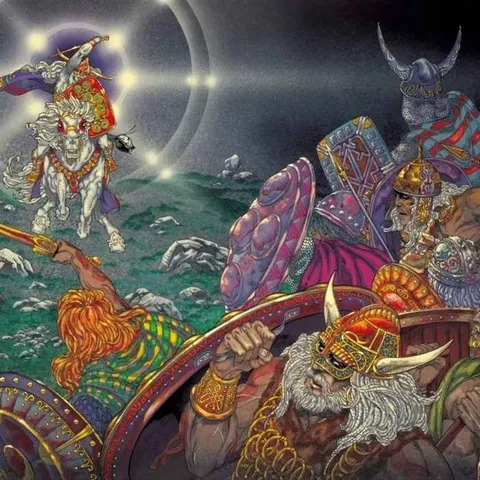
In this episode we finally get to the big clash between the Fomorians and the Tuatha Dé. It's a brutal and beautiful piece of literature. It also may have been inspired by Viking invasions...
Imagery for the episode, used with permission, is Lugh Attacks the Fomor by the iconic Jim FitzPatrick. You can view more of Jim's stunning work and purchase prints at jimfitzpatrick.com
Transcript
Welcome to the History of Ireland. The first Viking raids in Ireland took place in 795AD to the north and west coast. The primary targets? Monasteries, filled with gold and silver and all the wealth of Christian Ireland, but also filled with the monks and filly who wrote much of the mythological cycle. By 841AD, the Vikings had founded Dublin as one of their first fortified bases and radically reshaped the nature of Ireland forevermore.
Why am I telling you this? Well because there’s a strong argument to be made that our monastic writers, who spent a lot of the 19th century being raided by these strange new invaders from the sea, may have been inspired by the Viking invasion taking place around them as they wrote the Second Battle of Moitur. In fact, some argue that the Second Battle was heavily influenced by the Battle of Clontarf which took place in 1014, when Brian Brew defeated the Vikings. This battle took place on the 23rd of April and estimates suggest that 7 to 10,000 men were killed.
As you hear the beautifully brutal description of the epic clash between the Tuath Dé and the Fomorians, it’s not hard to imagine that whoever wrote it may have had first hand experience with the horrors they described. Obviously we can’t say that for certain, there’s no way of knowing, but you wonder.
Now last episode we followed the Dagda as he got ready for battle in the typical manner. Sleeping with the war goddess, eating the enemy’s porridge, then sleeping with the enemy king’s daughter. You know, the usual stuff. Today we’re going to look at what happens when the two sides finally meet. And as we dive into the story, I’ll forgive you if you start to picture Vikings clashing against Brian Brew.
The men of Ireland, the Tuath Dé, are daring enough to fight us. Are you ready to do battle? Pressed, asked Induc Magdatháin, king of the Fomorians. Their bones will be small, they do not pay us tribute, he replied. And with that, the Fomorians marched into Sligo, ready to face the Tuath Dé, ready to do battle, ready to grind their enemy’s bones into small, small pieces.
The Tuath Dé watched the Fomorians advance and began to prepare. It was decided that Lug be kept from the battle and protected by his nine foster fathers. They feared an early death for Lug because of his many skills. Lug, not too happy with being kept from the battle, assembled the Tuath Dé one last time and addressed them in such a way that every man had the courage of a king.
The next day, the battle began between the Fomorians and the Tuath Dé. But no kings or princes waged this battle, only fierce and arrogant common men. Because the battle was fought, the Fomorians were shocked to find their weapons blunted and their men who were killed did not come back to life the next day. But that wasn’t true of the Tuath Dé.
Gubnu the smith, Lug the carpenter, and Credna the brazier worked hard making swords and spears and javelins so that the Tuath Dé went into battle every day with unblunted weapons. Meanwhile, Dantyacht and his children chanted spells over a well named Sláin. They would cast mortally wounded men into the well, soaking them from head to toe. When the men were lifted out of the well, they found themselves healed and whole, wet but very much alive.
The Fomorians were concerned about all of this and wanted to send a spy into the Tuath Dé’s camp. Luckily they had Ruidán, the son of Bress and Bridget, and being a descendant of Tuath Dé like these, he looked just like them. Ruidán sneaked into the camp and there he saw the weapon makers hard at work and the physicians around the enchanted well. He headed toward the forge and boldly approached Gubnu.
Could I have a spear, great smith? Ruidán asked, doing his best to pretend to be a Tuath Dé. Standing up from his forge, covered in soot and hammer in hand, Gubnu examined the young man. He didn’t recognize the boy, but it’s true, Ruidán did have the look of a Tuath Dé about him. Of course, Gubnu replied, and the weapon makers were more than happy to make a spear for Ruidán.
Cron, one of the women of the Tuath Dé, and Bridget’s sister, ground the spear for him, so that the spear was given to Ruidán by his maternal kin and for this reason a weaver’s beam is still called the spear of the maternal kin in Ireland. As soon as this weaver’s beam, this spear, was placed in Ruidán’s hand, he turned on Gubnu and stabbed him. Gubnu was not fazed and he simply pulled the spear from his body and hurled it straight at Ruidán, who died right there and then. Ruidán’s mother, Bridget, was so distraught that at first she wept and then she shrieked, And this, they say, is how the Irish tradition of keening first started.
Bleeding heavily from the wound from Ruidán’s spear, Gubnu was carried to the well and made whole. But the Fomorians would not be stopped and they knew this well had to be destroyed. So next they sent Octrilach, the son of the king Induc Magdacdan, to deal with it. Octrilach came up with a plan and he suggested that every single man in the Fomorian army should bring a stone from the river Drows and cast it into the well. And this they did, filling the well with stones so that it became known as Octrilach’s Cairn. I’ll pause here and say this is a real cairn in Sligo. Today it’s known as Heapstone Cairn and is near Riverstown.
All this happened over many days as skirmishes occurred between the common men of the Tuath and the Fomorians. But soon it became time to wage the great battle and for the kings and champions to enter the fray. And for this the Fomorians marched out of their encampment and formed themselves into strong indestructible battalions. Not a chief or skilled warrior among them was without armor against his skin, a helmet on his head or a broad spear in his hand, a sharp sword in his belt or a strong shield on his shoulder.
The two of them looked on and muttered to each other. To attack the Fomorian host today is like striking a head against a cliff, one said. Or putting a hand in a serpent’s nest, another replied. Or sticking your face close to the fire, a third soldier added, casting his eyes over the large host and scratching the back of his neck absentmindedly.
Watching the Fomorian host approach, Lug decided it was time to join the battle. He escaped from his guards and soon was at the front of the battalion of the Tuath Dé. From the front lines Lug cried, fight fiercely so we should not be in bondage any longer. It is better to find death while protecting the fatherland than to be in bondage and under tribute. Then he chanted spells, going around the men of Ireland on one foot and with one eye closed.
The Tuath Dé gave a great shout. The Fomorians replied in kind and they came together and each began to strike the other. In a keen and cruel battle was fought between the race of the Fomorians and the men of Ireland. Great was the slaughter and the grave lying which took place there. Pride and shame were there side by side. There was anger and indignation.
Abundant was the stream of blood over the white skin of young warriors mangled by the hands of bold men while rushing into danger for shame. Harsh was the noise made by the multitude of warriors and champions protecting their swords and shields and bodies while others were striking them with spears and swords. Harsh too the tumult over the battlefield, the shouting of the warriors and the clashing of bright shields, the swish of swords and ivory-hilted blades, and the clatter and rattling of the quivers, the hum and whirr of spears and javelins, the crashing strokes of weapons.
As they hacked at each other their fingertips and their feet almost met, and because of the slipperiness of the blood under the warriors’ feet they kept falling down and their heads were cut off them as they sat. A gory, wound-inflicting, sharp, bloody battle was upheaved and spear-shafts were reddened in the hands of foes. Then King Nuada Silverhand was killed by Baelor, the fiercest champion of the Tuath Dé, and even Baelor’s wife, Cethlyn, managed to wound the Dagda.
With Nuada killed, Baelor of the Piercing Eye turned towards his grandson, Lug. Baelor’s eye was a fierce horror to behold, never opened except in battle. The eye was a strange thing that had been created one day when Baelor’s father’s druids were brewing magic. The young Baelor had looked over the window and the fumes of the concoction seeped into his eye and the venomous power of the brew settled in.
Baelor had a special eyelid made with a polished ring on it. The only way to lift the eyelid was to have four men all pull on that ring, and when it was lifted, any host that looked at Baelor’s Piercing Eye would collapse and offer no resistance to any warrior. As Lug and Baelor met in battle, Lug started to shout out to Baelor, reproaching him and cursing him and leaving Baelor in a furious rage.
Baelor turned to his men and said, lift up my eyelid, lads, so I may see the chatterer who is talking to me. But Lug was ready for Baelor’s infamous eye, and no sooner than the mighty eyelid had been raised, Lug cast a slingstone at him, which carried the eye through the back of Baelor’s head so it faced towards his own army of Fomorians. Baelor collapsed, crushing twenty-seven of his own men, and his head crashed into the breast of King Indyk Magdacdown.
Indyk was crushed, and soon blood bubbled from his lips. He called out for his poet to help him, but it was too late. The Morrigan came into the battle then, and as she had promised the Dagda, she took two hands of Indyk’s blood and gave it to the armies that were waiting at the ford of the river Unshen, and it was called the Ford of Destruction from that day. Soon after, the Fomorians were driven back to the sea, and it became clear the two a day had won the battle.
As they counted the dead, Lug found Bress, the man who had started it all. The beautiful Bress was covered in muck and blood and lay sniveling at Lug’s feet. Please, it is better to spare me than to kill me. Why would I spare you? What would come of that? Lug asked. I can make it so the cows of Ireland will always have milk, Bress said, adding, if I’m spared.
Lug consulted with his lawyer and wise man, Maltine More-Breathluck, but Maltine pointed out that even if Bress can control the cows’ milk, he cannot control their age or when they have calves. Sorry, lad, Lug said. This will not save you. Is there anything else that might? Of course, Bress replied. Tell your lawyer you will reap a harvest every quarter in return for sparing me.
Maltine thought about this and wisely said, The current system suits us. Spring for ploughing and sowing, the beginning of summer for maturing the strength of the grain, the beginning of autumn for reaping it, the winter for consuming it. This does not save you, Lug, said Bress, and Bress cursed the lawyer, Maltine.
Then Lug thought for a moment. Maybe offering a little less than changing the very nature of the seasons could save you. What? Bress asked, looking confused. How will the two-a-day plough? How will they sow? How will they reap? If you teach us these things, you will be saved. Bress looked up and quickly grasped this opportunity for redemption. Say to them on Tuesday they’re ploughing, on Tuesday they’re sowing seed in the field, on Tuesday they’re reaping, and from there he taught the two-a-day how to grow and reap crops and so was released.
While Lug was dealing with Bress, Ogma, the strong champion, was walking through the battlefield and in the carnage he found the sword of Tetra. Ogma unsheathed the sword and cleaned it and, as was the habit of swords at the time, the sword told him everything that had been done by it. Then Lug, the Dagda, and Ogma chased after the Fomorians because as they escaped the Fomorians had kidnapped the Dagda’s harp.
They followed the fleeing Fomorians to Bress’s old banqueting hall, where they found the harp on the wall. The Dagda summoned the harp by calling, Come summer, come winter, from the mouth of harps and bags and pipes, and the harp sprang from the wall, killing nine men on its way back to the Dagda. It flew to the Dagda and he played for the Fomorians the three things by which a harper is known, sleep music, joyful music, and sorrowful music.
He played sorrowful music for them so that their tearful women wept. He played joyful music for them so that their women and boys laughed. He played sleep music for them so that the hosts slept. And as the Fomorians slept in their hall, Lug, Ogma, and the Dagda escaped unharmed with the harp returned to its rightful owner. As well as this, the Dagda brought with him the cattle taken by the Fomorians as their tribute.
When the battle was won and the slaughter had been cleaned away, the Morrigan proceeded to announce the battle and the great victory which had occurred there to the royal heights of Ireland and to the Shea’s hosts, to its chief waters, and to its river mouths. She called out, Peace up in heaven, heaven down to earth, earth beneath heaven, strength in each, a cup very full, full of honey, mead in abundance, summer and winter, peace up in heaven. And that, my friends, is the end of the second battle of Moitura.
So the big question, were the Fomorians just Vikings? Without copping out, I’m going to say maybe, a little bit yes, definitely no. As ever, it’s complicated. First, it’s safe to say the concept of the Fomorians well predates any Viking invasion. In fact, the idea of a battle between two god-like beings, the Fomorians and the Tuadé, has deep roots in Indo-European mythology. Across Greek, Roman, Norse, Hittite, and other cultures, we see something similar. Think of Zeus fighting the titans.
And notice at the beginning of the story we meet Elitha, Brest’s Fomorian father, and he’s described as beautiful and he’s not a monster. What’s up with this anachronism? The theory I subscribe to is that the Fomorians were originally less seen as evil monsters and more as a balancing force to that of the Tuadé. They serve the function as the ultimate other and highlight the struggle between order and chaos or civilization and barbarity between the land and the sea. Take how Brest offers to change the seasons and the Tuadé push back saying it isn’t natural.
But it is clear to me that as the country was being invaded by Vikings, the writers at the time would have reshaped the Fomorians as the ultimate evil and the descriptions in the story feel so viscerally real. As I said at the top of the episode, scholars have made compelling cases that the second battle of Moitores links to the battle of Klantar and Viking raids in general. The Fomorians as villains and true monsters is a shift that makes sense when you think of the context the stories were written in.
And for me, whether historians or scholars would agree, I find this story gives us such a true window into what it must have been like in Ireland in the 9th century. Of course, not what actually happened, but rather how it must have felt. As ever, it’s amazing how an ancient pagan story, the clash of two great powers, the Tuadé and the Fomorians, was reshaped by what was happening to Christian Ireland in the 9th century. Because of this, the story gives us not only a glimpse into what the ancient pagan Irish might have believed and their worldview, but also how the people who were writing down these old stories were experiencing their own period of Irish history.
And that is where I’ll leave the second battle of Moitores. Next episode, we’re going to dive into the wooing of Adene, another beautiful story from the Irish mythological cycle. Now before I go, I’ll just ask one last question, are you enjoying these stories? This is a little bit of an experiment, I know it’s a little bit different from the previous seasons, so I’d be interested to hear if you’re enjoying it, if you’re finding it interesting, or if you have any feedback at all.
As always, just get in touch at the history of Ireland podcast at gmail.com. I love hearing from you, these stories are fascinating to me, but I want to check in with all the listeners. And if you are interested in all of this, I’ve been experimenting on TikTok with a few shorter videos that dive into some of this stuff. Simply search the history of Ireland on TikTok.
Thanks for listening. Subscribe wherever you get your podcasts, and if you’re enjoying it, give us a review on Apple Podcasts or tell your friends. It really helps. If you want to go further, you can support the show, get ad-free listening and bonus content on our Patreon page. Simply follow the Patreon link in the show notes or visit our website, thehistoryofireland.com.
You can also get in touch through the website or through social, which at the moment is Facebook, Blue Sky, and TikTok. It’s always great hearing from you guys, and if I’ve made a mistake, please do let me know.
The History of Ireland was written and produced by me, Kevin Doyle, with music by Liam Doyle and additional help from assistant producer Aoife Murphy. This podcast was recorded on the lands of the Wurundjeri people of the Kulin Nation. Sovereignty was never ceded.