Episodes Irish Mythology Season 3 — The Mythology
Honour Price & Fidchell
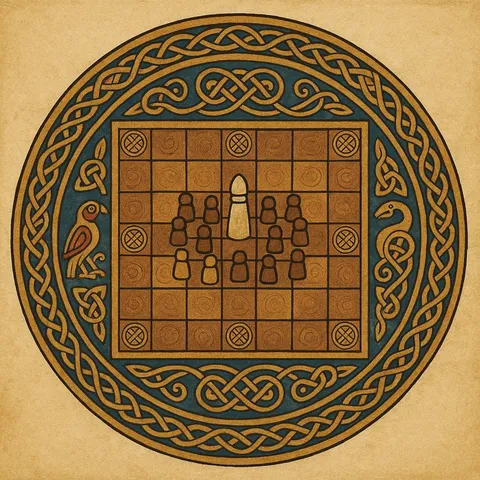
In this episode we explore the concept of honour price and how it was one of the most important legal concept in early medieval Ireland. We then dive back into The Wooing of Étain, where three games of fidchell (ancient Irish chess) demonstrate different approaches to keeping deals and saving face.
Transcript
Welcome to the History of Ireland. In the last episode, a thousand years after Aideen was born and lived among the Tuath Dé, she found herself reincarnated as a human, with no memory of her time with the Godspeople. Today, we’re going to explore how her old lover Midder works to start getting her back. But before we do, I think it helps to understand a certain aspect of early medieval Irish culture that was hugely important. Like, bedrock of society important. And that is the idea of Laugh Níonach, which literally translates to face price, but is generally referred to as honour price.
You see, early medieval Irish society was both very litigious in its own way, but also had no real concept of people being equal before the law. The whole society was quite stratified, with people split roughly into three groups, Nemed, Séar and Dóir, the lords, the free people and the unfree people. The Nemed would have included kings, filly, priests and the like, while the free people were everything from landowners and farmers to soldiers.
Within these groups, everyone had an honour price. It was basically a graded value that determined your rank before the law. It was used by lawyers to calculate how much money a freeman or noble would receive for any insults, injuries or crimes committed against them. But importantly, the honour price was not fixed. It was linked to how you lived your life and your reputation.
If you failed to host someone adequately, neglected your duties, committed a crime, or did anything seen as ill-befitting, your honour price could be reduced. Wounding someone would lead to your honour price being halved. Kinslaying or unsanctioned murder, well, that could mean the loss of your entire honour price.
And the honour price played out in interesting ways. If you were to, say, verbally insult someone, well, you might have to pay a seventh of their honour price. If you wanted a child fostered in another home, that was linked to the child’s father’s honour price, with girls costing more.
And a woman’s honour price was set at half of that of their husband, giving them the same social standing as an adult son. Which, look, we don’t love, but it did mean they had more rights than, say, the Greeks or Roman women. Irish women were seen as lesser by the law. But, relatively, did have quite a few rights. Especially women like Aideen, whose honour price, by association with the High King, would have been huge.
I’m telling you all of this because knowing the idea of the honour price puts into context the story that I’ll tell you today. We’ll see how both Myrr and King Njökulg are forced to abide by their word, or else their honour price will suffer. And, in the next episode, we’ll see that when things start to really go south, Njökulg is forced to take action to protect his honour price, but ends up carrying out a deed that, well, would have been so taboo that his honour price would have been forfeit.
So, with that all in mind, let’s explore the next section of the wooing of Aideen. One morning, on a lovely summer day, King Njökulgarum woke up and climbed to the top of Tyre to gaze across his land. His courtyard was radiant with flowers blooming in every hue, but something was amiss. A strange warrior stood among the flowers.
Now, Tyre wasn’t a place you just wandered into, especially not the king’s private courtyard, before the gates had even creaked open for the day. Yet, there he stood, amongst the riot of flowers, as if he’d simply bloomed there himself. He wore a purple tunic with golden-yellow hair to the edge of his shoulders, his eyes were a shining blue, and he had a five-pointed spear in one hand, a white shield embossed with golden gems in the other.
Njökulgarum was silent for a moment. No one had been in Tyre the night before, and the courts had yet to open. How had this man entered his private courtyard? Welcome to the warrior who we do not know, Njökulgarum said as the warrior approached him. It is for you I have come, the man said.
I do not know you. Ah, the stranger said, but I know you. Who are you? The warrior made me shrugged with a casual confidence. I’m not famous, simply Midr-Brileth.
What’s brought you here, Njökulgarum said a little less confidently one would imagine. To play Fihl with you, Midr said. You’ll remember Fihl as a chess-like game of cunning and strategy, translated literally to wood wisdom. Oh, I’m good at Fihl, Njökulgarum said smiling. Well, let’s make a trial of it.
Njökulgarum hesitated. Unfortunately, the queen is asleep, and that is where my Fihl-board is. I have here, Midr said, a chess-board that’s not inferior to your own. It will surely do.
Njökulgarum stared down at the Fihl-board that Midr had pulled from nowhere. The man was right. This was a board that no one could call inferior. The board itself was silver and the pieces golden, with each corner lit up by a precious stone. Even the bag of the pieces which Midr casually untied was made of plated links of bronze.
Midr started to lay the golden men out, arranging the board. Do you play? he asked. Only when we’re playing for a stake, Njökulgarum said. He sat down across from the board and maybe rubbed his hands together, excited for the competition.
What will the wager be then? Njökulgarum asked. It’s all one to me, said Njökulgarum. Well, if you win, you’ll have from me fifty dark-graced steeds with dappled-blood red heads, pointed ears, broad-chested with distended nostrils and slender limbs. Huge, swift, steady, easily yoked with their fifty enamel reins. They will be yours tomorrow.
Nothing, Njökulgarum probably said, beats a horse with distended nostrils. That is a deal. If you win, you’ll have the same from me. The two men played, and Njökulgarum easily got the better of Midr.
The man of the two day left with his chessboard and, true to his word, returned at sunrise the next day with fifty dark-graced steeds. How very honorable, Njökulgarum said. What is promised is due, Midr replied. Shall we play again? Willingly, if it’s for a stake. Njökulgarum was perhaps enjoying this.
You will have from me, Midr said, fifty young boars, fifty gold-hilted swords, fifty red-eared cows with fifty red-eared calves, fifty three-headed three-horned rams, fifty ivory-hilted swords, and fifty speckled cloaks. I do love a speckled cloak. Again they played, and this time it was closer, but Njökulgarum won a second time.
By now, Tara was beginning to look a lot less like a royal fortress and more like a fantastical farm. Njökulgarum’s father shoved his way through the new cows and sheep and boars and asked Njökulgarum, Where has all this come from? I’ve won them from a stranger, Njökulgarum replied. Hmm. Be careful. This is a man of magic power. If you’re going to keep beating him, make sure to lay heavy burdens on him.
And so, the next day, when Midr returned and Njökulgarum beat him again, the king asked even more of Midr. He soon had Midr clearing meath of its stones, covering Tethba in rushes, building a causeway over Moin Lamrig and a wood over Brethnen.
Before tackling the causeway through the bog, Midr confronted Njökulgarum. You give me too much work to do. I do not, Njökulgarum said. Fine, but do me this one favor. Let no man or woman be out of doors until sunrise tomorrow. It is done. A king’s word.
But kings are also curious. How would Midr work his magic and build a road through this deep and horrible bog? The king sent out a steward to watch Midr at work that night. As the steward approached the bog, it seemed that all the men in the world were working there. They had made a great mound of their disguided clothes, and atop it, like a general surveying his troops, sat Midr.
The steward watched, hidden as they laid the foundation of the causeway, whole trees, trunks and roots alike, were sunk into the grasping mud, a forest sacrificed to make a road. Then came clay and gravel and stones laid with an impossible speed and precision. Now, before this moment, the men of Ireland used to yoke oxen across the forehead. But the steward noticed, that night, that the men in the she yoked oxen by the shoulder. A much more sensible approach.
The steward rushed back to King Yuccag and told him everything he had seen. From that day on, Yuccag decreed an oxen be yoked by the shoulder and so became known as Yuccagarm, or Yuccag the Ploughman. But Yuccag had broken his promise to Midr.
When Midr returned to Tarra, the causeway finished, the forest planted, the rushes laid, the stones cleared. The man of the she was furious. There was an evil look on him and Yuccag was nothing short of terrified. But the king still welcomed Midr.
It is fierce and unreasonable for you to lay such hardship upon me, Midr cried. I have done everything as you have said, but you did not keep your people inside from sunrise to sunset and my mind is inflamed against you, Yuccag the Ploughman. The new epithet dripped from Midr’s mouth with a level of disdain worthy of the greatest heir. You will not get my wrath in return for your rage, Yuccag said.
Filthier frowned. Fine, shall we play? What will be the stake? Whatever we wish, Midr said. Maybe, Yuccag’s brow furrowed, perhaps a shiver of gambler’s thrill or a premonition of doom ran down his spine. Whatever the reason, whether pride or folly or the binding nature of their strained contest, he agreed.
The game began and it was immediately, terrifyingly clear that Midr who had played before, the one who had lost so easily, was not the Midr playing now. This Midr played with a savage genius, his golden pieces sweeping Yuccag’s from the silver board like wind scattering leaves. Soon, Yuccag’s pieces had been disposed of and Midr had won.
Yuccag sat, the silence in the hall heavy. You have my stake, he said, his voice flat. What will it be? I could have had it earlier, Midr bragged, letting the words hang in the air. What would you have for me? Yuccag asked, shaken by his loss.
Midr looked at him and then his gaze drifted perhaps towards the queen’s chambers. My arms around Aideen and a kiss from her, said Midr. Yuccag sat in silence. He had lost his wife to this man. After a long time, Yuccag spoke quietly. Come a month from today, an Aideen will be given to you.
And that’s where we’ll leave it for now. It’s important to think about how the chess playing and the stakes would have been seen as legally binding and intrinsically linked to Midr and Yuccag’s honor prices. You also see how Yuccag breaks his promise, hurting his honor, while Midr does everything that is asked of him. And this discrepancy only becomes clearer and clearer and only gets worse and worse in the end of the story. But we’ll leave that for the next episode.
Simply follow the Patreon link in the show notes or visit our website, thehistoryofireland.com. You can also get in touch through the website or on Facebook and Twitter. It’s always great hearing from you guys. And if I’ve made a mistake, please do let me know.
The History of Ireland was written and produced by me, Kevin Doyle, with music by Liam Doyle and additional help from assistant producer Aoife Murphy. This podcast was recorded in the lands of the Wurundjeri people of the Kugul Nation. Sovereignty was never ceded.