Episodes Irish Mythology Season 3 — The Mythology
Ireland's First Psychopath?
Transcript
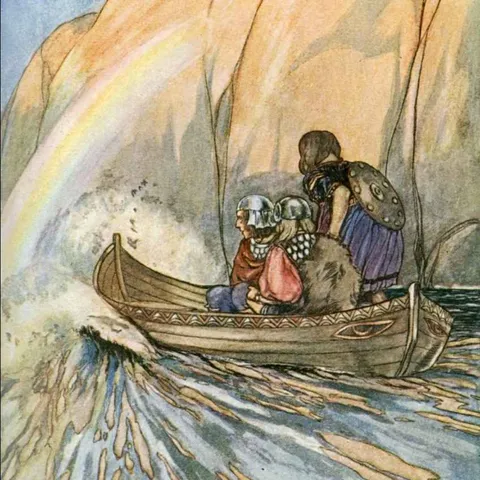
Welcome to the History of Ireland. In today’s episode, we’re moving on to a new story in the mythological cycle, a story called The Fate of the Children of Turin. It’s part of a trio of stories known as the Three Sorrows of Storytime. The other two being the Sorrows of Deirdre and the very famous Children of Lír, which we’ll hear more about in future episodes.
The Fate of the Children of Turin has been described as the least popular, but by far the most interesting of the three. I’m not one to make such sweeping statements. I think there’s a lot to unpack in the Children of Lír. But the Children of Turin is bloody fascinating, with an underline on the bloody.
The Fate of the Children of Turin, or at least the version we have today, is most likely a creation of the 15th century, making it much newer than the stories we’ve been looking at so far. Though the story itself is mentioned as far back as the 11th century, but we know the version we have is definitely one written and adapted much later. One reason we know this is that it’s deeply influenced by Greek and Roman classics, most notably Jason and the Argonauts, as you’ll see when we get into it.
Back in the day, some scholars argued that these similarities pointed towards the proto-European nature of these shared myths. But a much simpler explanation is that the writers in Ireland in the 15th century were well-read and heavily influenced by the classics. We know that Ireland was not an uneducated backwater. Far from it.
The other reason it’s believed this is a later story is the themes it inhabits. The version it paints of the Tuath Dé, and the Ireland in which they inhabit, is one that is in ruins. The idea is that the story shows how flawed a society Ireland was before it was Christianised.
Gweibhinn Breithnach, a senior lecturer at UCD, points out that the story paints a much more negative picture of the Tuath Dé than pre-Norman stories, in which they are very much held up as positive figures. Now this is going to allow us to dive further into Breithnach, which we’ll do in the next episode. It gives us a sense of how the Irish saw themselves in the wider context of the world. And it’s just fascinating.
Before we get stuck into the story, it should be pointed out that within our mythological cycle, this takes place sort of within the second battle of Moitur, as Lug readies the Tuath Dé for battle against the Fomorians. Some, like Lady Augusta Gregory, have folded into the second battle of Moitur. But I prefer the idea of keeping it separate, as it is a later addition to the story. Think of it as what, I don’t know, and or is to A New Hope, a new story slotted into the medieval equivalent of a cinematic universe.
So, without further ado, let’s tell the fate of the Children of Churn. One early morning, Lug was preparing to fight against the Fomorians, when he saw three men coming towards him. His father, Cian, and his two uncles, Cru and Cethil. What are you doing up so early? Cian asked.
I have good reason for it, Lug said. The Fomorian are coming to attack and we need to prepare. Each of us will bring one hundred men to fight against them, Cian said, eager to help his magnificent son. That is good help, Lug replied. But I would rather have you do something else for me. Ride out and gather the raiders of the sea from across the country.
Always happy to help and not needing to be told twice, Lug’s father and his two uncles split up and spread across the country. Cru and Cethil went south, while Cian headed north to the plains of Mirthim, in Louth, admittedly a much more dramatic name for the area than Louth.
As Cian rode across the rolling hills of Ireland’s smallest county, he spotted three riders in the distance and stopped in his tracks. Cian immediately recognized the men as the three sons of Turin, these sons who had had a feud against Cian and his brother for years. It was said that whenever the sons met, there was sure to be fighting amongst them. And that is what would have happened if Cian was with his two brothers.
Cian thought to himself, if my two brothers had been here, it is a brave fight we would make. But since they’re not, it’s best for me to fall back. So what is one to do when one is the father of the most powerful God’s person in Ireland and yet does not want to fight?
Cian looked around and close by saw a herd of pigs. So he grabbed his druid stick, struck himself with it and turned himself into a pig and then quickly ran to hide amongst the herd. The three brothers, however, had spotted Cian in the distance.
Brian, the leader of the brothers, spoke up. Did you see that iron man that was walking the plain a while ago? We did see him, said the brothers. Do you know how he got away, said Brian. We did not know that, they said.
Brian was definitely the smartest of the brothers and often rolled his eyes at his two dullard siblings. It is a pity you are not keeping a better watch over the plains of the open country in a time of war, said Brian, scolding them. Brian had seen everything that Cian had done. He is rooting up the ground now like any of those other pigs and whoever he is, he is no friend to us.
That is bad for us, said the other two, but the pigs belong to some of the two a day and even if we kill them all, the druid pig might chance to escape us in the end. Brian frowned. You really did learn nothing from the city of learning that you were sent to, he said. How were you never taught to tell an enchanted beast from that of a normal one?
As Brian spoke, he pulled out his own druid’s rod and struck his two slow-witted brothers, turning them into hounds. Immediately, the two dogs started to yelp and howl and ran after the herd of pigs. Brian probably put his druid’s rod away and strolled after the hounds, smiling to himself, ready for a little bit of butchery.
Brian’s plan was a smart one because, though pigs are smart, two-day men disguised as pigs are even smarter. And as the hounds fell upon the pack of swine, only one was smart enough to run off into the forest before the hounds struck. But this was exactly what Brian was hoping for and as Cian, in pig form, ran off from the herd of pigs, he threw his spear and it flew straight through the pig’s body.
The pig cried out in a very unpiggy way, saying, It is a bad thing you have done to have made a cast at me when you knew me. Brian sauntered up to the injured pig and, looking down at the beast, said, It seems to me you are the talk of a man. I was a man indeed, said the pig. I am Cian, son of Concha, and give me your protection now.
I swear by the gods of the air, said Brian, that if the life came back seven times to you, I would take it from you every time. If that is so, said Cian, give me at least one request. Let me go into my own shape again. We will do that, said Brian, for it is easier to me to kill a man than a pig.
So Cian took his own shape then, and he said, give me mercy now. We will not give it, Brian replied. Well, I have got the better of you for all that, said Cian, for it was in the shape of a pig you had killed me, there would only be the blood money for a pig on me. But as it is, in my own shape you will kill me, there never was and never will be any person killed for whose sake a heavier fine will be paid than for myself.
Struggling to breathe back in human form, but still with a spear impaled through his stomach, Cian let out one last angry gasp. Whatever weapon you use to kill me, he said, they will tell the deed to my son Lug. Brian considered this for a moment, and then smiled wickedly to himself. It is not with weapons then you will be killed, but with the stones lying on the ground. And with that they pelted him with stones fiercely and roughly till all that was left of him was a poor, miserable, broken heap.
Brian and his brothers, no longer hounds, then proceeded to bury the broken remains of Lug’s father. But the very ground itself refused to accept the broken body. Every time they buried the corpse of Cian, the ground spit it back up again. They buried the body deeper than the height of a man, but still the earth spat back up the murdered corpse. It was not until seven burials did the body stay put. It was put underground, and the earth kept it.
Now, remember, Brian and his brothers were not Fomorians. They were two a day, just like Cian, Lug, Nuida, and the rest. So, when the armies of the two a day were called to fight the Fomorians, Brian and his brothers answered the call and joined the host gathering to fight. But soon Lug would find out of his father’s murder and come looking for the perpetrators.
We’ll stop there and uncover what happens next to Brian and his brothers after Lug finds out about his father’s murder in the next episode. Before we go, I just again want to highlight how very different tonally this story is from the Second Battle of Moitora, or even the Women of Eighteen. Some scholars have argued that Brian is one of the earliest examples of a full-on psychopath in medieval literature. And, like Jesus, he does come across as brutal. The line about how it is easier to kill a man than a pig is nothing short of horrific. It’s just great writing.
Again, it’s fascinating to think how the more Christianized writers were using these ancient pagan stories, reshaping them to drive home their own worldview. A view that highlighted that anyone pre-Christian, anyone praying to the gods of the airs like Brian does, was nothing short of abominable. And things go from bad to worse as the story continues and we see both what Brian gets up to and how Lug punishes the Sons of Turin.
Or on Facebook and Twitter. It’s always great hearing from you guys. And if I’ve made a mistake, please do let me know.