Episodes Irish Revolution Season 1 — The Revolution
Will The Real John Jameson Please Stand Up?
Transcript
Welcome to the History of Ireland. Last episode, we introduced John Jameson, a Unionist and Communist keen to help get guns to the IRA. But in a thunderbolt of information involving a moustache, we uncovered John Jameson wasn’t who he said he was. Thanks to Collins’ frankly amazing ability to plant moles in even the highest of British positions, we found out that John Jameson had been reporting to Basil Thompson, the leader of the Special Branch and head of British intelligence efforts. Which raises the question, who was Jameson and what was actually going on?
Well, first of all, his real name was John Charles Byrne. He was born in London and whether or not he actually had an Irish father is unclear. We know he served twice in the British Army in the Mediterranean and India, where he’s said to have gotten quote, delicately rendered oriental tattoos. He loved stories of the wild west and kept birds as pets. So the bird watching thing was actually true. After the war, he began working for Scotland Yard as a double agent investigating police unions. It seems this is where the John Jameson alias was first created and where he first met Thomas McElligot, Collins’ contact involved in the British police. Through McElligot he was introduced to Ard O’Brien and as the Special Branch was most definitely interested in the Irish Self-Determination League, he was encouraged to get to know the Irishman.
Basil Thompson’s original plan seemed to be to use John Byrne under the alias of John Jameson to simply try and convince Irish nationalists to stop shooting police officers. But once Jameson slash Byrne was invited to Dublin to meet Collins, Thompson was presented with the perfect opportunity to get close to the most wanted man in the British Empire at the time. It was at this point that the cover story for Jameson was further developed. The ex-serviceman bit was all true and it was easy to paint him as a Bolshevik loving pro-Chinfey union man. The whole theatre ticket gig was put in place so that he could easily access the Dublin district barracks under the guise of doing business with the cinema there. In the cinema he was able to meet with his handlers and make reports for Thompson.
And a lot of work went into the whole plan. Before heading to Dublin, Jameson slash Byrne met with Thompson and had many thorough planning sessions. In one of them, he stated that if there was an attempt to seize Collins or anyone else, that Jameson should be shot, ideally in a quote, non-vital place so as to keep his cover. If his cover was blown, Byrne argued, he’d be dead within the hour. Thompson reluctantly agreed, saying it would be quite an inconvenience. It was also at this meeting that they came up with the idea of the whole war of cypher thing.
So that was that, Byrne was sent to Dublin under the guise of Jameson. And he was told to work closely with the district inspector William Redmond, who had just been moved down from Belfast to Dublin with a contingency of detectives in January 1920. It was Redmond’s job to take control of the G Division. They had suffered heavily from the IRA’s increased assassinations and it was believed Redmond, a well-respected hardliner, could take control of the force and take the intelligence fight to Collins. Redmond vowed to hunt down Collins and eliminate the IRA. Though unfortunately for the man, Collins’ spy James McNamara was made his assistant.
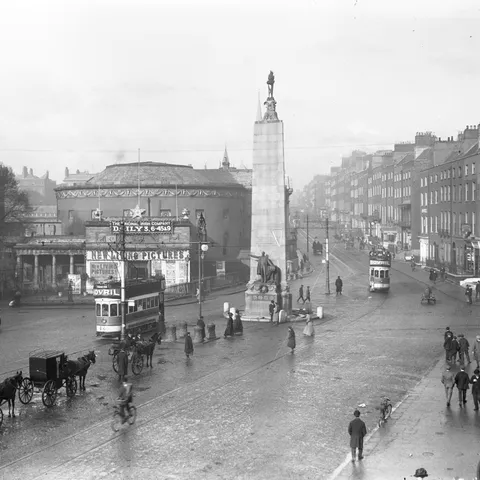
So a month after first meeting Collins, Jameson slash Byrne returned to Dublin, most likely knowing that he was placing himself in a bit of danger. Information regarding the moustache had put Collins on edge, but he still wanted to be sure that Jameson was a spy before acting. Once Jameson slash Byrne was back in Dublin he met with Tom Collins. This had been unplanned and Collins was not expecting to see Jameson. So when the Englishman handed over a heavy suitcase filled with handguns, Collins was a tad bit suspicious. Thinking on his feet he quickly led Jameson down O’Connell Street to a tobacco shop. Collins turned to Jameson and said, I’m going to take these guns in here as it’s a dump for us. He then said goodbye and left. He walked through the front of the shop and out the back but took the guns with him and concealed them at a separate location. That evening Chief Inspector Redmond, with Collins’ man McNamara in tow, raided the tobacco shop and obviously found nothing.
So now we had the moustache and a failed arms raid both pointing to the fact that Jameson was a spy. But the final straw involved a bit of a stupid blunder on Redmond’s part. Redmond, presumably angry over the G Division’s continued failure, began berating one of his detectives. He shouted at the man, You were supposed to be looking for Collins. You’ve been after him for months and never caught sight of him. While a new man, just over from England, met him and talked to him after two days. James McNamara heard the whole thing and reported back to Collins. This was all the proof Collins needed that John Jameson was definitely a spy.
And it did more than that. Collins knew that Thompson and the Special Division were linked to Jameson, thanks to the moustache intel. And he now knew, thanks to the outburst, that Redmond was linked to Jameson. So this led Collins to believe that clearly Redmond was linked to the Special Division and doing more than just leading the G Division. It meant the G Division was stronger than the Irish intelligence had originally believed. Collins was sure he’d had them on the ropes. Now things would have to heat up.
And in amongst all of this, Thompson had brought in another fella, Adam Bell, who was putting immense pressure on Collins. We mentioned Bell before, he’s the man who was investigating the Dawes National Loan Fund. Bell had put together a team and subpoenaed the managers of the biggest banks in Ireland and was given powers to quote, interrogate bank managers and others in order to lay his hands on that money. We’ve discussed the loan previously, so we know how important it is to funding both Sinn Féin and the IRA. Collins, as finance minister, had converted some of it to gold and hid it in Bridget O’Connor’s house, but had also persuaded wealthy nationalists to deposit the rest of it in private accounts. But, under an ancient statute known as the Crime Act, Bell was now able to interview bank managers and find out where the money was going. He was very close to uncovering and seizing a huge portion of the Dawes funds. This coupled with the fact that Collins now knew that Thompson, Redmond and Jameson were all working together, put him firmly in the firing line.
So, it was quickly decided to take out all three men, Redmond, Bell and Jameson. First up was Redmond. Luckily for the IRA, McNamara was perfectly placed to gather information on the Belfast man. The IRA knew that he lived outside the castle walls and walked to and from work. On top of this, it was reported he wore a steel protective vest under his suit. Important info when you’re trying to shoot a man. And finally, a photo was found by one of Collins’ Belfast spies. Also important, when you’re trying to ensure you’re shooting the right man. Everything was in place to ambush Redmond.
So, on January 24th, 1920, a squad were sent to wait outside Redmond’s flat. Once he arrived, they made sure to aim for his head. The first shot smashed his jaw as Redmond went for his revolver. The second shot was fatal, hitting him in the forehead. Redmond had barely lasted a month in Dublin. Once he was dead, his team of detectives retreated to Belfast.
But for some reason, after Redmond was killed, Byrne slash Jameson was still not pulled out of Ireland. So he continued to bounce around Dublin for a little while longer. And in late February 1920, the squad met Byrne slash Jameson, telling him they would take him to meet Collins in Glasnevin Cemetery. They hopped on a tram in O’Connell Street and headed up to Glasnevin. Apparently, once there, Byrne asked the men if they’d like a pint. They declined and instead brought him to a spot called Lover’s Lane. And apologising, said to him, We know you’re a spy and you’re going to die. We are only doing our duty. John Charles Byrne, a.k.a. John Jameson, replied saying, And I am doing mine. I shall love to die for my country. God save the king. He snapped to attention, saluted the men and they shot him. I gotta say, he comes across as one hell of a class act. James Bond, eat your heart out.
After the assassination, Tom Collins snuck into Byrne slash Jameson’s hotel room to check for any more information. He discovered that in fact Jameson was not a lone agent, and had a huge network of men working under him. A whole group of spies planted to gather information on the Irish. But unfortunately for the IRA, the rest of the agents had managed to slip out of the country the night before, once they’d heard of Byrne’s death. And then sadly, a few days later, a Mrs John Charles Byrne of Romford, England came to Dublin to claim Byrne’s body. The IRA had known him as John Jameson, the special branch as Charles Byrne, but she simply knew him as Jack.
When the cabinet were briefed on the whole mess a few weeks later, Walter Long declared that Jack Byrne’s, quote, had been the best secret service man we had. And he had done a lot of good work for Basil Thompson. It’s said Byrne provided a detailed description of Collins, which meant the British finally had a solid physical description of the big fella. But more importantly than that, Byrne’s provided a clear breakdown of Collins’ personality. The military historian, Hiddle, puts it like this, quote, On a strategic level, Byrne’s detailed description of Collins’ personality, demeanour, likes, dislikes, tastes, personal preferences and idiosyncrasies would prove invaluable to Lord George and the cabinet when it subsequently sought to open a secret channel of communication with the insurgent leadership to explore peace talks. Even more importantly, it was personality assessment data that could aid the British immensely in trying to manipulate and outmanoeuvre Collins, should he participate in any future peace negotiations. End quote.
Though this information was vital, it had come at a terrible cost for the British. With Redmond and Jameson now dead, So, on the 26th of March, the squad grabbed Bell at the Merion tram stop, dragged him off the tram and shot him. Bell was an older, distinguished gentleman and his assassination was widely reported and condemned in Britain, unlike Jack Byrne’s, which was never mentioned because, well, he was a spy. Bell was seen simply as a government magistrate going about boring financial business, so his murder seemed especially abhorrent. But at the same time, keeping the Dole loan out of the hands of the British was vital to the Irish war effort.
And that was that. By April 1920, three of Britain’s leading intelligence operatives had been killed and the G Division was left all but useless. As Hiddle puts it, quote, And the IRA emerged as the clear winner. But taking down the local G Division was one thing, going head to head with the British special branch was a whole other matter. Thompson knew that Britain’s approach needed to change and so change it did. But hey, that’s all for a later episode.
Thanks for listening. And if you’re enjoying it, give us a review on Apple Podcasts or tell your friends. It really helps. You can also get in touch and support the show through our website, thehistoryofireland.com or follow us on Facebook or Twitter. It’s always great hearing from you guys. And if I’ve made a mistake, please do let me know. Thanks for listening.