Episodes Irish Revolution Season 2 — The Civil War
The Aftermath of the Irish Civil War
Transcript
Welcome to the history of Ireland. In civil war, alas, there is no glory. There are no monuments to victory or victors, only to the dead. This is a quote from Todd Andrews, pro-treaty Irish revolutionary. I think it sums up the Irish Civil War very well. It’s hard to say that anyone really won the war. Yes, for all intents and purposes the Irish Free State defeated the anti-treaty IRA, but the whole country was left demonstrably weaker by the end of the conflict.
Michael Collins, Arthur Griffith, Erskine Childers, Liam Lynch, Liam Mellows, Roy Connor, so many leaders died on both sides. These were the most committed, the men involved in the movement from the very beginning, and without sounding trite, often well the best and the brightest, wiped away, leaving the country so much weaker by the end of this conflict. And those are just the famous names. So many others died as well.
It’s hard to get a definitive count of the dead, but estimates range from about 1,500 to 2,000, with three or four hundred of those being civilian deaths. And I really do believe that is 1,500 people needlessly killed. A real waste of life, a total tragedy. But it is also a relatively small number if you consider other civil wars in similarly sized countries. For example, the Finnish Civil War, which took place in 1918 amongst a similar sized population, had a death toll of a whopping 36,000. Now, I’m no expert on Finnish history, so bear with me as I oversimplify, but the Finnish Civil War between a radical socialist group and conservative capitalists had clearly defined ideological sides and a clear victor. The conservative whites, backed by Germany, won hands down.
The Irish Civil War was a tad more complicated. The sides were a little more muddy. As writer Eunoan O’Halpin puts it, it was not a class war, an ethnic war, a religious war, a class between economic and social radicals and conservatives. And maybe because of this, its impact was larger than the death toll might suggest. Historian Dermot Ferriter describes the war as small scale, but the rhetoric it generated was grandiose.
And part of this, I think, is because it leaves you with so many questions. Were the Irish rebels conservative or radical? Did the IRA surrender or not? Was the treaty a compromise, a loss, or a victory? Was the Irish Free State freedom or more of the same? A listener, Kevin McNulty, recently pointed me in the direction of a book titled Are the Irish Different, edited by Tom Inglis. In it, Inglis writes about how Greco-Roman western mentality is very either or, this or that. But the Irish, Inglis argued, were a tad more both and. And I think maybe there’s some truth in that. Or at least it helped me understand the Irish Republican movement a little better. As well as the aftermath of the Civil War.
The Irish rebels were conservative and radical. The IRA surrendered and it didn’t. The treaty was a compromise and a victory. The Free State was freedom and more of the same. And the Irish Civil War was similarly both and. It was both completely forgotten and it shaped politics for a century. It was never discussed and had huge psychological effects. It was small scale and grandiose.
And there was a real silence around the Civil War. Take Seán Lamas, an anti-treaty soldier who in the 60s became Taoiseach and always refused to discuss the period. Only ever saying that terrible things were done by both sides. There are lots of stories like this. Grandparents or parents who played down their role refused to acknowledge the period and whose children only found out about their involvement decades later. Some have posited that this was commendable. And I can see the argument. A generation torn apart did not want to pass on the violence and hatred to their children. And it mostly worked.
But the silence hurt us at the same time. As one pro-treaty historian wrote in 1929, the Civil War proved, quote, that the deep-rooted belief that there was something in us finer than, more spiritual than, anything in any other people was sheer illusion. And that we were really an uncivilized people with savage instincts. And the shock of that, plunged from the heights to the depths, staggered the whole nation. But this realization was never really acknowledged or studied or addressed, not for decades after the war. And now it’s only recently that we’ve begun to unpack this complicated, messy and depressing period in our history.
As well as the ongoing psychological effects, there were also the more practical and immediate impacts of the Civil War. For one, it forced the Free State to back the treaty a hell of a lot more forcefully than I think anyone had ever planned to. Both Griffith and Collins had seen the treaty as a stepping stone, imperfect and something to be improved upon at the earliest opportunity. But Cosgrave, and the government that followed, who had fought so bitterly in defence of the treaty and executed upwards of 60 more Irishmen than the British ever had, well they were forced to back the treaty in a much more full-throated way.
And this had few consequences. First, it entrenched partition on the island of Ireland. By holding the treaty as sacrosanct, partition was also defended, even though the signatories of the treaty had never really planned on long-term partition. Secondly, it allowed the status quo to thrive. By delineating politics down the lines of those who stood on what side of the treaty to debate, well you could have two parties who believed in very similar socio-political agendas, but positioned themselves as opposition. And as Kevin O’Higgins famously suggested, this created quote, the most conservative-minded revolutionaries that had ever put through a successful revolution.
Thirdly, it created a power vacuum in which the church was more than happy to step into. If you don’t mind me quoting something a little more unusual, well I’ll point you in the direction of the Rubber Bandits Guide to 1916, which you can watch on YouTube. In one line, they describe the Civil War, and it sums up things pretty nicely, if a touch reductively. Blind Boy puts it like this, Unfortunately, as soon as we won, we started fighting each other. And then there was nobody left, except De Valera and the priests.
For a more academic take on the same subject, historian Deirdre McMahon points out that the Civil War shook the country, and allowed the church even more influence. As she puts it, The Civil War gave the church reason to crack down on the population, the opportunity to influence more and more of this new country, and a power vacuum in which they could step into. On top of all of this, as we discussed in the last episode, the Civil War stripped women of their main political body in the form of Cumann na mBan, and left them as second-hand citizens with no real way to organise or advocate for many, many years to come. I can’t imagine there were many revolutionary feminists who had organised under the banner of Cumann na mBan, who were too happy with the way women were treated over the next few decades in Ireland.
And then of course, there was the financial aspect of the Civil War. One estimate, suggested in 1923, put the cost of the Civil War at a whopping £50 million, which equated to about a third of the entirety of the national revenue of 1926. This was not a great way to start a young country, and Ireland suffered financially for years. The Civil War created a politically weaker, financially poorer, more conservative and less risk-averse state.
Now you could argue, and many have, that Ireland would have been like this anyway. And I think it’s fair to say those fighting for a socialist republic, well they never really stood a chance. But I do believe the Civil War needlessly hurt the country, at a time when it could have been building itself up, when it could have been innovative and progressive. Look at the 1916 Proclamation, or even the Free State Constitution itself. These were forward-looking, modern documents for their time, and the Free State never really lived up to that. The Civil War needlessly hurt the country, at a time when it should have been building itself up, rather than tearing itself apart.
One thing we should point out though, is that once the conflict was over, there were very little reprisals on the side of the Free State towards the anti-treaty. You know Anil Halpin points out that Ireland was remarkable for the lack of serious post-conflict sanctions upon the losers, except for an embargo of limited effectiveness on public service employment. They lost no civil rights, most returned unhindered to their families, homes, farms and occupations. Cosgrave must be given credit for promoting this rapid, frenetic recourse to normality all around. And there was a real hunger among the population and the leaders of the Free State, not to continue on with the violence or conflict any more than was necessary. And though we’ve seen how chaotic and brutal both sides got towards the end, the government did its very best to restore order as quickly as possible. People were war-weary. Election after election in this period proves this. And it’s one of the reasons why the anti-treaty IRA failed.
But this need for stability at all costs, came at a cost. Verrider explains it very well, saying The stability, however, was also accompanied by stagnation. During the decades when economic underdevelopment and immigration were pervasive, and the neglect of civic morality and debate about the meaning of republic and citizenship. A preference for strong centralization of political power was a legacy of the state being baptized in blood. And the paternalistic culture that discouraged women from active roles in public and political life was also partly a consequence of the Civil War, when many politicized women had rejected the treaty and the new state.
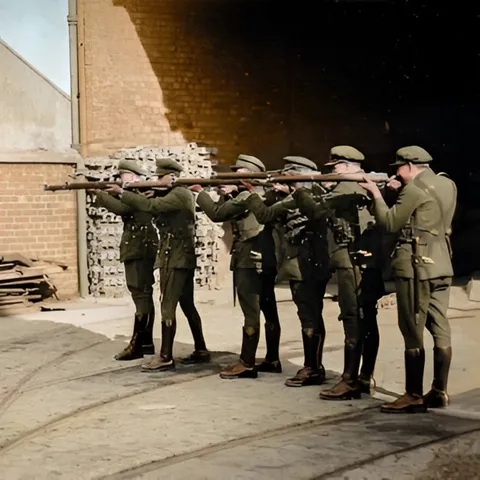
And it’s easy to leave the Civil War period with a bitter taste in your mouth. It feels a little bit like a failing of our poor young country. That feeling is summed up very well by a quote from Sean Irwin, a Free State Commander at Beggars Bush. In the 70s he wrote about his time and how he Cursed the fates, the frailty of the leaders, the stupidity of men, or whatever it was that brought the country to this pitch of barbarity. It is impossible to describe the harrowing and the anguish of the soul of having to see one-time comrades in arms brought out and shot to death by a firing squad. And be aware that these men did not really know what it was all about.
And the Civil War was barbarous. Some would say utterly pointless considering de Valera’s actions in the future. And there were many things wrong with the Irish state post-Civil War. And to be honest, there’s a lot right up to the modern day that we can blame on the treaty split. But I will try to end on a more positive note.
A positive note inspired by the great historian Michael Laughan. In his UCD lecture series, all available online in the form of a podcast, Laughan speaks about how firmly ingrained the ideas of democracy were within the Irish revolutionaries. And how despite all the turmoil of the Civil War, democracy did prevail in Ireland. And this was not a given. Especially if you look to Europe throughout the 30s and 40s, where strongmen, fascists and army coups were not uncommon. Think Italy, Germany, Spain, Yugoslavia, etc, etc, etc. In fact, without jumping ahead, the fact that Ireland was able to have a peaceful handover of power between the winners and losers of the Irish Civil War is something to be immensely proud of.
And speaking of pride, it can be good to take a step back and look at the period of 1916 through to 1923. It was a time when a colonised country, which had been oppressed in one way, shape or form for centuries, managed to bring the biggest empire in the world to the bargaining table. Managed to question the status quo, managed to upend the normal order of things and make change for the better. You could argue it was the beginning of the end for the British Empire and for a certain era of European colonialism. It was a huge win for the rights of small nations and for self-determination. Yes, it was bloody and imperfect. It set the stage for decades more conflict. And the state we got was nowhere near the state we deserved. But it was ours.
And as we look back on that period from 2024, a year where we can see clearly that sadly neither self-determination nor statehood is guaranteed. A year when it’s clear not everyone is as lucky as the Irish. As we look back, all we can do is be eternally grateful for the rights that the revolutionary men and women worked so hard to obtain. Laffan rightly encourages his students to hold that democracy dear. That ability to vote, to chart the course of one’s own country. We are very lucky that Ireland has held on to those ideals to this day.
And that, everyone, brings me to the end of the story of the Irish War of Independence and the Irish Civil War. I started this podcast with the idea that I’d maybe do 10 or 20 episodes. And that if 100 people listened, well, that would be like if I filled a lecture hall. Now, something like 112 episodes later and 1.1 million downloads, I have to say I am genuinely so very grateful for the amount of people who have come on this journey with me. What a very large lecture hall you all would have filled. I know I have listeners from all over the world and I hope that like me, after this journey, you’ll feel like you understand the strange little island that is Ireland and the even stranger people that inhabit it a little better. Your support as listeners has meant the world. I love hearing from you all and I love that I get to make this podcast. And that it resonates with people. Even if I don’t always stick to my schedule.
But let’s stop getting sentimental. This is not the end of the show. Nope, nope, nope, nope, nope, nope. Not by a long shot. There are so many areas and areas, topics and themes I would love to explore together. From Brian Baru to the mad lads who made Newgrange. From Parnell to Wolftone. There’s a lot of history to unpack. Not to mention Ireland in the thirties with trade wars and the blue shirts. So I’m asking you, if there’s any period you would like me to cover, please do get in touch at the history of Ireland podcast at gmail.com. And if you enjoy the show, please do become a Patreon subscriber. The more people who support the show, the more time I can spend on it.
What next I hear you ask? Where do we go from here? Well, I started this show by diving into what was interesting me at the time. And I’ll say after the barbarity of the civil war, I’m looking for a little break from the death of Irishmen. It’s also inspired me to ask, well, why are the Irish the way they are? And one way to uncover that is to look at the stories we’ve told ourselves over the centuries. From here, I plan to dive into Irish mythology for a little while. The Táin, the Fianna, the folk tales of the country. Maybe you’ll cry and complain that that isn’t history. But for me, this podcast has always been about understanding the people who came before us. And as I worked on the war of independence, it became clear how much these stories influenced the revolutionaries idea of what it was to be Irish.
There’s also opportunity to expand the show, maybe some video, a sub stack, who knows what else. Again, I’m always interested to hear what you would like. So I’m going to take a little bit of time to collate all of that into a structure. I’ll be back in a month or two with a new series of the history of Ireland that will explore the history of Irish mythology. We can see how long it holds our interest and you can send in what areas you’d like to cover next.
From the very bottom of my heart, with a whiskey in my hand to celebrate for getting this far, I say thank you very much for listening. Go raibh míle maith agat. Or visit our website, thehistoryofireland.com. You can also get in touch through the website or on Facebook and Twitter. It’s always great hearing from you guys. And if I’ve made a mistake, please do let me know. The History of Ireland was written and produced by me, Kevin Dolan. With music by Liam Doyle and additional help from assistant producer Aoife Murphy. This podcast was recorded in the lands of the Wurundjeri people of the Kugan nation. Sovereignty was never ceded.