The Black & Tans in Palestine
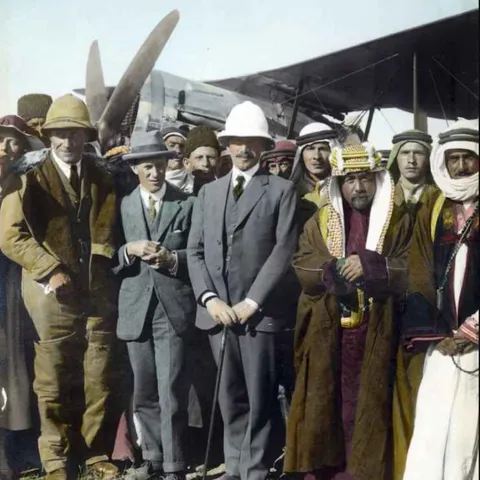
A slight diversion from our current series on mythology to look at a unique connection between Ireland and Palestine.
If you'd like to donate to support the people of Palestine you can do so here:
https://www.savethechildren.org/us/where-we-work/west-bank-gaza
As this could be a contentious episode, I wanted to ensure I shared all my sources. If it's something people find interesting, I'll keep doing for episodes moving forward.
Seán W. Gannon, “The Formation, Composition, and Conduct of the British Section of the Palestine Gendarmerie, 1922–26,” The Historical Journal (2013). Cambridge University Press & Assessment
Seán W. Gannon, “‘Our Irish Constabulary’: The British Palestine Gendarmerie, 1922–1926,” in The Irish Imperial Service
Richard A. Cahill, “The Image of ‘Black and Tans’ in Late Mandate Palestine,” Jerusalem Quarterly 40 (2009).
Richard A. Cahill, “Going Berserk: ‘Black and Tans’ in Palestine,” Jerusalem Quarterly 38 (2009). Palestine Studies
UCC, The War of Words: Propaganda and Moral Force. University College Cork
Transcript
Welcome to the History of Ireland. Today I want to take a break from our study into myths to examine something a lot less enjoyable, if I’m honest. But it’s been something that has been on my mind for a while and an avenue I wanted to explore as well as a question I’ve been getting asked by a few people. What’s going on in Gaza at the moment is something the world cannot ignore. And though the Israeli-Palestinian situation is not my conflict, not my story, and I am by far no expert, I did want to examine something related to it. Especially now as countries have finally started to recognise the Palestinian state. Something Ireland did in May 2024, over a year ago.
For many it might not seem obvious why the Irish are so pro-Palestinian. For others it might be remarkably obvious. Either way, today I’m not going to look at current events but instead examine a unique connection between Ireland and Palestine that might help people understand the support while placing everything within its wider colonial context. Today I want to look at the Black and Tans who were brought to Palestine.
Anyone who has listened to season one of the podcast will be well acquainted with the Black and Tans and the Auxiliaries. But it doesn’t hurt to do a quick recap. In 1920 the British launched a recruitment drive to encourage ex-soldiers to join a new force within the Royal Irish Constabulary. Some 7,000 men were sent over, badly clad in a mix of RIC’s dark green and a surplus of British Army uniforms meant for Africa. On top of this a second force, the Auxiliaries, better paid and taken from the officer class, was also created. Both groups were extremely brutal, ill-trained for guerrilla warfare, ill-equipped to deal with the Irish landscape and excessively violent. They were soldiers who were basically let run wild on the civilian Irish population, looting, murdering and committing arson. They also had a semi-government approved tactic of reprisal attacks on civilians and civilian property.
So to jump over a whole season or two of podcast content, the Black and Tans did their thing right up until 1922 and then as the British were pulling out of Ireland, the Black and Tans were disbanded. Including regular RIC officers, over 500 had died in combat and 600 had been wounded. Many simply returned to Britain with 3,000 needing financial assistance after their time in Ireland and around 250 joined the Royal Ulster Constabulary. But there were 760 men, a sizeable amount of the force, who on April 30th 1922 headed to Palestine.
To understand why we have to go back a little further. Arthur James Balfour was a British Conservative politician born in 1848. He entered Parliament in 1874 and was soon Chief Secretary of Ireland where he cracked down pretty brutally on agrarian unrest. For example, defending police under his command who opened fire on protesters in Mitchelstown, County Cork in 1887. After this he was briefly Prime Minister between 1902 and 1905 and by 1917 he was David Lloyd George’s Foreign Secretary and the man behind the Balfour Declaration.
You see the British conquered most of the quote Arab Middle East from the Ottoman Empire during the First World War and once the war was over and the winners were dividing up the map the British were granted control over Palestine and Iraq under the League of Nations mandate system. This gave them control over the territory of Palestine with the idea of preparing their population for eventual self-government. This population at the time consisted of about 750,000 in 1922 made up of almost 600,000 Muslims, 73,000 Christians, 83,000 Jews and a small number of Samaritans and others.
In 1917 Balfour made a statement that became known as the Balfour Declaration. This was a statement in which the British government announced its support for a quote national home for the Jewish people in the Palestinian area. Now you could do a whole podcast on the Balfour Declaration and I won’t be getting into the pros and cons or into a debate over Israel. It’s a complicated nuanced situation that I frankly don’t feel educated enough to comment on in a podcast like this.
Regardless, after the Balfour Declaration as Zionist Jews began to settle in Palestine the British saw quite an intensification of Palestinian opposition. The British army was exceptionally thin on the ground at this point spread across Ireland, India, Egypt and the rest of the empire. The British wanted to pull the army out of Palestine but that would leave only the locally recruited Palestinian police force to control the anti-Zionist insurgency. And the Palestinian police force were probably not the best people to be controlling anti-Zionist sentiment considering many were against the idea of Zionism full stop. In fact during anti-Zionist riots in April 1920 and May 1921 some Palestinian police actually attacked the Jewish settlers.
So Winston Churchill as secretary of state for the colonies decided a British led police force would have to be brought into the area. Luckily for him he just happened to have one lying around. With the Irish war of independence wrapping up he had just the lads ready for action. In November 1921 Churchill proposed to the British cabinet to reuse the model of the auxiliaries and the blackened towns in Palestine. Sir Henry Wilson, head of the British army at the time, staunchly disagreed. He had previously referred to the blackened towns as a gang of murderers. And the evidence of their destruction throughout Ireland was pretty bloody clear. It’s also not like they had succeeded particularly well in subduing the IRA considering the British were now leaving Ireland.
But despite all of this the cabinet sided with Churchill and in January 1922 the British Gendarmerie as it was known opened its doors for recruitment. As intended over 90% of the force came from the auxiliaries and the blackened towns. It’s often said that Ireland was a laboratory for the British Empire’s wider colonialism. And this is such a striking literal example of that happening. The blackened towns were tested in Ireland and then the men themselves were shipped to Palestine.
And not everyone was all that pleased. Palestine’s High Commissioner Sir Herbert Samuel was worried about the blackened towns negative press carrying over to his new police force saying Most desirable if it could be avoided that no public announcement should be made connecting the blackened towns with our Gendarmerie. Their reputation as a corps has not been savoury and if any idea was created in the public mind in England or here that the blackened towns or any part of them were being transferred as a body to Palestine the new Gendarmerie might be discredited from the outset. Churchill agreed but not enough not to recruit from the blackened towns. Instead just asking Henry Tudor to approach recruitment quote with a view to eliminating as far as possible the moral connection between the new force and the blackened towns. Thereby disposing of the inevitable idea that we were importing into Palestine the traditions of recent Irish politics. But for all intents and purposes it very much was the same force. And for simplicity I’ll keep referring to them as blackened towns.
Churchill’s plan to avoid the two forces being conflated failed and the blackened towns reputation preceded them. So much so that it was said initially that their fearsome reputation did enough to keep people in the area in check. And there definitely were a few riots averted just by the blackened towns arriving and looking cross. They had at this point added a Stetson hat to their uniform for reasons that are unclear.
Now there are mixed reports on whether the blackened towns actually brought their violent approach to Palestine. It was argued at the time that all that was needed to keep the peace in the area was the towns reputation and that the men spent most of the time quite bored as the area was quite peaceful. Author and historian Sean Gannon describes how they were tough, they adopted a shoot to kill approach from bandits and brigands and when they did get physical it was brutal enough. But there were no mass casualties and there were no reprisals. They didn’t burn houses or anything like what happened in Ireland. So much so that historian David Leeson argues this could show that situational factors i.e. the Irish were more the cause of their policing style in 1921 in Ireland.
But I’m not sure I buy that and Richard Cahill writing for the Institute for Palestinian Studies a highly respected non-profit public service research institute speaks to the many instances where members of the blackened towns carried across their approach from Ireland to Palestine and that this continued long after the Gondarmerie were disbanded. Cahill writes about Douglas Duff for example a former blackened town who was credited with teaching other members of the Palestinian police how to torture without leaving physical marks. In fact Duff was so brutal that the term duffing up became slang among colonial police for torture. Or there was Raymond Cafarrata who went on to be a district commander in Hebron and in 1929 attempted to disperse rioters by firing into the crowd. He was actually awarded a medal for saving lives there but there was some contention around the violence of his methods. Finally there was Michael McConnell who helped set up the police mobile force in 1943 which was a young and undisciplined force who after a series of high profile misconduct in 1946 and 47 were disbanded.
As Cahill writes quote Not only did former blackened towns serve in Palestine they played a significant role in the police force controlling most district commander positions by the early 1940s. They acted at times in brash and rough ways they were prone to controlling the situation through force and taking decisive often brutal action. So you see the link between the blackened towns approach in Ireland and in Palestine is real and quite tangible.
And for that reason and many many many others it becomes quite obvious why the Irish support Palestine so fiercely. We have seen what colonial powers can do we have also seen the horror that can be caused by terrorists in the name of the people and have worked towards an uncomfortable peace. We hold those two truths very closely. But the Irish and Palestinian stories are obviously very very different and again the blackened towns give us a good example of this.
Back in the 20s 30s and 40s the media did not cover a lot of the blackened towns violence in Palestine and in fact often praised former blackened towns. The Irish war of independence was ended in no small part due to the international pressure on the British. As historian Mike and Laughan summarises London shifted course in 1921 more in response to international hostility and to the shame and revulsion felt by British public opinion than to battlefield defeat alone. Anyone who has listened to this show knows that the British could not commit a total war in Ireland. They fought with the gloves on because they were concerned about public opinion the wider international opinion and importantly had a huge contingent of American public with connection to Ireland breathing down their neck.
Sadly Palestine today does not have this luxury. Benjamin Netanyahu’s government has unleashed total war on the Palestinians and is committing what many describe as a genocide. His government is doing this with the backing of America and while much of the international community sits by and watches. It’s why it’s so important we all speak up. It’s why it’s important to condemn Hamas but it’s just as important to loudly and fully condemn the Netanyahu government. We must pressure governments around the world to do everything they can.
The last thing I’ll say is that if you want to do more than speak up as important as that is you can also donate to Save the Children. I’ve seen the work they’re doing to help children living in Gaza and when so few charities are able to work in the area I trust Save the Children to be doing their very best. I’ll leave a link in the show notes as well as details on where I’ve found all my sources as I know this is a contentious topic.
I’ve only two things left to say. One, hopefully this gives you a sense of the long connection between Ireland and Palestine. I’m quite proud to be Irish as you see the likes of kneecap raising a stink, Sally Rooney getting threatened with being arrested and our soon to be ex-president Michael D Higgins railing against the Netanyahu government. All I can do is add my small voice to theirs and say free, free Palestine.
You can also get in touch through the website or on Facebook and Twitter. It’s always great hearing from you guys and if I’ve made a mistake please do let me know. The History of Ireland was written and produced by me, Kevin Dolan with music by Liam Doyle and additional help from assistant producer Aoife Murphy. This podcast was recorded in the lands of the Wurundjeri people of the Kulin Nation. Sovereignty was never ceded.