Episodes Irish Revolution Season 1 — The Revolution
A Summer of Riots
Bang on 100 years ago on July 21st 1920, riots erupted in the Belfast shipyards. This week we investigate what was the cause and continue to look at Northern Ireland throughout the 1920s. We also introduce the Ancient Order of Hibernians, discuss pogroms and try to untangle a very complicated summer.
www.thehistoryofireland.com
Transcript
Welcome to the History of Ireland. Before we start off today’s show, you may have already seen my little bonus note. But just in case you haven’t, the show has passed over 150,000 downloads. It’s amazing! Thank you all so much for listening. To celebrate, I’ve put together some History of Ireland merch featuring a kick-ass illustration of Donal. I won’t go on about it too much again. Listen to that bonus announcement for more info or check it all out at thehistoryofireland.com. As always, I really appreciate your support. And I reckon you’ll really like the t-shirts. Anyway, onwards with the history.
Last episode, we boldly stuck our toes into the complicated history of Northern Ireland. You’ll remember that by the beginning of 1920, thanks to the Government of Ireland Act, tensions were on the rise throughout Ulster. This week, we’re going to look at how they boiled over. And boy did they boil over.
1920 kicked off with the election of Hugh O’Doherty as the new Mayor of what was then known as Londonderry, now just Derry. This was a big deal because O’Doherty was a Catholic. In fact, he was the first Catholic voted Lord Mayor since 1690. As Charles Townsend puts it, this was a shocking moment for Unionists psychologically and very dangerous in political terms. There was a worry that a Catholic and pro-nationalist Mayor would put a spanner in the works of Ulster’s Home Rule. Plus, O’Doherty began refusing to attend any events that involved a declaration of loyalty to the Crown. Not ideal for Ulster Unionists.
This just led to a further increase in tensions in Derry. And in April, riots broke out across the city. They continued on into June and 19 people were killed. And this was just the beginning.
This violence and most of the violence that occurred across Northern Ireland in this time period was slightly different from what was going on in the rest of the country. And as we mentioned last week, it was a lot more sectarian than anything that occurred in the South. As well as this, it didn’t really involve the IRA to the extent it did in the other three provinces. At least not initially. As I mentioned last episode, in the beginning of 1920, the IRA were just a weak organisation in the North. There are two stories that demonstrate this pretty well.
First, on June 21st, the Orangemen, an organisation of Ulster Protestants, attacked a Catholic school. The IRA jumped in to try and defend against the Unionists, but ended up facing a fairly embarrassing defeat and were forced to retreat. As their leader put it, the discarding of rifles and ammunition and the hasty disappearance of men was not edifying.
Second, there’s the rather embarrassing story of an attack on the Crossgarg RIC barracks in County Down on June 1st. The IRA battalion had been provided with fairly advanced bombs that should have made the attack a pretty simple affair. But unfortunately, the men had no idea how to use them. So, before the attack they were all sent to a hall for training under a man named Roger Macauley. Macauley lined them all up and explained the basics of operating rifles and these fancy new bombs. Unfortunately, it was clear the men had no idea what they were doing. Macauley, after going to one side of the hall to help a group fix a dismantled rifle, returned to find one of his trainee bombers’ bomb in hand. The man was standing there, quote, with a pin extracted just about to let the lever fly off. Macauley continued saying, he appeared to be under the impression that nothing would happen if he did not throw the bomb.
This did not bode well for the attack. The men were totally unorganized and as Macauley describes it, before the bombs went off the party panicked and ran into the street screaming, thus alerting the police. Macauley tried to call a retreat but couldn’t because he’d forgotten his whistle. Remember people, always bring your whistle. Half the RIC garrison had been wounded by the blast but managed to hold down the barracks as the confused IRA men retreated. Macauley rather dejectedly pointed out that he’d exposed a certain lack of determination to carry an operation through, even at a certain cost in casualties.
Basically, in early 1920 the Northern IRA men were just not as organized, as eager or as numerous as their southern counterparts. This is not to say that all of the Northern Irish IRA’s attacks were complete failures though, and in Easter, along with the rest of the country, they had successfully burnt several small barracks and tax offices. Though this ended up doing nothing more than invigorating the Unionists, and this was one of the reasons the Northern IRA were slower to attack. They feared, and rightly so, reprisals from Unionists. Unionists who were a lot better armed and more numerous than they were. The burnings were a prime example and actually led Sir Edward Carson to revive the Ulster Volunteer Force.
We’ve briefly mentioned Carson way back in episode 1 or 2, but let’s give him a quick reintroduction because he’s a pretty interesting fella. Born in Dublin, Carson seems a bit of an unlikely candidate for Ulster Unionist leader. Originally he’d been determined to keep the entirety of Ireland as part of the UK, but as this became less and less likely he settled for Ulster, believing it to be the only chance of keeping any of Ireland in Britain. A lawyer and politician, Carson was an aggressive and persuasive public speaker. In his days as a lawyer he’d actually worked against both Oscar Wilde and Cadbury’s. Working against Oscar Wilde is definitely a point against the man, and I would have thought going against Chocolate was bad too, but the case was all about Cadbury’s use of slave labour so it kind of cancels out. Anyway, Carson was an aggressive Unionist who used his position to incite hate and rile up the North. He was an extremist who often went even further than the rest of the British establishment was happy with, and this is exactly what happened on July 12th, 1920.
Every year on July 12th, Ulster Unionists celebrate the Protestant William of Orange’s victory over the Catholic King James II in 1690 in the Battle of the Boyne. They’ve been doing it since the late 1700s and they continue to do so to this day. As most of the Irish listeners will know, the run up to this celebration, which involved a lot of marches, is generally a pretty tense time in the North. July 12th, 1920 was no different, and it was on that day that Carson called for the UVF to be reformed. Arguing in a speech, he said that the British government wasn’t doing enough. He exclaimed, but we tell the government this, you are yourselves unable to protect us from the machinations of Sinn Féin and you won’t take our help. Well then, we will tell you that we will take the matter into our own hands. And these are not mere words, I hate words without action.
Imagine people putting together a bonfire. They pile sticks and tinder and newspapers and leaves into a giant pile that’s ready to burn. Well, things have been piling up in Northern Ireland for months, years, maybe even centuries at this point, and Carson’s speech was like someone pouring gasoline over the whole thing. Even British-leaning newspapers described it as inflammatory. But it was an event five days later, on the other side of the country, that acted as the spark that set everything ablaze.
This brings us back round to the Listowel mutiny, all the way down in Cork. You see, the assassination of Colonel General Smith on the 17th of July pushed everything over the edge. As we mentioned, Smith was from the North, specifically Banbridge in County Down. His murder and the following refusal of railwaymen to transport his body infuriated Northern Protestants. On top of this, the delay in transporting the body meant that his funeral would take place on July 21st, the day everyone would return to work after the July 12th holidays. It was a perfect storm.
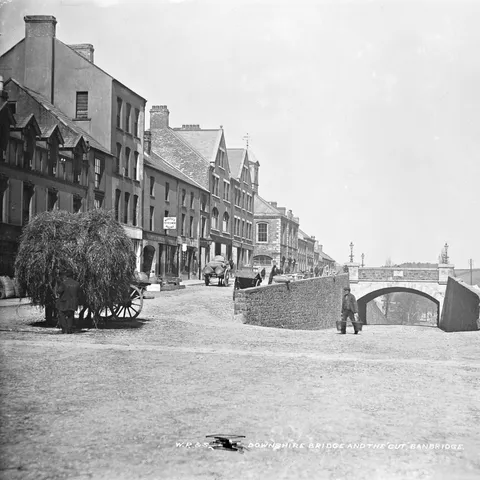
First, violence exploded in the town of Banbridge, where around 2,000 Unionists chased Catholics out of their jobs at the local linen mills and burned Catholic buildings. Smith’s mother even announced that the family’s mills would no longer employ Catholics.
And up in Belfast, it was even worse. On the morning of the 21st, Protestant workers arrived and got to work as normal. But at lunch, they sat down and quote, with Carson’s call to action still ringing in their ears, decided to remove what they saw as disloyal Catholics working from the yard. The Protestants rounded up the Catholics, ripping open people’s shirts to check who was wearing Catholic iconography. Those who were, were beaten and driven from their jobs. Some men were even forced to jump into the river Laughin to escape. The violence spilled out from the shipyards, with Unionist mobs attacking Catholics throughout the city. Apparently, the weapons of choice were bottles, stones and paving slabs. There are even stories of Unionists cutting the hoses of firemen who tried to put out the fires of Catholic-owned buildings. It continued for weeks. There’s no two ways about it. It was nasty stuff.
At the time, people used the term pogrom, and it’s been used since to apply to what happened in Northern Ireland. A pogrom is a violent riot aimed at the massacre or expulsion of an ethnic or religious group, one generally approved or condoned by authorities, or at least that’s the generally agreed upon definition. But historians argue over whether or not this term fits in this case. Some say that the death toll was too small, and that it was all intertwined with nationalism too much to be an exclusively religious situation, while others argue that, well, it’s how people at the time described it, and that Catholics were being targeted because of their religion. Either way, over the two years, 450 people would be killed, two-thirds isn’t Catholic, and over 8,000 driven from their homes, with over 600 houses and businesses destroyed. I don’t really know if it matters what you call it. This was a fairly harrowing period of violence, mostly along religious lines. However else you define it, this was a tragedy. But like anything in Northern Ireland, there’s just nothing clear-cut about it.
Whatever the historical consensus, at the time Sinn Féin liberally used the term pogrom, and to be blunt, it made for great Republican propaganda. But the nationalist response was fairly complicated. You’d think the IRA would have been out in force defending the Northern Catholics, and Sinn Féin would be encouraging them to do so. But, I’ll say it again, things are never simple in Northern Ireland. As mentioned, the IRA were just too weak to deal with the Unionist aggression. But more than that, they actually believed they shouldn’t be getting involved in sectarian issues, issues they believed were getting in the way of nationalism, and that they described as, nothing more than the usual patricidal strife.
But that’s not to say the Catholic nationalists did nothing. They actually had a separate group other than the IRA ready to defend their interests. Enter the Ancient Order of Hibernians. The Hibernians were formed as a counter-group to the Protestant Orange Order, and were led by the Irish Parliamentary Party leader, Joe Devlin. I introduced Joe Devlin incorrectly last week as John. Oops. As I said last week though, Devlin was one of the few IPP men not to be kicked out of office in the 1918 election. And in general, Devlin and the Hibernians had a lot more support than the IRA or Sinn Féin. Both groups also hated each other. Devlin described Sinn Féin as running a phantom republic, and believed they would go down in the ridicule of the nation. While the IRA viewed the Hibernians as an unorganised group who were getting in the way of the fight for the Republic, describing them as a mob of corner boys, which wasn’t really true.
Townsend describes the Hibernians as follows. Occupying the front line in Ireland’s most vicious battles over two generations had produced a resilient nationalist organisation, backed by notoriously tough and sectarian street-level enforcers. And it was these tough Hibernians who, during the summer of 1920, came out in force to defend the Northern Catholics. And you’d think something like the enemy of my enemy is my friend would apply here, but the IRA and the Hibernians simply never saw eye to eye. In fact, they would often steal munitions from each other. There’s one story where Macaulay, the man I mentioned earlier, who led the failed Barracks attack, found out that a priest had 60 rifles and was offering them to the Hibernians to help with the defence of the city. Macaulay rocked up to the priest’s home, pretending to be a Hibernian, and collected the precious rifles. The story goes that the priest specifically told Macaulay that he was happy to give over the rifles as long as the IRA didn’t get their hands on them. Sorry father, that didn’t really go to plan, did it?
But it even goes further than that. The IRA disliked the Hibernians so much that there are stories of them even attacking members of the group. There’s one tale of an IRA man arriving at the home of a Hibernian member. Quote That’s the treatment meted out to nationalists at Sinn Féin’s hands. Partition is a glorious thing compared with the rule of those boys. And I wonder how any nationalist can stand up and offend such men. As we tell the story of the War of Independence and the IRA, it’s important not to simply paint the organisation as heroes. They could be brutal towards anyone they saw as hurting the cause of the Irish Republic. Even if those people were Irish, Catholic and nationalist.
So that’s where things were at in July of 1920. The Protestant Unionists, roiled up by Edward Carson, were all but trying to remove any trace of Catholicism from Belfast and the rest of the North. The ancient order of Hibernians was trying to defend Catholics while taking the fight to the Protestants. And the IRA were kind of confused and weak right in the middle of it. All the while the riots continued and continued and continued. Say it with me again people. Northern Ireland is never simple.
Northern Ireland was written and produced by me, Kevin Dole. Additional research and fact-checking by Robert Babbington, music by Liam Doyle and production help from Aoife Murphy. This podcast was recorded in the lands of the Wurundjeri people of the Kulin Nation. Sovereignty was never ceded.