Episodes Irish Revolution Season 2 — The Civil War
A Guerrilla Winter
Transcript
Welcome to the History of Ireland. I am back after my usual Christmas break. This one a little longer as I was off getting engaged to a certain assistant producer of this podcast. With that done and dusted I can safely say I am very excited for 2024 and eager to get stuck back into the show.
The winter of 1922 into 1923 was a difficult one. Early December had seen execution after execution of anti-treaty IRA men as well as the murder of Sean Hales. And people were uncertain about the future. As the editor of the Connacht Tribune wrote, Christmas 1922 falls upon an Ireland riven with the saddest of all strife, the strife of brothers, whose economic life is ebbing, where joy has been turned to sorrow because of the conditions that we ourselves have brought about. While a writer for the Freeman’s Journal called for truce, let us put away pride and bitterness, he said, and remember we are Christians and brothers. Each side has much to forgive. To both sides I would say, you are ruining your ideal of democratic government on one side and of complete independence on the other by the violent methods you use. Nothing founded on force lasts.
But sadly a truce was still a far ways off and as historian Colm Kenny explains, spring was about to bring some final acts of viciousness and a further waste of lives before open hostilities came to an end. Over November, December and January of 1922-23, the anti-treaty IRA were struggling to survive but still hell bent on disrupting the new Irish restate as much as possible. Across the country a policy of quote systematic and continuous destruction was underway.
Here was one set of orders given to anti-treaty forces, laying out in quite a bit of detail the approach to be taken. Roads, these are to be made impassable at as many points as possible. Bridges are to be destroyed by explosives wherever this can be done. Roads to be trenched, blocked with trees or masonry, telegraph poles or other material available. In certain localities the roads may be flooded by breaking down the canal banks. Barricades to be of any use must be placed at frequent intervals at one section of the road.
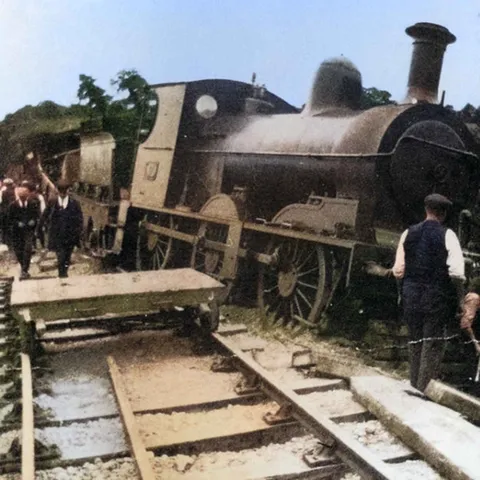
Railways, to be destroyed by every possible way. Bridges to be destroyed by explosives, small stations to be attacked and burnt. Where station buildings cover the tracks, they should be destroyed so as to block the permanent way. Station coverings are generally supported on cast iron columns and one or two blows with a heavy sledgehammer will generally knock these to pieces. By blocking the railway line by means of the station buildings at two points, protection will be afforded to a demolition party working between these two points. Before the obstructions are cleared and an armoured train reaches them, the demolition party will have had time to completely wreck the train.
If a train is held up, it need not be run into an obstruction to wreck it. Four men with sledges can destroy the wheels of all carriages and the locomotive in a few minutes. By destroying the wheels on either side only, some carriages can be thrown across the other track. The carriages should be soaked with paraffin and set on fire, and the mechanism of the locomotive battered to pieces.
Now how’s that for thorough? And this destruction of the railways was so effective that a specific regiment of the army had to be created, the Railway Protection and Maintenance Corps. Made up of just over 3,000 men, it consisted of a mix of soldiers and railway men who travelled the country in armoured trains and trucks, defending the vital train network. And still, Ireland’s largest railway company estimated that by the end of the year its line had been damaged in 75 places, 42 engines had been derailed and 51 bridges destroyed.
This was the height of the guerrilla phase of the civil war, with people like Tom Barry leading a short conquest of towns in the Midlands. He managed to take Carrigan Shore, Thomastown and Molnavut before the Free State Army pushed him back due to a lack of men and equipment.
Backing up all of this destruction of roads and trains and the conquering of places like Thomastown were Cumann na mBan. As the anti-treaty side was forced to go deeper into hiding and break into smaller groups, it became imperative for this guerrilla conflict for Cumann na mBan to act as supply lines, a means of communication and, well, keep the scattered army vaguely in some kind of order. One contemporary described how Cumann na mBan organised women to assist flying columns, to attend to the wounded and arrange for changes of clothing and transfer of ammunition and arms.
The anti-treaty IRA and Cumann na mBan’s actions had a real impact on the people of Ireland. I have two little stories to illustrate this, one from WB Yeats and one from yours truly. We’ll start with the less poetic of the two.
According to family history, my great-grandfather was feeling ill on St. Stephen’s Day. Now all his friends and family told him he had just eaten too much on Christmas Day. But the stomach ache did not disappear and eventually it was decided the man must have appendicitis. He had to be rushed to a hospital. With this being West Cork, the anti-treaty IRA had blown up the local bridge and because of this, well, he didn’t make it to the hospital in time and the inflamed appendix exploded inside him, killing him there and then. Admittedly, a different kind of explosion to the one we’re used to hearing about, but one that was no less a terrifying story for a young podcast host as he lay in hospital at the age of 9 or 10 waiting for his appendix to be removed.
Yeats also tells the story of having a bridge blown up near his home in County Galway. The anti-treaty forces arrived and as Yeats tells it, they forbade us to leave the house, but were otherwise polite, even saying at last, goodnight, thank you, as though we had given them the bridge. A few years later he would go on to publish Meditation in the Time of Civil War. It’s a great collection of poems that I recommend you go read, but The Road at My Doorstep is one of my favourites and a particularly vivid description of the time, with many seeing the pear tree mentioned as a metaphor for the entire country. It goes like this. An affable irregular, a heavy-built, foul-stafian man, comes cracking jokes of civil war, as though to die by gunshot were the finest play under the sun. A brown lieutenant and his men, half-dressed in national uniform, stand at my door and I complain of the foul weather, hail and rain, a pear tree broken by the storm. I count those feathered balls of soot, the moorhen guides upon the stream, to silence the envy in my thought, and turn towards my chamber caught in the cold snows of a dream.
The cold snows of a dream indeed, winter of 1922 and 1923, was not especially nice. And every day that the fight continued, it further hurt the Irish Free State, with one estimate made in 1923 stating that the whole war cost the country £50 million, equates to about 30% of the country’s entire revenue at the time.
But despite all of this, it was becoming increasingly clear that the anti-treaty side had no real path to victory. As historian John Borgonovo describes, guerilla fighters were hard-pressed, on the defensive, and aware of the widespread war-weariness and hostility among the local population. The expanded National Army developed new tactics to tackle the IRA. They deployed special units to deter agrarian conflict and flooded troubled areas with mobile columns to hound and harass Republican flying columns. Republican arrests and executions rounded. The Free State controlled most of the country by the close of 1922. And for the first time, IRA fatalities began to outnumber the National Armies. Unlike the British Army, Free State soldiers understood how guerrilla warfare was organized and could identify Republican leaders and their supporters within the community.
Basically, a superiorly armed Free State Army, a lack of support from the wider population, and the brutal policy of execution by the Free State, left the anti-treaty forces well and truly demoralized by the end of 1922. This is highlighted by the acts of Liam Deasy in January 1923. Deasy was a corkman and basically the second-in-command of the anti-treaty forces. In a skirmish in Clonmel on January 15th, Deasy was captured and sentenced to death. However, Deasy issued a public statement calling for the immediate and unconditional surrender of all arms and men as required by General Mulcahy. This was followed by anti-treaty prisoners all across the country calling for an end to the conflict. As Borgonogo put it, the demoralized Deasy and the dissenting prisoners were saying out loud what many Republican leaders and rank and file thought privately. That armed resistance no longer offered Republicans a way to defeat the treaty.
And on February 9th the government announced a quote temporary suspension of executions, giving anti-treaty leaders the chance to reply to Deasy’s call for a surrender. They even offered amnesty to anyone who surrendered before February 18th. But Liam Lynch, the anti-treaty leader, was having none of it.
Lynch was not blind to the difficulties facing the anti-treaty forces. In September he’d written that the disaster of this war is sinking to my very bones. Who could have dreamt all our hopes could have been so blighted? While in December he wrote to his mother saying would that English hounds had tracked me down rather than old comrades who had been false to their allegiance. But despite all this he still refused to surrender. In fact one senior anti-treaty IRA officer even went as far to say that quote Lynch’s iron will alone kept the civil war going. Now that might be giving Lynch too much credit but regardless the fight did continue and in some parts of the country the fighting sank to even more barbaric depths.
In fact March became known in Kerry as the month of terror. Next episode we’ll look at that month and the conflict in Kerry and uncover the horrors of what occurred in Ballysea.
Simply follow the Patreon link in the show notes or visit our website thehistoryofireland.com You can also get in touch through the website or in Facebook and Twitter. It’s always great hearing from you guys and if I’ve made a mistake please do let me know. The History of Ireland was written and produced by me Kevin Dohern with music by Liam Doyle and additional help from assistant producer Aoife Murphy. This podcast was recorded in the lands of the Wurundjeri people of the Kugan nation. Sovereignty was never ceded.