Episodes Irish Mythology Season 3 — The Mythology
Newgrange, The Celts & The People of the Sídhe
Transcript
Welcome to the History of Ireland. We are back people. Thank you for bearing with me in the longer than usual absence of the show. But we’re diving into a very new topic and something I’m pretty excited for. So I had to take my time to get all my ducks in a row to start exploring the mythology of Ireland. And oh man, is it fascinating. I have to say, ye are in for a treat.
I was once chatting to John Tunney, a lecturer in heritage studies at GMIT, who explained the idea of Irish myth, folklore and culture as something that sits on a spectrum. On the one hand, you have the truest, most authentic, real Irish Irishness. All of which you can imagine me saying while making air quotes. And on the other end, you have the 1959 film, Darry O’Gill and the Little People, starring the Scottish Sean Connery as an Irishman who meets, well, little people. The authentic and the paddywhackery. Maybe on the authentic side, there’s the old fairy tree near my family home, which the council literally diverted a motorway around, rather than cut down. And on the other hand, you’ve say, maybe a plasticky, disnified Irish pub in Alicante, where the Guinness is served with one long pour.
But the point that John was making was that so much of Irish culture lives on that spectrum. And as we try to delve into what constitutes real Irish mythology, well, it’s important to keep this in mind. It’s all a spectrum. Why is this? Well, because mythology and folklore have always been built on the interactions between the people telling the stories and those who came before them. And nowhere is that more true than in Ireland.
Our mythology has constantly been in flux. A fascinating dance between Neolithic structures, Celtic stories, Christian parables, 19th century revivalism, modern day historical science and, of course, podcast hosts. Unlike the Greeks or Romans or even the Norse, the Irish don’t have a clear, clean-cut, written-out version of what the ancient Irish people actually believed. It’s hard even to define what we constitute as the ancient Irish people. Generally, the Celts is what we’re referring to, but even that’s a complicatedly loaded term.
This is all because Ireland has always been a country built on migration. People coming and going, cultures assimilating, changing and merging. Sometimes peacefully and sometimes not so peacefully. But that’s part of the beauty of it. And the history of Irish gods, Irish mythology and Irish folklore is an amazing way to understand how the country has evolved over, well, millennia. So, to that one star Apple review I got once telling me that the history of Ireland was too focused on the 1920s, buckle in buddy, because we’re about to start century hopping.
My job here is not going to be to define the truest or most authentic version of these stories, but instead give you a better understanding of the country, its people and the amazing stories that they told over generations. It’s fascinating stuff and I really hope you’re going to enjoy it as much as I’ve enjoyed researching it all. The rough plan is to explore everything from the early mythological cycle, through to Finmacule, Cú Chulainn and maybe even some of the folktales that were still being told right up into the 20th century. But before we get into those actual stories, we need to unpack two very important elements in what’s going to be a bit of a two-parter intro episode. First, we’ll look at the land and its influence on Irish mythology. Then, we’ll explore the people telling the story. So, let’s get started.
The wonderful Shanachí of the modern Irish tribe, as I imagine he’d like to be called, Tommy Tiernan, tells a great joke. Tommy says, We call ourselves the Celtic people, and there’s some truth in that. But it’s not the whole story. The Celts arrived 3,500 years ago. Newgrange is 5,000 years old. There’s a 1,500 year gap between who we are and who we think we fucking are. And the interaction between the Neolithic people of Newgrange and the Celts, the people that we are and the people that we think we are, that’s what leads to one of the most important concepts you need to understand when thinking about Irish mythology. The Shí, the Hollow Hills, the Otherworld, the Home of the Fairies.
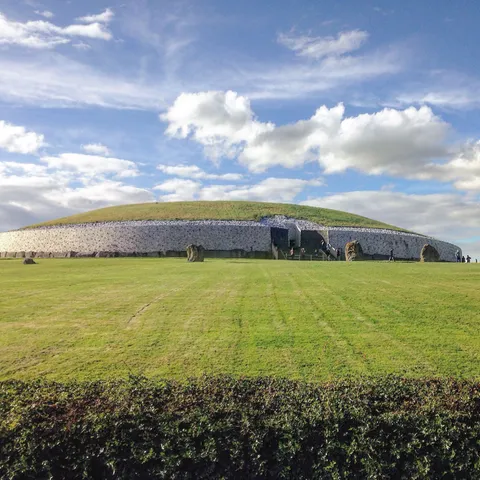
To understand the Shí, you have to go back to Neolithic Ireland, to an area known as Brú na Bóinne and its passage tombs, namely Dóth, Nóth, and most famously, Newgrange. I’ve always had a fascination with Newgrange. It’s a passage tomb built around 3,200 BC, which for context is 500 years before the Pyramids of Giza or Stonehenge. That means you and I, we are closer today to the Romans who built the Colosseum than the Romans were to the people who built Newgrange. It’s an amazing structure. Every year on the winter solstice, my birthday as it happens, which is where the fascination started, the sun shines through Newgrange’s passage and lights up the inner sanctum, like something out of Indiana Jones. The Newgrange Visitor Centre’s website, which looks like it was built around the same time as the structure itself, describes it as an ancient temple, a place of astrological, spiritual, religious, and ceremonial importance. Much as present-day cathedrals are places of prestige and worship where dignitaries may be laid to rest.
But we know very little about the people who built Newgrange. They were a stone-age culture who farmed and raised cattle. And it’s posited that they were led by an elite ruling class who could very well have seen themselves as divine. How do we know this? Well, genetic testing shows that the people buried in passage tombs around Ireland were closely related to each other. And one fragment of bone found in Newgrange was actually from someone who was the offspring of a brother and sister incestuous relationship. So because of this, it’s been hypothesized that they saw themselves as divine, hence the incest. Similar to the pharaohs or the Targaryens, they may not have wanted to dilute the bloodline. Dr. Daniel Bradley of Trinity College, a specialist in DNA, goes as far as to describe the remains found saying, It’s a pharaoh. I said it’s an Irish pharaoh.
The general consensus between historians is that the people who inhabited Newgrange were eventually superseded by the Beaker people, who migrated to Ireland, who in turn were replaced by the Celts. Whether this was by invasion, slow assimilation, or a combination of both, it’s hotly contested. And remember, this took place over thousands of years. But it’s that interaction between the Celts and the Neolithic builders of Newgrange that I want to discuss.
First though, we should define what we mean when we say Celt. It’s a bit of a loaded term, and one with many different definitions. The Celts never really described themselves with anything close to that name. They were instead a loose group of tribes from all over Europe who surfaced in Europe around 1000 BC. The Belgae, the Helvetii, the Gauls, anyone interested in Roman history will recognize these names. These tribes wrote nothing down. So anything we know about them, we know from either other people of the time, like the Romans, or from later Christian writers. Herodotus, a Greek historian, described the Celtoi as tall, with light skin and hair and eyes, boastful and vainglorious, but demonic in battle, childlike and ostentatious, but hospitable, fond of hunting and feasting and music and poetry and glittering jewellery and bright colours. I find that little snippet amazing because it kind of matches what we think of an Irish cliché today. We love our feasting and music and poetry.
Anyway, the Romans all but wiped out the Celts throughout much of Europe. However, in Ireland the culture survived. Now, it was a culture heavily influenced by Roman Britain, but it did retain its Celticness, for want of a better term, right up until the arrival of Christianity in the 5th century AD. I will explore more of that change in the next episode. But what you need to know is that by 600ish BC through to 500 AD, Celtic culture, again imagine air quotes, was predominant across Ireland.
Sadly, we have very little first-hand knowledge of what these people believed, and there was no written-down stories of the gods and very, very little archaeological evidence. But one thing we can guess at fairly confidently is that there was a strong belief in the very uniquely Irish concept of the She, the Hollow Hills. Newgrange and other burial grounds across the country were no longer used as burial sites by the time of the Celts. But there is some archaeological evidence that suggests offerings were left there. In fact, in Newgrange two Donativas have been found. These are medallions awarded by the Roman emperor to high-ranking officials. As historian Mark Williams puts it, Overall, it looks highly plausible, though at present unprovable, that there was a late Iron Age cult focused on supernatural beings, whether gods, deified ancestors, or the spirits of the dead, associated with the mounds of the Boyne necropolis, and perhaps others as well.
And regardless of how they were used, it’s safe to say that Newgrange and other mounds did inspire the concept of the She. Unlike the Greeks, the Norse, or it seems even the European Celts, the Irish didn’t believe in one spot in which all the Irish gods lived. There was no Asgard or Mount Olympus. Instead, they had the She. It’s a bit of a weird concept. The She were both physical places, often associated with Neolithic mounds like Newgrange, and otherworldly realms where supernatural beings lived, as well as a term used to describe these supernatural beings themselves.
Who were these supernatural beings? Well, we don’t actually know. One of the earliest references comes from a 7th century text by the Bishop Tyr Conn. He was writing at least 150 years after the advent of Christianity in Ireland, but is one of the closest writers we have to actual Irish pagans, and so his writing gives us a sense of what he at least thought Irish people believed in before converting to Christianity. In one story, Tyr Conn writes, The two girls supposed that Patrick and his followers were men of the She, that is, men of the earthly gods, or an apparition. Tyr Conn glosses over this phrase, earthly gods, giving us a glimpse into how early Christian Irish understood these beings, and academics get into all kinds of debates unpacking the Latin translation. But all we need to know is that this idea of earthly gods is crucial. Unlike the transcended deities of classical mythology, Irish gods were seen as more tied to the land, and living alongside humans in a parallel realm.
As Mark Williams puts it, and I’ll warn you, there’s going to be a lot from Mark Williams, he’s fantastic, but as Mark Williams puts it, it is possible that, after the end of paganism, one category of supernatural being, the human-like mound dwellers, ballooned in the Irish imagination and absorbed beings who’d originally belonged to other orders. Basically, the pagan deities got lumped in with these mound dwellers, and the Christian writers were happy to describe them all not as gods, but simply as supernatural beings.
Now, Tyr Conn writes about earthly gods, but another name was the god-people, or the Tuath Dé, and these had a deep connection to Newgrange and the surrounding area. Now, you might be used to hearing the phrase Tuath Dé Danann, but this was a term coined around 1000 AD and translates to the people of the goddess Danu. But Danu was never really an important god, and it’s unclear where this phrase comes from, which is why I prefer Tuath Dé as a term. The Tuath Dé means the god-people, and this description of them as god-people matches more how they come across in the story. These Tuath Dé were the men of the sea, and they are fascinating. The theory is that these were the gods of pre-Christian Ireland, gods who became characters in the Christian mythological cycle. The Dagda, Bridget, Lug, Morrigan, Angus, Manannan MacLear, Bowen, and many others. These are all characters we’ll explore over the course of this series. And interestingly, the concept of the She evolved, and in later folklore, the She became associated with the fairy folk, leading to the term Éis She, or people of the mounds.
What you can literally see over the course of Irish mythology is the inhabitants of the She slowly being downgraded from gods to god-people to a race of superhumans and eventually to supernatural beings and fairies. This slowed emotion has a lot to do with those who are telling the stories, and that’s who we’ll be investigating next episode. The Druidic class known as the Fili who originally told the stories, and the Christian monks who eventually wrote them down. And once that’s done, we’ll dive headfirst into the coming of the Tuatha Deannan.
It’s always great hearing from you guys, and if I’ve made a mistake, please do let me know. The History of Ireland was written and produced by me, Kevin Dolan, with music by Liam Doyle, and additional help from assistant producer Aoife Murphy. This podcast was recorded in the lands of the Wurundjeri people of the Kulin Nation. Sovereignty was never ceded.