Episodes Irish Mythology Season 3 — The Mythology
Why The Children of Lír Was The Perfect Story For 19th Century Nationalists
Transcript
Welcome to the history of Ireland. In the last episode we started on the fate of the Children of Lír and studied how Ireland’s most famous myth wasn’t a myth at all. Today we’re going to look at how it became so famous.
The modern day story of the fate of the Children of Lír could be said to start with a man by the name of Thomas More who made the story famous through song. Born in 1779 Thomas More was one of the first Catholics admitted into Trinity College and quickly became involved with the United Irishmen. Most likely through these connections he would have met Elizabeth Rawdon, the Countess of Moira. Rawdon was a significant literary patron and part of a group of upper class Protestants who were trying to reassert their Irishness through studying so-called Celtic culture. More found this fanciful fiction, i.e. Lír, among some manuscripts translated from the Irish which were begun under the direction of the enlightened friend of Ireland the late Countess of Moira.
Based on that fanciful fiction as he calls it, he wrote a poem called Silent O Moil or The Song of Fionnuala and set it to the tune Arra my dear Eileen. He released this in the early 1800s and it quickly grabbed the attention of Irish nationalists. The lyrics go as follows.
Silent O Moil, be the roar of thy water, break not ye breezes your chain of repose, while murmuring mournfully Lír’s lonely daughter, tells to the night star her tale of woes. When shall the swan, her death-note singing, sleep with wings in darkness furled? When will heaven, its sweet bell ringing, call my spirit from this stormy world? Sadly O Moil, to thy winter wave weeping, fate bids me languish long ages away, yet still in her darkness does air and light sleeping, still doth the pure light its dawning delay. When will that day star, mildly springing, warm our isles with peace and love? When will heaven, its sweet bell ringing, call my spirit to the fields above?
It was the perfect song for a certain kind of polite Irish nationalist, one who had witnessed defeat after defeat but through the 1800s didn’t really want to act. The image of Vanua, noble, beautiful, but trapped in a non-human form and condemned to silence until the holy bell rings, serves as a proxy for the Irish nation. It reassured these nationalists that their day would someday come, even if through most of the 1800s things were looking pretty bleak. Now it should be said, James Joyce later highlighted the paralysis of this group of people in Dubliners, using the song to point out basically everything that was wrong with 19th century nationalism. But anyway. So thanks to Moore the song and the story soon became well known throughout Irish nationalist circles.
But for the children of Lear to really take over we have to introduce Eugene O’Curry. O’Curry was born in 1794 and was part of a new wave of academia interested in what was dubbed at the time as Celtology. He had a colossal knowledge of Irish manuscripts and did a huge amount to introduce them to the wider public. In 1863 his version of the story was posthumously published in the Atlantis, a journal of the Catholic University of Ireland, O’Curry having died the year before. He’d pulled together all available manuscripts, synthesised them and translated them with an academic rigor that had yet to be seen in the field.
This was a real medium as the message kind of moment as O’Curry wanted to show that both old Irish stories were beautiful, well written and civilised, while proving that the Irish academics could be the same. And it was a big moment for the children of Lear as it gave the world a definitive version of the story to work from. In fact this podcast has been using some of O’Curry’s work.
So by the middle of the 19th century the children of Lear was well on its way to cementing itself in Irish culture and as we explore today’s section with its talk of 900 years of suffering you can see how these themes were latched onto by nationalists. But before we go further into the story of the story, let’s see what happens to the children now that they’re swans.
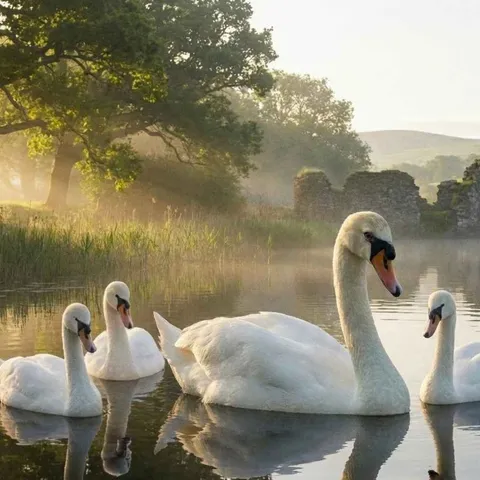
The four children of Lear, floating on the lake in the shape of swans, turned towards Aoife. Vanula spoke. It is an evil deed you have done, Aoife, it is an ill act of friendship to ruin us without cause. But you shall fall in revenge for this, for your power is not greater than our friends’. Please, for your sake as much as ours, tell us when you will end this curse.
It is worse for you to ask it of me, said Aoife, her voice hard. The curse will last until the women from the south and the men from the north are united. No friends will have the power to bring you out of these forms. Since you have asked me to declare it, here is your sentence. You shall spend three hundred years on Loch Darbuck, three hundred years upon the storm swept through Namweela, and three hundred years at Erisdownan and in the glory of Brendon.
Aoife then paused. Maybe a little sliver of doubt crept into her mind. Maybe it was too much to banish these children for nine hundred years, forced to live as beasts. Maybe she had gone too far. She shook her head and relented only slightly. Since I am not able to afford ye any other relief, she said, you shall retain your own speech and you shall sing plaintive music at which the men of the earth would sleep. And there shall be no music in the world its equal. You shall retain your own reason and dignity and you shall not be distressed by being in the shape of birds.
With that Aoife climbed onto her chariot and rode on to the home of Bob Dark, leaving the children of Lyre floating quietly on the dark waters. When she arrived at Bob Dark’s house, his first question was, of course, where are the children? You are not beloved by Lyre, she said, and he does not trust to send his children to you. He fears you would capture them. I wonder about that, Bob Dark said, eyeing Aoife closely, because these children are dearer to me than my own. He did not trust Aoife and so sent a messenger to Lyre.
And when the messenger arrived, Lyre looked rightly confused. What have you come for? he asked. For your children, the messenger responded. Is it that they have not reached you with Aoife? Lyre said, his brow furrowing. They have not, the messenger replied, and Aoife said that it was you that did not let them go with her. Melancholy and sorrow immediately took Lyre right then. He knew in his gut that Aoife had ruined or killed his children.
Early the next morning, his steeds were caught and Lyre set upon the road, galloping directly south-west towards Bob Dark’s house. But on the way, he reached the shores of Loch D’arbrek, and the children of Lyre saw their father and his retinue flying down the road. Vanula spoke up, started to sing. Welcome the cavalcade of steeds which I see hired by Loch D’arbrek, a company indeed powerful and mysterious, seeking us, following after us. Let us move to the shore, O aid, O fiocra and O comely con. No host under heaven can those horsemen be, but only Lyre and his household.
Lyre came to the water’s edge and heard these strange swans speaking with human voices. Who are you? How is it that you speak? he asked. Understand this, Lyre, son of Lugh, Vanula said. We are your four children who have been ruined by your wife and the sister of our own mother. No, no, surely not, Lyre said. Is it possible to put you into your own forms again? It is not, Vanula replied. When Lyre heard this, he shouted three times, once for grief, once as a loud cry, and once as a lamentation. Can you come ashore to us, he begged, since you have your own senses and memory? We have not the power, Vanula said, to associate with any person henceforth, but we have our own language, the Gaeilge, and we have the power to chant plaintive music, and it is quite sufficient to satisfy the whole human race to be listening to that music. So remain with us tonight, and we shall sing for you.
And so Lyre and his people remained on the banks of Lough Derbeck, listening to the music of the swans. Lyre slept soundly. That was the power of his children’s song. The next morning he woke up and recited this poem. It is time to depart from this place. I sleep not, though I lie down to sleep. Departing my beloved children is what embitters my heart. Evil was the fate by which I brought over you, Aoife, the daughter of Ulú Aran. Had I known what you have got by it, I would never have followed that advice. O Vanula and Con the Comely, O Aide and O Feochir of the beautiful weapons, from the verge of the shores upon which ye are, it is time yet for me to depart from you.
Lyre left with his retinue and travelled on to the home of Veldaric. When he arrived, the king shouted out to him. Good to see you, Lyre. You are very welcome. But I am annoyed. You haven’t brought your children. Where are they? Ah, it was not I that would not bring my children, Lyre cried. Aoife has turned them into the forms of four pure white swans.
Bob Darragh started at the news. Then he turned on Aoife, his voice shaking the hall. This treachery will be far worse for you, Aoife, than for the children of Lyre. They shall obtain relief towards the end of time and their souls will be in heaven at last. But you? What shape on earth do you think it is the worst to be? Aoife stared, shaken by Bob Darragh’s outburst. She whispered something to herself. Speak up, woman, Bob Darragh cried. A demon of the air, Aoife said. That would be the worst form.
No sooner than the words left her mouth did Bob Darragh strike her with his own druidical metamorphosing wand. She was transformed. For once the beautiful, if brutal, Aoife had stood. Now a dark and twisted thing hunched before them. We do not know exactly what a demon of the air would have looked like. But we can imagine it was horrific. Scaled and black, a winged shadow of a creature. As twisted and repulsive as Aoife’s own jealousy. With a flap of her leathery wings Aoife threw herself into the air and flew away. She is still a demon of the air and shall be forevermore.
With that we’ll leave our story there. Next episode we’ll explore why the Christian brothers latched onto the story and how it finally cemented itself as Ireland’s preeminent myth. Thanks for listening. Subscribe wherever you get your podcasts and if you’re enjoying it, give us a review on Apple Podcasts or tell your friends. It really helps. If you want to go further you can support the show, get ad-free listening and bonus content on our Patreon page. Simply follow the Patreon link in the show notes or visit our website thehistoryofireland.com. You can also get in touch through the website or on Facebook and Twitter. It’s always great hearing from you guys and if I’ve made a mistake please do let me know.
The History of Ireland was written and produced by me, Kevin Dalton, with music by Liam Doyle and additional help from Demon of the Airwaves Aoife Murphy. This podcast was recorded in the lands of the Wurundjeri people of the Kulin Nation. Sovereignty was never ceded.