Episodes Irish Mythology Season 3 — The Mythology
How the Tuatha Dé Evolved into Fairies
The old gods of Ireland never really died — they went under the hills, and people learned not to say their name. We follow the Tuatha Dé into folklore, where they become the fairies, the Sídhe, the Good People — and take the first step towards the changeling and the 1895 killing of Bridget Cleary.
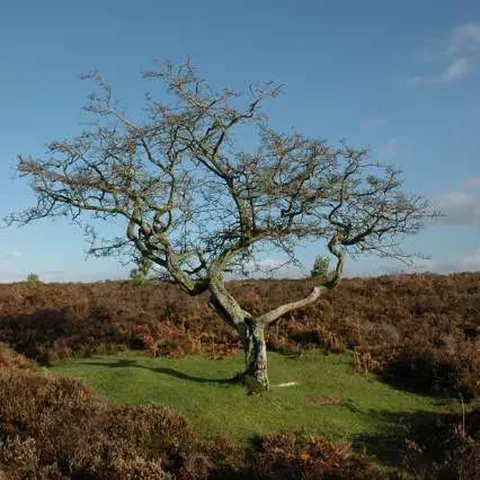
The episode cover image is a hawthorn tree, famously associated with fairies in Ireland. (Wikimedia Commons/Robin Somes)
Transcript
Welcome to the history of Ireland. Oh, it is good to hear that intro again. I know, I know, it seems I make some version of this apology every few years. But this one has been a far longer absence than I planned. So a very sincere sorry for that one.
The good news is that it’s been for good reasons. And there should be a lot less of this stop and start going forward. Some of it has been personal, some of it has been for the podcast. On the personal side, I’ve been moving back to Ireland and getting settled at home. Which took a fair bit longer than I’d hoped and has been the bulk of the delay. I still am not back in a proper studio, so we’ll just have to see how we go. But on the podcast side, now that I’m home, there’s a lot bubbling away behind the scenes. And I’ll have some very exciting announcements in the next few months. But you’ve waited long enough, so let’s get stuck in to today’s episode.
As we’ve seen over the centuries, the two-a-day developed in Irish literature. With monks, lily and writers adapting the stories across the centuries to fit their own needs. Today, I want to follow them off the edges of the manuscripts and into the mouths of ordinary people. Because that’s where they kept living. They shrank, they went under the hills and they picked up a new name. The good people. That’s the thread I want to pull on.
So, so far we’ve spent our time deep in the mythological cycle. That loose grouping of stories about the two-a-day. And there are three more cycles. The Fenian Cycle, the Ulster Cycle and the Cycles of Kings. But we’ll wait for another season in the future to come back to those. And it is worth saying that these are academic groupings. Tidy boxes invented long after the fact. Nobody sitting by a fire telling these stories would have recognised them as such. And before we leave the myths and get back to quote-unquote regular history, I want to spend the next couple of episodes on what became of the two-a-day. After the stories stopped being written down and kept being told. How they turned into the fairies of Irish folklore. And how that links back to everything we’ve covered. And next episode, how that belief could have genuinely chilling real-world consequences.
Now, folklore is a gorgeous thing to study and a nightmare to pin down. It’s a theme we keep hitting all season. But there’s no authentic original Irish myth waiting to be uncovered. And that goes double for folklore. It is by its very nature an oral tradition that leaves no paper trail. So almost everything we know about it reaches us second hand. And there’s a catch in who did the collecting.
In the 18th and 19th century, there was a huge appetite for gathering up folktales. And a lot of this work was done by Anglo-Irish Protestants. Why them? Well, partly because they were the class with the time and the money to go traipsing around the country writing books. But also because they had something to prove. They wanted to show that Irishness was more than just Catholicism. And that they had a claim on it as well. So you get the likes of Elizabeth Rawdon, William Wilde, Lady Gregory and WB Yeats either doing the collecting or bankrolling it. In fact, the folklorist Jemir Do Giollin in his book Locating Irish Folklore goes as far to argue that folklore and even the idea of the peasant was partly an invention of Romanticism and these antiquarians.
So picture the process. These collectors travel around interviewing the so-called peasant Irish, writing down what they hear, often tidying and reshaping it as they go. And then they publish it. Putting it right alongside polished translations of old literary tales of the Tuath Dé, which were also hugely unpopular at the time. Remember, we just looked at The Fate of the Children of Lyre and how that spread throughout the country. And then these printed versions got read back to the very people they came from. You can imagine how messy that all gets.
Good example of this is an American folklorist called Walter Evans Wentz who worked in Ireland at the start of the 1900s. And later became famous for translating the Tibetan Book of the Dead. In his 1911 study The Fairy Faith in Celtic Countries, he argued he’d uncovered the genuine ancient and Celtic fairy faith. But when you look at what he was doing, a lot of what he was recording is 19th century Romantic and Revival literature, being handed back to him as folk belief. So as always, if you came here expecting a clean line between the oral tradition and the literary one, well, there just isn’t one. The two have always been tangled together. Very messy and very Irish.
The best we can do is take the oral traditions of the early 18th and 19th century and try to get a feel for who the good people were said to be. So let’s do that, why don’t we? The fairies, the good people, the people of the she, were said to be magical creatures who lived in ring forts and burial rounds or in another version of the world that you reached through those.
One of my favourite descriptions comes from, of all people, Oscar Wilde’s mother. Lady Wilde was a respected collector in her own right. And in Ancient Legends, Mystic Charms and Superstitions of Ireland, she writes, But the fairies were sometimes willful and capricious as children and took dire revenge if anyone built over their fairy circles or looked at them when combing their long yellow hair in the sunshine or dancing in the woods or floating on the lakes. Death was the penalty to all who approached too near or pried too curiously into the mysteries of nature.
Now, and this loops straight back to Evan Wentz, as lovely as Lady Wilde is to read, she’s exactly the kind of source you have to handle with care. A lot of her material was gathered for her by others or drawn from her husband William’s notes and she’s writing as an Anglo-Irish literary romantic, not jotting down what people said word for word. She isn’t a clean window onto what people believed, but that’s sort of the point and it is a lovely passage and broadly true to what people held to be the case.
The tradition often explained the fairies as fallen angels, thrown out of heaven when Satan rebelled, but not damned along with him. The worst of them became demons, the ones with something redeemable left in them were allowed to go on living here on earth. Yeats put it best, repeating what the country people told him. He described them as fallen angels who were not good enough to be saved, nor bad enough to be lost. And that, people said, explained their nature. Sometimes kind, sometimes vicious, and it gels with the origin story of the Tuath Dé from the Book of Invasions. People who traveled north, studied magic, and returned to Ireland, the different species of magical creatures. And the fairies being a mix of kind and vindictive could be explained away by the fact that they are fallen angels, but it also rings true to what we know of the Tuath Dé. The Tuath Dé were characters with all the foibles of humans. Some, like the Dagda, were generally kind, others, like Midr, were very cruel. So you can start to see that the Tuath Dé and fairies hold a hell of a lot in common.
But the tightest link of all is where and how they lived. The folklorist Simon Young, who co-wrote Magical Folk, British and Irish Fairies, puts it like this. Here they lived a strange existence, mirroring those of human beings. They were born, they married, they feasted, and in some cases they died, though Irish tradition is unclear as to whether the fairies were mortal or not. The exuberant underground kingdoms of the Shí sometimes spilled out into the human world. Passerbys, especially at night, would hear music and dance, or even the thwack of a football as the fairies entertained themselves. And that’s the Tuath Dé almost exactly. Powerful beings living in the other half of Ireland, coming and going as they please. And those underground kingdoms weren’t just a turn of phrase, we know this. The fairy forts nobody would dare disturb were real things sitting out in the fields, ring forts, wraths, and old burial mounds.
So why were they called the good people? Well, that’s kind of the heart of it. For all that the fairies were described in such loving detail, their music, the dancing, the long yellow hair, there was one thing you never did. You didn’t call them fairies. Not out loud, not if you have any sense, which I clearly don’t. They weren’t named, they were talked about. The good people, the gentry, the fair folk, the wee folk, the good men, the fair folk, the wee folk, the good neighbours. Every one of them is a euphemism, and a flattering one. You call them good in the hope they live up to it.
And this is wild conjecture on my part, but you could imagine how ancient gods were not discussed other than in euphemism in a country that became Christianised. It wasn’t on to talk about these pagan deities, but it felt dangerous to totally ignore them. And this is where the thread back to the Tuath Dé pulls tight. Think about where we started this whole mythological season. These were gods who could no longer be written as gods, recast by Christian scribes as a clever race of invaders, driven underground after humans defeated them. And over the centuries, these gods, these characters, people like the Dagda, Lug, Midr, the great figures of the mythological cycle, slowly stopped being spoken of as gods, then stopped being named outside the stories, until what was left was a nameless, powerful, dangerous people under the hills that you were careful to flatter, and careful never to cross.
That’s essentially what the scholar Mark Williams argues, as we’ve discussed, that she, in his words, became a discreet way to signal the divinity of original non-Christian figures without directly describing them as gods. And though it’s too simple to say pagan beliefs lived on through folklore, it’s also not bare to speak of the stories of fairies as nothing more than stories told around the campfire. There is real proof that people really did believe in all of this, and it was intrinsically linked to the land, to the she, just like the two a day.
And of course, some people did dismiss it as nonsense, sure, but for plenty of others, it was a real working system of belief, and it did a real job. It carried hard-won knowledge about herbal medicine. It gave people a way to bear the loss of a child. It explained the unexplainable in a world that had very little else to offer. But it could go horribly wrong. The darkest edge of the whole thing was the changeling, the idea that the good people could spirit away a person and leave one of their own in bed in their place. And this wasn’t just children, it could be a new mother, a young woman, anyone who suddenly seemed different or not themselves.
Next episode, we’ll see that the good people weren’t just stories you told around the pub, but sometimes became something you acted on. We’ll go to County Tipperary to the year 1895 and the killing of Bridget Cleary, a grown woman who burned to death in her own home as the people who loved her became convinced she was a fairy. But that is for next time.
on Facebook and Twitter. It’s always great hearing from you guys. And if I’ve made a mistake, please do let me know. The History of Ireland was written and produced by me, Kevin Doyle, with music by Liam Doyle and additional help from assistant producer Aoife Murphy. This podcast was recorded in the lands of the Wurundjeri people of the Kulin Nation. Sovereignty was never ceded.