Episodes Irish Mythology Season 3 — The Mythology
The Children of Lír in the Classroom
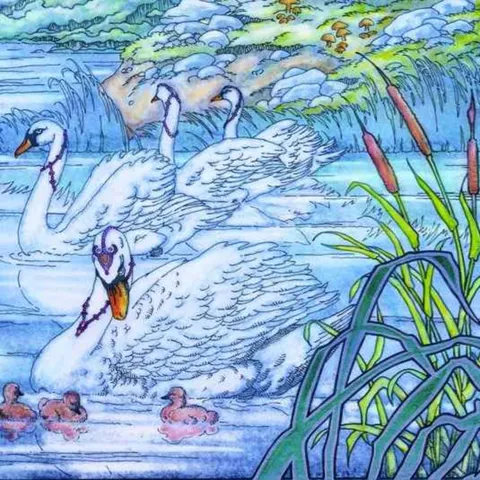
In today's episode we finish off the last section of The Fate of the Children of Lír and explore how really it was the Christian Brothers who cemented it in the Irish psyche.
Transcript
Welcome to the History of Ireland. Last episode we followed the evolution of the fate of the Children of Lír over the 19th century. From the famous song O Moil to Eugene O’Curry’s academic translation. But there were still a few more steps for this story to take before it became ubiquitous.
Next in line to bring the story to life was a teacher from Nimic named P.W. Joyce. No relation to James. In 1856 he was one of a select group of teachers brought to Dublin to reorganise the central training college for teachers. And he went on to become hugely influential on the Irish curriculum. And what does that have to do with Children of Lír? Well in 1879 he wrote a collection of stories called Old Celtic Romances. These were one of the first easily understandable Irish stories. Written not as a song or an academic translation but as Victorian fairy tales. This coincided, in a manner that I can’t imagine was a coincidence, with the Intermediate Education Act of 1878 which allowed Celtic materials to be taught in school.
Now as we know some of the Irish myths would say that Dagda bedding goddesses in rivers or psychopaths murdering their way through the Mediterranean might not have been especially suitable for a 19th century school. And maybe didn’t paint the refined noble picture of Ireland that the nationalists were after. But Children of Lír? It was about a familial love. It had a strong caring father figure at the centre. There was no sex. It was also about children condemned to 900 years of suffering but would someday be saved thanks to their faith. You couldn’t really ask for a more perfect Catholic nationalist Irish allegory. It was ideal for schools.
Enter the Christian Brothers. The Christian Brothers were a religious order founded by Edmund Rice who basically taught a huge majority of the Irish male population right up to the 90s. Yours truly attended a Christian Brothers school. And the Christian Brothers loved the fate of the Children of Lír. They latched onto the story and taught it not quite as a fairy tale but almost as a pseudo-history. Note how very religious the section I’ll tell today is. Way more than anything else we’ve looked at to date. You can see why the Christian Brothers were so happy to teach it. Plus there was the whole 800 years of Irish oppression, 900 years of suffering that was mirrored together and became a beautiful little metaphor for Irish nationalism. And the children as you’ll see are saved by their faith which the Christian Brothers loved. And so by spreading it across schools it made the story intensely popular and well known. And arguably it was this that really cemented it in Irish popular culture.
There is so much more you could say about the Children of Lír. The literary giants of the revival Lady Augusta Gregory and Douglas Hyde both wrote magnificent versions of the tale. But their work belongs to a different part of this history, the artistic revival, which we will cover in a future episode. For today it’s just important to see how the story reached the classroom and it was from there that it took over the country. So keep all of that in mind as we tell the last section of the fate of the Children of Lír. Here goes.
After Bob Darroch had turned Aoife into a demon of the air he and his men decided to visit the Children of Lír at the shores of Loch Darroch. A camp was set up and soon people from all over Ireland gathered there to hear the music of the swans. For a while it was as close to a happy existence as the Children of Lír could have hoped for. By day they told stories and chatted with people, learning from tutors and students who sat by the water’s edge. By night they sang sweet fairy music, so beautiful that anyone who heard it would sleep soundly, no matter what grief, disease or illness plagued them. For three hundred years the Children of Lír lived on those shores, singing to the Tuath Dé and the Gaels alike.
The time, even for magical swans, eventually runs out. One day Fionnuala turned to her brothers. Do you know, youths? she asked, that we have just one night left here. When the brothers heard this a great sorrow seized them. Living at late Darroch, surrounded by friends, was almost like being human again. But now the terms of the curse demanded they fly to the angry quarrelsome sea Shrutnamoyle in the north, the treacherous stretch of water between Ireland and Scotland.
They spent one last night with their friends and then bid them all farewell. Fionnuala sang a song of parting, a lament for the life they were leaving behind. Farewell, O Bob Darroch, the man whom all science has done homage. Farewell to our father, Lír the Sheave Fionnuala. The time has come for us to separate. We shall go from here to be punished upon the raging Shrutnamoyle. Our beautiful garments shall be nothing but the waves of salt water. As the four comely children of Lír, sorrowful now is our separation. With that the four swans took to the air, flying high and light towards the north. The people of Ireland grieved then and declared that throughout the country no swan should be killed.
Now the north of the Irish Sea was a terrible home. The children were filled with cold, grief and regret as they suffered upon the currents. One night a thick tempest came upon them. Fionnuala shouted as the storm gathered. My beloved brothers, it is certain this storm will separate us. Where will we meet if it happens? Let us settle, the brothers called back, at the meeting place of Carragneron, the Rock of Seals.
Then as darkness descended and midnight came, the wind came with it. The waves increased their violence. Thunder cracked and lightning flashed. Imagine the sight. Four tiny white swans sitting atop waves the size of mountains. The storm was brutal. Maybe one brother was blown high into the gale. Maybe another was dragged under the surf. By morning the children of Lír were scattered and lost.
When the sea finally calmed, Fionnuala was alone upon the current. She sat on Carragneron, looking out at the grey, empty water, and sang of her despair. In my condition it is a woe to be alive. My wings have frozen to my sides. It is little that the furious wind has not shattered my heart and my body after taking me from a Woe to this night in my condition. But Fionnuala kept her vigil. And after some time she saw a con And after some time she saw a con floating towards her. His head heavy and his feathers drenched. Then came Fionnuala, cold and wet, and so faint they could not understand him when he spoke. Fionnuala took them both under her wings, trying to warn them with her body. Finally, A arrived. Somehow, his feathers were dry and beautiful. He settled underneath Fionnuala’s breast, and the family was whole again. If you thought that night was bad, she whispered to them. Many of its like are ahead of us.
And she was right. The children of Lyr spent three hundred years being blown across the cold and wretchedness of the Marl. One night, one January, it was so cold that children’s feathers and their feet froze to the rocks so they could not move from the spot. Fionnuala cried out, Evil is this existence, the colds of this night, the greatness of this snow, the hardness of this wind. Where they have lain together is under my graceful wings, the waves beating violently upon us. Con uncomely feocre, our stepmother has put us, these four of us, this night, into this misery. Evil is this existence.
Eventually, they tore themselves from the frozen rock, but the cost was terrible. The very skin was ripped from their feet and their feathers torn from their wings. Imagine the agony. Raw, skinless flesh forced to float in freezing salt water. The salt stung their wounds, the cold cut through their featherless bodies. The children suffered mightily.
It is fine summer spite each day they would fly to either the coast of Ireland or Scotland and shelter on the land. But every night, as was their curse, they were forced to return to the sea. One day, while resting on the shore, the bedaggled siblings met a splendid cavalcade of riders, all dressed in pure white. Do we know these men? Fionnuala asked. No, we don’t, her brothers replied. They are probably some group of gale, or the two a day. The horsemen rode towards them. Their leaders introduced themselves as Aya Hishock, the quick-witted, and Fergus Fickalock of the Chess, both sons of Bob Darragh. They had been searching for the swans for a long, long time.
How is Bob Darragh and our father, the children asked, desperate for news? They are well. All in one place are your father’s sheep. They live happily, without fatigue or uneasiness, except for the sadness of your absence. We miss them too, on the shores of Loch D’Arbuck, said Fionnuala. For much evil and suffering and misery we have endured on the tide of the current of the mile to this day. The riders returned to Lear with the news, but the swans could not follow. Their time on the mile was done, but the curse was not.
They moved on to the point of Irisdáin in the west. There they stayed another three hundred years, suffering cold and a life of chilling. During this time, the text tells us they met a young man from a good family who loved their singing. He wrote down their adventures, and it is thanks to him that we know this tale at all.
It was also here, in the depths of their suffering, that the children of Lear found God. On one especially frozen night, Fionnuala turned to her brothers. My brothers, believe in the splendid God of truth, who made heaven with its clouds, and earth with its fruits, and the sea with its wonders, and ye shall receive help and full relief from the Lord. We do believe, they replied, and I believe with you, said Fionnuala, and the true God, perfect, truly intelligent. Neither tempest nor bad weather affected them from that time out.
Finally, after three hundred years at Irisdáin, nine hundred years since they had left home, the children of Lear were free to return to their father’s house. They flew as fast as their wings could carry them to Lear’s Shea. The nine centuries is a long time. When they landed, all they found was an empty deserted hill. There were no halls, no music, no father. Nothing but unroofed green mounds and forests of nettles. Without a house, without a fire, without a residence, the poor swans huddled together in the ruins of their childhood home and wept.
The next day they arose early in the morning and headed to Inys Glór of Brindán, and all the birds in the country followed them until they landed upon a lake that became known as the Lake of Birds. Now, in and around 680, a man by the name of MacCreefogh came to Ireland. He founded a monastery in Leithmoor, County Tipperary, but one day was travelling through Mayo where the children were living. He stayed on an island at the Lake of Birds, and in the morning the children heard him ring his bell for morning prayer. For some reason, this bell filled the brothers with terror. They started and leapt around, their wings flapping, their feathers flying everywhere, honking in fear. What is it, brothers? Vanilla asked. We know not what a faint and fearful voice we have heard. That is the bell of MacCreefogh, she said, calming them. And it is that bell that will liberate you from pain.
The swans listened until the prayers were finished, and then they responded with their own song. MacCreefogh, hearing this unearthly music, prayed to God to reveal who was singing. The next day he went to the lake. Are ye the children of Lear, he said? We are indeed, they replied. I am God, he said. It is for your sake I have come to this island above all others in Ireland. Put your trust in me, and I will separate you from your sins.
The children of Lear did just that and went home with the saint. They lived with him, attending Mass and living in peace. And to show his affection, MacCreefogh made chains of bright white silver for them, linking A to Fanula and Con to Feagra, keeping them safe and together.
Now at this time, the king of Connacht was Lag Nen, son of Colman. He was married to Diuk, the daughter of the king of Munster. Diuk had heard of these swans and became filled with affection and love for them. She told her husband she would not spend a single night longer with him unless he got her those birds. Lag Nen, furious and henpecked, sent messages to the saint asking for the children of Lear to be delivered to him. MacCreefogh refused.
A great anger seized the king. He rushed across the country to the church, bursting through the doors to find the saint at prayer and the swans sitting on the altar. Is it true you will refuse me these birds, Lag Nen shouted, barrelling down the aisle? It is indeed, MacCreefogh replied, calmly, almost saintly, some would say. Lag Nen would not take no for an answer. He grasped the children of Lear by their long white necks, two birds in each hand, and ripped them from the altar.
But as soon as Lag Nen laid his hands on the birds, their feathery coats fell off them to reveal three withered, bony old men and a lean, withered old woman without blood or flesh. Lag Nen started. He screamed and ran from the church. Vanula, no longer a beautiful, pure white swan, but now a withered old woman, turned to MacCreefogh. Come, baptise us, O cleric, for our death is near. Be certain that you do not think it worse to part from us than we think it is to part from you.
And so MacCreefogh baptised the children of Lear and moments later they died. They were buried, as Vanula asked, with Conn to her left, Veika to her right, and Ae before her face. A stone was raised over them and their names were written in Om. And they were keened there and heaven was gained for their souls.
And that is the fate of the children of Lear so far. Just one small note before we go. How interesting is that so far? It’s in the original text and I think it’s great. It’s a real sign of the Christian writers. The children of Lear had gone to heaven, they had died. This was not the end of their story though. It’s really just an interesting little point that underlines the worldview and the belief of the writer. Next episode, we’ll move into the Fenian cycle and tell another very famous Irish myth.
Thanks for listening. Subscribe wherever you get your podcasts and if you’re enjoying it, give us a review on Apple Podcasts or tell your friends. It really helps. If you want to go further, you can support the show, get ad-free listening and bonus content on our Patreon page. Simply follow the Patreon link in the show notes or visit our website thehistoryofireland.com You can also get in touch through the website or on Facebook and Twitter. It’s always great hearing from you guys. And if I’ve made a mistake, please do let me know.
The History of Ireland was written and produced by me, Kevin Dolan, with music by Liam Doyle and additional help from assistant producer Aoife Murphy. This podcast was recorded in the lands of the Wurundjeri people of the Kulin Nation. Sovereignty was never ceded.