Interview – The Diaries of Michael Collins with Anne Dolan & Will Murphy
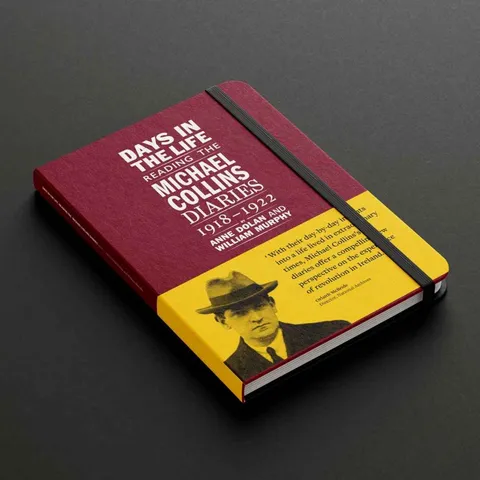
Today on the centenary of the death of Michael Collins I'm sharing excerpts from an interview with Anne Dolan and Will Murphy authors of Michael Collins: The Man & The Revolution and Days in the Life, Reading the Michael Collins Diaries 1918-1922. Reading the Michael Collins Diaries just came out last week and it was fascinating to unpack what Anne and Will learned while putting the new book together.
Subscribe to Patreon to listen to the full episode. Enjoy!
Transcript
Welcome to the History of Ireland. Now, I’m sure you’ll have heard it all over the news and whatnot, but today is the 100 year anniversary of the death of Michael Collins. We haven’t quite got there in the show just yet, but I did want to mark the centenary with an interview I did with Anne Dolan and Will Murphy, authors of several great books on Michael Collins. What I love about Anne and Will as historians and authors is their ability to strip away the myth around Collins and get a really unique insight into what he must have been like as a man. During times of commemoration, when it feels easy to mythologize, I think this forensic and balanced look is really important. The full interview is available to Patreon subscribers and it’s really a lot of fun. We look at how London made Collins, the influence of the IRB, his relationship with his sister, and how a young clerk, well, helped create a country. Here’s a snippet for you to enjoy.
The new book has come out of the occasion of the Collins family donating diaries that they have of Michael Collins to the National Archives. And National Archives contacted us because of the book you talked about, Collins, the Man in the Revolution, and said, would you write something for us introducing the diaries and helping to contextualize them for people? So that’s what we’ve tried to do. And I suppose they need a little bit of contextualizing because I’ve described them as diaries, but in many ways what they are are, you know, working appointment books. And a lot of the entries consist of two or three word entries. They’re not long, reflective entries where Collins is reflecting on his life. So they’re two or three word entries about a meeting he has to get to or about an appointment he has to keep or a job he has to do. And very often he’s recording of the two or three words, at least one of them, maybe two of them might be abbreviations.
So what we’ve had to try and do, first of all, is try and contextualize the entries and figure out what they mean. And we’ve relied heavily on our knowledge of Collins and of the revolution to do that. And then we’ve tried to pick out some patterns across his life that we can discern then. Once we figured out, I suppose, what most of the entries, at least, we think meant, then trying to try and put some shape on what they might tell us about Collins’ life and career and also what they might tell us about the revolution. So it’s built on the previous book. And in some ways, it’s a wrestle between myself and Anne wrestling with a source and then also trying to add to what we know about the life through wrestling with the source.
Amazing. And I love that idea of wrestling with a source. Was it exciting to get your hands on this new set of sources and look through it? Did you learn anything new about the man through the diary?
Yeah, I think it was really exciting to see them. I’d gone up to see them for the first time and the boxes opening up and seeing these little tiny little books and then opening them up and seeing, as Will said, there’s just words and random words and unstructured words. And I thought, OK, what do we do now? I think we think of Collins as someone who, through so much of, if you like, the sources we have him to date, they’re very much about him imposing order on things, him writing memos that are very structured. And here are these completely unstructured diaries, if you like, that were personal to him alone. They were just written for himself. We weren’t meant to understand them. We weren’t meant to see them. And I think in some ways you have this odd situation where they bring us closer to him. But at the same time, he doesn’t make it easy either.
This is another challenge. We had that impression that this is an incredibly busy person. But when you see it, you just turn those pages on a day-to-day basis. You almost see the hours blocked out. You get the sense, bloody hell, this is someone who worked incredibly hard. But also just the pace at which that life was being lived. There’s a huge amount being condensed into those five diaries that we have in front of us. And I think that was really exciting.
I think once, as historians, as Will said, you’re expecting diaries to be these reflective long entries where he finally tells us what he thinks. In a way, what we’ve got is something much more, I suppose, challenging and leaves us with questions to ask for another few decades, I think, rather than giving us the answer in a neat and tidy way. So I think we’ve got lots to think about, really.
And I imagine it feels very typical of Collins to be providing you with more questions rather than answers. It may be an odd way to put it, but almost in real time, this development of this individual through these different organisations and through the revolution itself. And I don’t know, we were struck by this idea almost of, like we mentioned in the book, this idea of the diaries almost have this feeling of you’re watching a newsreel, but suddenly it’s really fast and suddenly it’s really slow. Because I think when you read about the revolution and you write about the revolution, you move from one big event to the next, you get the sense it’s a really fast paced time.
And yeah, in many ways it is. But in a way, moving through these diaries, page after page, day after day, you just get the sense of how the steady, slow grind of it all, the amount of work that went into it, and not just for Collins, presumably, for lots of the people around him, and particularly for the people who had to answer some of his quite snippy memos about do more, get more done. You know, so there’s just that sense of the grind of the work, which I think maybe we don’t think about so much when you’re moving from one key date to the next key date, if you like. And I think that, for me, that was a real eye-opener, if you like.
And one of the things about them in that regard is that they conclude things which are utterly mundane and which we don’t usually attach importance to. And there are no reference to things which we might think are absolutely key and essential. So he doesn’t mention that all has passed the treaty, or he doesn’t mention he signed the Craig Collins Pact, or whatever, things like that. He does mention that he needs to buy underpants, or that he needs to go to the dentist. So in that sense, you know, you’re just coming into the life through a different lens, one of the things it does for you. In this kind of diary, it shouldn’t surprise us that I suppose he’s not mentioning that the treaty has been passed today, or whatever. It wasn’t something he was going to say.
London, I think, transforms, it looks like it transforms a nationalism into a radical nationalism. And then the other thing it does, it’s that really modern city, and he’s very aware of the British press, for instance, and how they respond to radicals. He’s aware of the impact that sensation has inside the popular press. He’s seeing what the effects of the suffragette campaign and Indian nationalists or anarchists have in London in the period he’s there, and how they attract attention. And so when he comes home, he brings certain awareness of British attitudes and what London is like, but also he brings home that changed, that set of contacts and a changed perspective about his own nationalism. That’s what I think.
I love the idea that it was London that both shaped that nationalism, but also gave him a lot of the skills that he would go on to use in the fighting and the organisation of the movement. It’s fascinating that one of Collins’, I don’t know how you want to define him, but Greatest Revolutionaries was forged by his time in London. And so I’d love to hear what you think about that time in London working and how that shaped the organisational side of Collins, which was so important.
Yeah, I think, again, it’s one of those parts of his life that have been underestimated. I think it’s been talked about in terms of some of those connections he made, and as Will just mentioned, meeting some of those people joining those various different organisations. But just the Londonness of London has been kind of left out of our thinking about it, if that makes sense. And just in terms of even just the cultural influences on him. As Will said, yeah, he’s reading the kind of typical things that you would expect young Irish nationalists to be reading, but he’s also reading much further beyond that. He’s going to the theatre. He loves JM Barrie. He loves Shaw. He’s fully engaged with that world of London where you can go to so many different plays every night.
He’s doing all those things. But he’s, as you say, he’s also learning to be a very good clerk. He’s learning to be someone who can write and write until the end of the day and beyond. And that is probably the thing that sets him apart, as Will said. He’s one of many nationalists who’s shaped in a very particular way, but he’s the one who becomes Michael Collins. And I think that the sort of voracious appetite for work, there’s something about how he’s trained in that period as a worker within this great big organisation of the post office in London, must have had an effect in shaping that, just that appetite for work and writing letters and taking on jobs that nobody else wants to do.
And I think, as Will mentioned, just that association with the GAA and even within the GAA, he took on a job like a secretary. He was the secretary of the GAA club in London that nobody else, people don’t necessarily want to be the secretary of the club, but yet the secretary of the club is the important person. So there’s that side of it. But I think there’s also those other cultural influences of London that I think you see coming out in his thinking later on, which maybe others aren’t as quick to pick up on.
And I was really struck by a piece he wrote in 22 to Desmond Fitzgerald, who’s then director of publicity, when he’s saying to him, you know, we should make films. We need to make five or six films about Ireland. And these are the things that films should be about, because nearly every small town in Ireland now has a cinema and we need to take advantage of that. That’s what they’re doing in Germany. He’s looking out, he’s looking outwards, he’s picking up influences from all over the place. He’s quite happy to use them in all sorts of different ways. But I think we have for a long time underestimated how much just being a young man in London, never mind the nationalism, never mind all those things, but just being in London across those years must have had an enormous effect on shaping who he was and how he taught and all those things.
And that, I think, leads to a great question and a big question and one that you, in your first book, almost, I think, put together a whole chapter on, is with a lot of these figures, we know they wanted Irish freedom. What do they want after that? Do we have any idea of what was his vague beliefs? Was he left wing? Was he right wing? Was he, where did he sit and what did he want?
It’s not so easy to come to definitive conclusions on this because he was not, he wrote an awful lot of letters, as we’ve said a number of times now, but a lot of the time they were about getting the immediate job done. So he tended not to produce long, reflective pieces of writing, laying out his vision of the world. And he does so a little bit more because he has to in the context of defending the treaty. And he has to make an argument for the kind of state he thinks can be created in the concept of accepting the treaty. And a lot of the things he’s saying are all very similar. This is the other thing, putting Collins back in perspective, they’re very similar to things that his colleagues are saying.
As you say, he firmly believes in Irish nationalism. He believes in the creation of the right of the Irish people to an independent state. He thinks the nation resides in some sort of mystical spirit, the sort of classic romantic nationalist idea of the 19th century. He looks around a lot of the time and he doesn’t see what he thinks is a sort of, how does he put it, he thinks like the spirit lives, but it is battered, bruised and that’s this kind of thing. It’s not immediately apparent that it’s in robust health. He sees far too much of a culture that looks like an English culture. These are typical rhetorical tropes at the time.
What does he believe in? Language revival. He believes in, it seems he believes in, quite like de Valera, when he sees his ideal Ireland, he sees a version of his own upbringing, or at least a somewhat improved version of his own upbringing maybe, where you have the medium sized small farmers, the heart of the country and they’re living in reasonable comfort on these small farms. The term he uses are fair comfort or moderate luxury, which are not that far away from de Valera’s frugal comfort in some ways. He says he doesn’t believe in unrestrained capitalism, but he’s certainly not a socialist. You get a sense that perhaps cooperativism is something that he sees as having lots and lots of potential going forward in the country. He very much has a sense that the resources of the country can be better utilised or managed or developed. So he’s interested in, for instance, hydroelectric power. You can see that does play out in the early years of the state and is developed. But again, some of the language of Griffith about protectionism and tillage, all that kind of thing seems to be there.
And I suppose one of the other areas where he clearly, you can see a clear commitment is towards unification in the long term. He’s very, very committed to the end of Northern Ireland. Yeah, I think he’s, as you say, he’s quite typical in his sort of incomprehension of Northern Unionism, as many of his colleagues do. He’s very much cut from the same class as many of his contemporaries.
And I think it’s back to something you raised earlier, that early death, the fact that he doesn’t, as Will says, write a huge, great tome about what his vision of a free Ireland would look like. But it gives us that opportunity to effectively read whatever we want onto him. We can say he would have done all sorts. I think at times over the, certainly over the last few decades, we have this sense of him as this lost moderniser who would have made an ideal Ireland, depending on your own preferred ideal. And I think that’s slightly problematic, because if you do look at what he was saying in 1922 after the treaty was signed, as Will says, they’re very familiar ideas. There are ideas that at times, if you read Blind and you said, who said that? De Valera Collins. You’d actually struggle to distinguish one from the other. So it’s, I think we sometimes quite willingly take him out of context and just present him as a champion of whatever cause we happen to favour ourselves because he leaves that gap for us to do that.
But I think there’s a, there’s an element as well. The treaty is really that moment where all those words, as you say, freedom, independence, republic. That’s what’s fascinating. There’s this piece of paper that suddenly says, what do you in your own head understand by those words? That’s why it’s such a fascinating moment. They have to suddenly decide. I’ve been saying these things for years. What do they actually mean? How do we put them into practice? Are we content with this much compromise or that much compromise? So it’s a fascinating moment. And in a way, he’s having to deal with that, that confrontation with what he means himself by those things. And those, so those speeches after the treaty sign are in many ways really fascinating and quite revealing and obviously pushing towards getting the result he wanted on the treaty itself. But it does suggest how his own ideas are formed.
Put a gun to your head and ask one thing. What do you think is the biggest misconception we as a public have of Collins? Two that rival each other. One, the image of him in the uniform. This idea, and Griffith is responsible for it as much as anyone, but this idea of he says in the treaty debate, he’s the man who won the war. I think we think of him as being Michael Collins’ fighting story. He’s responsible for every ambush. He’s responsible for everything that happens. And I think that the Diaries, again, really rammed it home for me, just the degree to which he’s a man at a desk in a suit. He’s most comfortable in that position. Yes, that has ramifications in terms of the amount of money that’s raised by guns. It has implications, yes, all over the country. But he is not in charge of everything. He’s not responsible for everything. He’s very much part of a wider team. He’s a very important part of it, but he is part of a wider team.
And I think, again, that leads to my second one, which is that idea that things can’t go on without him. Thinking back to that Hayes quote, they do replace him quickly. They do change some of his decisions quickly. I think, yeah, I think that idea of him as being this very exceptional figure and the man who won the war, I think that’s my biggest one, at least because he’s so many other things. It really undersells just how far and wide his reach actually was.
Yeah, I don’t, I just want to emphasise those again, to say that it’s one of the things that’s interesting when you start writing Michael Collins’ books, as we’ve now done too, I can’t believe it, and you start talking to people about how do we promote this book and what image of the book do you want to project? And very often the thing is, well, obviously you want to photograph him in a uniform in the front, don’t you? And we found ourselves saying, actually, that’s the exact opposite of what we want. You know what I mean? But it’s very, it’s very difficult because it’s understandable entirely why that’s the image that’s being chosen for the front, because that is immediate. I think that’s overwhelmingly how he’s perceived. It’s the most recognisable form of Michael Collins.
Despite the fact it’s probably a Michael Collins, he wouldn’t have recognised himself for much of his. Now it’s one he’s very busily involved in projecting and creating in early 1922, when he wants to start to project himself, if not the father of the nation, then the uniformed uncle of the nation. Do you know what I mean? There’s a particular kind of leadership and reassurance I think he’s seeking to offer through that uniformed image. Then, and I suppose it’s the last image he left behind, but it has dominated for too long. And the case of the moustached accountant behind the desk is maybe not as exciting as an image, but it’s probably a little bit closer to the truth.
What do you think, after reading his diaries, after delving into it all, what do you think of the man? I haven’t come to like him more or less. I haven’t stopped being interested in him. Let’s put it like that. I think I’d agree if you just look at it coldly, on the basis of, even just thinking of the diaries, you start the first of January 1918 with this person who’s a clerk in a very particular organisation that is, as Will said earlier, isn’t that well known, is working his way up. By the end of it, he is the head of a provisional government of what’s going to be a new state. That’s a hell of an achievement, whether you think we agree with his message or you don’t agree with his message.
We’ll leave it there, but the full interview is over an hour. So if you’re interested, sign up to Patreon at thehistoryofireland.com. You’ll get early access to episodes and more interviews like this one. There’s a great one with Colm Kenny and Arthur Griffith up there as well. New episode will be up next week.
Thanks for listening. Subscribe wherever you get your podcasts, and if you’re enjoying it, give us a review on Apple Podcasts or tell your friends. It really helps. If you want to go further, you can support the show, get ad-free listening and bonus content on our Patreon page. Simply follow the Patreon link in the show notes or visit our website, thehistoryofireland.com. You can also get in touch through the website or on Facebook and Twitter. It’s always great hearing from you guys, and if I’ve made a mistake, please do let me know.
The History of Ireland was written and produced by me, Kevin Doyle, with music by Liam Doyle, and additional help from assistant producer Aoife Murphy.