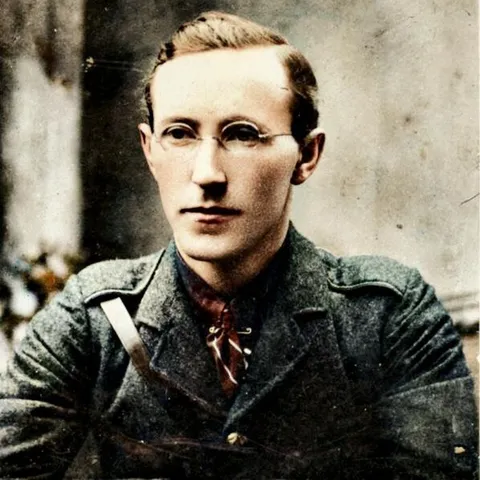
Interview – The Lives of Liam Lynch & Rory O'Conner with Gerard Shannon
Transcript
I bring you a message today from the people of Ireland. The Irish desire peace with England and with the rest of the world. It is a question of a republic. And we want the creation of a new Ireland. I wish to talk to you this evening about the state of the nation’s affairs. I wish to talk to you this evening about the… Hello, hello.
I’m here to share another snippet from a Patreon interview. This time with historian Gerard Shannon. Discussing the life and times of Liam Lynch and Rory O’Connor. Super relevant to where we are in our timeline on the podcast. As ever, the whole hour-long episode is available for Patreon subscribers. And it is a treat, I really had fun with this one. Thank you so much to everyone who has subscribed so far. Subscribing really helps support the show and allows me to do more interviews like this. You can join Patreon at patreon.com forward slash the history of Ireland. Here we’ll dive into the interview where Gerard talks about the early life of Liam Lynch. Enjoy.
Liam Lynch was actually a huge supporter of Home Rule prior to 1916. He’s a very vocal supporter of the Irish Parliamentary Party and Home Rule. He actually joins the National Volunteers when there’s a split in the volunteer movement. But 1916 of course changes that. Like Lynch said to contemporaries at the time, I was a nationalist until I saw Thomas Kent and his brothers being led through the streets of Formoy after their arrest. And you would have known of course that Thomas Kent was later executed. And this is what completely radicalised them.
So by the time the Formoy Volunteers is reformed in 1917, Lynch signs up. He very quickly becomes First Lieutenant. He becomes one of the most admired volunteer leaders in the area. And it’s in November 1917, he writes in a letter to his youngest brother Tom, probably his closest personal confidant, the very famous line that we all associate with him. We have declared for an Irish Republic and we will not live under any other law. And this is often cited as some sort of statement he made at the Civil War. It was a private comment he made to his brother Tom. It wasn’t really revealed or came as a kind of popular lexicon, shall we say, under the publication of Fleury O’Donoghue’s biography of Lynch in 1954.
But at the time of the War of Independence, actually just prior to it, Lynch becomes Head of the Cork No. 2 Brigade, so encompassing much of North Cork, one of the three Cork Brigades. He would become a very much respected figure within Cork at the time, particularly following the Conscription Crisis. So with the outbreak of the War of Independence, Lynch oversaw some of the most provital actions, or approved some of the most provital actions. He seems like he had a really instinctive mind for that guerrilla conflict, and was one of the leading figures in the flying column movement.
Did he have any experience? No, that’s generally one of the most extraordinary things about him, that he didn’t have that guerrilla or soldier experience prior to joining the Volunteers. He was very devoted to it. Like after the For My Arms raid, he goes on the run. He’s full-time active service, as they probably would have said later on. And even prior to 1919, he would have got to know the brigade area. He would have got to know the men. He would have met them all in the local companies, picked their brains for different ideas, heard their opinions, listened very carefully to them. And this would have gained the respect of the men as well. And one thing you would have to credit Lynch as a military leader in this period is that he never asked his men to do anything he wasn’t willing to do himself.
I wanted to ask, as one of the most influential leaders outside of Dublin, as you say, he goes anti-treaty. He doesn’t side with the likes of Collins and the rest. Do we have an inkling as to why? Do we know what his politics were like?
You can read the letters he wrote to his youngest brother, Tom, in the period. They’re all digitised up on the National Library of Ireland website. And you can see from September 1921, where Devler’s initial negotiations with Lloyd George began, Lynch was sceptical. Lynch always had a very strong scepticism of the political side of the revolutionary movement. Even Fleury O’Donoghue, who was a very sympathetic first biographer, and it is still a great book that Fleury wrote, but he even says in the book that Lynch lacked the political temperament to be a politician.
But Lynch essentially says to Mulcahy, we have to accept that the political wing of the movement was not helpful to us, the IRA, during the War of Independence. And he’s very scathing of Dáil Éireann and the Dáil Corsais one. Now I think, to be honest, it’s a bit of an unfair kind of opinion on Lynch. It wasn’t unique to an IRA leader that they disdain for the politicians and political activists. But it’s a bit problematic when he’s one of the most prominent IRA leaders, that he has this disdain for the use of political activity. Political activity that built Dáil Éireann up, built up the underground institutions, kept them going during the War of Independence.
So I think when the treaty essentially comes in December 1921, he’s immediately opposed to it. He’s immediately opposed to it because he sees it as a betrayal of the Republic. He can see the correspondence to his brother Tom. You can see even Lynch is trying to convince himself of the stepping stone argument in these letters. And you can look them up in December 1921. But he’s definitely very much swayed by early 1922 that the treaty is not the Republic that he fought for. It’s not the Republic that comrades that he was very close to, such as Michael Fitzgerald, such as Sean Tracy, who he deeply admired, had died for.
I would love to talk about Rory O’Connor and his background. Because there was a man who was disdainful for the political wing of the IRA. If ever there was one, am I right?
Rory O’Connor was active in political activism prior to any voluntary activity. So Rory O’Connor, very different to Liam Lynch in terms of a background. Lynch came from a rural background, steeped in his own family, steeped in the Fenian tradition and agitation during the land agitation in the late 19th century. Rory O’Connor comes from a very upper middle class background in Dublin. He is the son of John and Julie O’Connor. John O’Connor was a state solicitor. And there’s some kind of suggestion that he was very disdainful of Rory’s later political activities. Rory attends Congo’s school, which is very much associated with the rising nationalist elite in Dublin at the time. He trains as an engineer in 1911.
Did I read it somewhere that he studied theoretical physics? Oh yeah, I know, he was a very knowledgeable and capable man in that area. Definitely a serious student of science. Which comes into play later on when he gets very active as a volunteer.
His initial political activism, just to roll it back slightly before he goes on to Canada, he was active in the United Irish League with Joseph Plunkett, actually prior to going off to Canada in 1911. And the United Irish League was a militant constitutional nationalist grouping. It eventually became more associated with the Irish Parliamentary Party. But it initially was its own kind of animal, so to speak, in terms of its pursuit of Home Rule. It advocated for more aggressive methods with the constitutional nationalists.
So unlike Lynch, he would have been a little bit more radicalised right from the get-go? Yeah, definitely, definitely. He would have been active politically in that sense. But what Rory O’Connor was most infamous for in this period is an improvised press conference. And it was improvised that he gave to the national and international press on the 22nd of March, 1922. Now, what probably made this even worse was the setting of the conference. It was in the headquarters of a new Republican Party that de Valera, Harry Boland and Karl Habro were trying to form, called Clan de Publica. Obviously the same name as the political party decades later. And it was in the offices of this new political party. And Rory O’Connor, much to the disgruntlement of many on the attitudinal side, started freely taking questions from the press.
And at one point he says, look, the IRA will have to act if provincial governments betray the Republicans and so on. And a member of the press says, can we take it that means a military dictatorship then? And O’Connor says very flippantly, you can take it that way if you like.
From my reading of the man, and maybe this is unfair, I’d love to hear your thoughts, is he comes across as a little bit undemocratic at this point. He has a little bit of that old 1916 vibe of… And so, do you take it as it was a flippant, he was not pro-military dictatorship? Or do we think he was planning on a coup and a military dictatorship?
It’s funny you use the word coup because I’ll mention very shortly the idea of a coup d’etat when it comes to the Siege of the Four Courts, which I’ll speak about in a moment. Yeah, I think basically what, this goes back to what him and the other anti-treaty IRA leaders were looking for. They wanted to have a new constitution for the IRA or the volunteers, like flippantly referring to them as that. They wanted to restore the authority of the executive over the volunteer body. So that’s how it was prior to the War of Independence.
Now, look, that’s the whole of the podcast itself, the relation between the Dáil and the IRA during the War of Independence. You probably could get a panel of us on talking about that. But this was a big thing for many people. The Colour Blue would be a great example of that. This idea of civilian control of the IRA. And this is what Rory O’Connor and those wanting to roll back, because they wanted the IRA or the volunteers to stay true to the Republic, which they would remain the army of the Republic. And the provisional government can do what they like. So you’ll have the army for the Republic and the government for the Free State, which the likes of Arthur Griffin and Michael Collins is absolute nonsense. But this was the public stance that Rory O’Connor and others such as Liam Mellows were advocating.
But it’s fascinating and I guess it’s so hard to unpack with these kind of figures. Especially someone like Rory O’Connor who hasn’t left many notes on his thinking. So do you think it’s unfair to lump him in? Because in this period in history, there were your Mussolini’s and your Brownshirts and your Hitlers. And it wasn’t maybe as a ridiculous stance as we might think of it now. People did think there was benefit to a strong leader and a military control propelling society. Do you think I’m stepping too far? Is that too much of a leap for Rory O’Connor?
You made a reference to Rory O’Connor being very much the 1916 position. Remember the proclamation of the Irish Republic in 1916. That said that they’ll set up a provisional government of the Irish Republic. So in Rory O’Connor’s thinking and those of others, they’re like in 1916 it was alright for the volunteers to go out and claim the Republic. He would have been looking at that. He very much would have been looking at that. He would not have been looking at examples or obviously thinking of what a military dictatorship would look like. I don’t think his political thinking went that deep. You absolutely can say it was a very foolish statement to make. And it created ructions on the anti-treaty side as well.
That leads me to the question I always have at this period of time. So Liam Lynch and Rory O’Connor, how much did they see eye to eye? Did they see themselves as allies in this? Did Liam Lynch see Rory O’Connor as causing trouble? Because you get the sense that Liam Lynch would not have liked the Four Courts occupation. But Rory O’Connor didn’t like Liam Lynch’s sort of reticence to stand up to a provisional government. How do the two men interact at this point?
One of the most difficult parts of the book I’m writing on Liam Lynch, I have the first draft on, has been this period. I actually think you could write a whole book on the first six months of 1922, exploring the different dynamics on both sides of the split revolutionary movements. When it comes to Liam Lynch and Rory O’Connor as individuals and how they got on, I definitely think there was respect there. I think there definitely was a respect for each other. Liam Lynch is there with O’Connor when they make their opposition very clear to Mulcahy in January and February of that year.
It gets tricky when we roll towards the convention on the 26th of March 1922. So this convention, this proposed IRA convention had been banned by the provisional government. It goes ahead anyway. Most units outside Dublin, most anti-treaty units, some remain neutral, do go to this convention. And Lynch has elected the IRA Chief of Staff at this convention. And they later have another convention on the 9th of April.
Lynch at this point is very much seen as a moderating figure on the anti-treaty side. Lynch is very much involved in key conferences and negotiations with Mike Collins and Richard Mulcahy, be it within the IRB, which O’Connor was no longer a member of after 1916, but more official negotiations, there was intermediaries from the Catholic Church and the Labour movement. When Liam Lynch is elected IRA Chief of Staff, this is where Lynch sees an opportunity to come to a rapprochement with the Free State side, or what became the Free State side, Collins and Richard Mulcahy and so on. Lynch wants a rapprochement, he wants them to come together in the spirit of camaraderie and brotherhood, be it IRB or what have you.
And that would have very much been opposed by the likes of Roy O’Connor and Lee Mellows and others associated with what became the anti-treaty IRA’s Four Courts garrison. So that would have been known as the Executive Headquarters. Because of course there’s a new Executive Elective on the 26th of March. O’Connor and Mellows would have been on this. Lynch would have had key individuals from the First Subdivision who would have been more around to his way of thinking on the Executive too. So there’s trouble from the beginning.
Do you think there’s a world where O’Connor doesn’t take the Four Courts and Liam Lynch is able to reach a diplomatic solution and the Civil War doesn’t break out and we all have ice cream and daisies and everything is wonderful? Or was it inevitable?
Some sort of conflict was inevitable. Be it with maybe a small contingent of the anti-treaty IRA. But some military kind of activity, some outbreak of Civil War was inevitable. Remember there’s a degree of lawlessness in the country at this time. You have the British withdrawing from barracks across the country. Different anti-treaty and pro-treaty IRA units are taking over those barracks. The outbreak of the Civil War nearly begins on March 1922 over Limerick. IRA units, anti-treaty IRA units led by Ernie O’Malley clash with pro-treaty elements led by the famous Clare. It might come as a surprise to many people, sent down by Richard Mulcahy to stamp out this. Lynch writes to his brother Tom, the stunt in Limerick was all gas, a disgrace to both sides. Lynch is absolutely scathing of both sides in Limerick during this near outbreak of the Civil War.
So Lynch was not happy with this. There’s bank robberies happening at the time. There’s a couple of indiscriminate killings of British soldiers. Henry O’Connor actually publicly denies that his wing in the forecourt, shall we say, was responsible for. But it’s very hard to see how much there was an overreaching authority on the anti-treaty side of the IRA. Like during the War of Independence, I’m sure you’ve units and commanders taking local initiative and local actions and so on. So there’s a very much heightened atmosphere at this point.
As we roll into June 1922, I personally don’t see… Yeah, it’s very hard to see that action wouldn’t have happened anyway, regardless of Lynch’s efforts for kind of reconciliation with the British State side.
We’ll leave that there. Next episode will be up soon. If you want to listen to the rest of this interview, do subscribe to Patreon. Thanks so much. Thanks for listening.
Subscribe wherever you get your podcasts. And if you’re enjoying it, give us a review on Apple Podcasts. Or tell your friends. It really helps. If you want to go further, you can support the show, get ad-free listening and bonus content on our Patreon page. Simply follow the Patreon link in the show notes, or visit our website thehistoryofireland.com. You can also get in touch through the website, or on Facebook and Twitter. It’s always great hearing from you guys. And if I’ve made a mistake, please do let me know.
The History of Ireland was written and produced by me, Kevin Doyle, with music by Liam Doyle, and additional help from assistant producer, Aoife Murphy.
Turn your shopping trips into trips away with Tesco Clubcard. Now, every €2.50 in Tesco Clubcard vouchers can be turned into €600 avios to spend with Aer Lingus. Your fast track from the shopping aisle to the sunny isles. Turn your shopping trips into more with Tesco Clubcard and Aer Lingus. Tesco, every little helps. Clubcard required, decencies apply. Book via the Tesco app.