Episodes Irish Revolution Season 1 — The Revolution
Setting The Scene
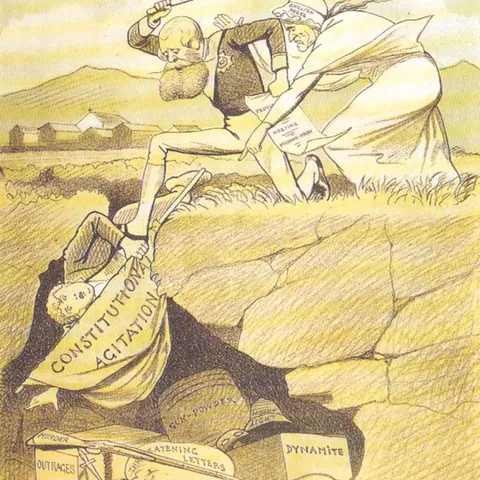
In this the inaugural episode the parties, players and movements bouncing around Ireland in the early 1900s are introduced.
Subscribe for more episodes coming soon.
Support the show through Patreon for bonus content and ad free listening!
Transcript
So 2019 marks 100 years since the formation of the first Dáil. As good a time as any to throw together a podcast looking at the history of Ireland and the War of Independence. Inspired by the amazing History of Rome podcast, I figured Ireland was due a smaller version. In the future we might jump back and look at the wider perspective of Irish history, or narrow in on little important stuff.
But first we’re going to focus on the War of Independence, the founding of the Irish Republic, and all the chaos it took us to get there. If this was Star Wars we’d need a rolling title sequence to set the scene. These first few episodes are our version of that. Grossly oversimplified, but important context.
First off we’re going to give a quick timeline of English occupation in Ireland. The line 800 years of oppression gets thrown around a lot, so it’s important to understand it. The first proper invasion was in 1169 when the Normans invaded, though they ended up keeping mostly to the pale, an area around Dublin. Through the 16th century there was a prolonged invasion by the Tudors which eventually led to Ireland becoming completely taken over by the British Empire in 1601.
Then in 1801 the Act of the Union formally joins Ireland as part of the United Kingdoms. Don’t worry, these dates won’t be on the exam. Since the late 1800s there had been a huge surge in Irish nationalism, but also a range of different views on how best to achieve independence. To set the scene for where we’re headed I’m going to try and quickly give you a sense of the different groups bouncing around the country at the turn of the century. And hold on to your hats, there were a lot of them.
Probably the easiest group to classify are the Unionists. Mostly Protestant and strongest in Ulster, these were people who didn’t want to leave the UK. They were happy living in a Protestant majority country and worried if Ireland became independent they’d turn into a minority overnight. The way things turned out you probably can’t blame them.
These Unionists then formed the Ulster Volunteer Force between 1912 and 1913. Known as the UVF, and get used to the acronyms there’s going to be a lot of them, they became a de facto army whose sole aim was to keep Ireland part of the UK. They liked things how they were and were willing to fight to defend the status quo. Pretty simple.
Next you had your cultural activists. These folks wanted a more Irish Ireland. They weren’t necessarily fighting for an independent Ireland, but were at least determined to de-anglicise the country. Ireland’s first president Douglas Hyde was one of the leaders of the movement, and at the time he was actually pro-union. He just wanted to culturally differentiate Ireland from England, and he made the argument that there was no point in fighting for an independent Ireland if we were culturally no different from the English.
He wanted more Irish speakers, more Irish literature, more Irish poetry, and more Irish sports. Though these cultural activists weren’t inherently separatist, the groups did become places where separatists would gather, especially the Gaelic Athletics Association. This idea of an Irish Ireland would inspire the separatists who would later fight for an independent Ireland.
That brings us on to the next group. They were the people who wanted out. And this is where things start getting a little complicated. By the beginning of the 1900s, the Irish independent movement came down to two main groups. Political activists, who believed they could use the system to instigate change, and military activists, who believed that violence was the only way forward.
At the turn of the century, this was roughly broken into Home Rulers and Fenians. Home Rule was simply the idea that Ireland would remain part of the UK, but with its own parliament. Though around as a concept for a while, it really gained momentum thanks to Charles Parnell in the mid-1880s. His push for Home Rule imploded, but Parnell was a political genius who set the scene for the Irish independent movements of the 1900s.
If there’s appetite for it, we’ll go back and do a deep dive into Parnell and his Land League. But for now, we plough on. So Home Rule had been set as the best Ireland was going to get. And at the turn of the 1900s, that’s what the majority of Ireland supported. Ulster and the UVF being a tricky exception. How’s that for an understatement?
After Parnell, John Redmond led the Irish Parliamentary Party, or the IPP, more acronyms, in a push to get a Home Rule Bill into Westminster. And by 1913, he was doing a bloody good job of it. But then there was the last group. Those who believed violence was the only way forward. They were called the Fenians.
Though Fenianism was as much an attitude as it was an organisation. And in fact, a number of different groups all sat under this vague categorisation of Fenian. One of the longest running groups was a secret society set up by a man called James Stevens. Over his lifetime, he faked his death to escape to France, then walked from France back to Ireland, and when arriving home, set up a secret society. As you do.
The idea was to slowly amass enough followers, create a large enough army that open insurrection against the British would be possible. All while keeping the group as hush-hush as possible. Formed in 1858, and originally meant to be a completely invisible group referred to as just the organisation. But by 1873, they officially formed as the Irish Republican Brotherhood, or the IRB.
Obviously, trying to garner mass support while staying a secret society was a relatively tricky business. And the Fenians never really managed to square that circle. They ran several newspapers, sent out pamphlets, and had delegates moving back and forth between America and Britain. Not exactly low-key.
And though this might not have stuck with the original plan for a secret society, it did manage to create a very dedicated, loyal and passionate membership. So they were Republicans. But the flavour of republicanism varied and was purposely vague. This remained the case with most Republicans right up to independence.
They wanted separation from Britain and held vague ideals of a republic. But, as often is the case with rebel forces and married men alike, they were so determined with separating, few considered what to do once actually successful. As Michael Collins said, the cause was not the Irish Republic, but rather a liberation from English occupation.
So the Fenians, or the IRB, they were Republican, but more differentiated by their willingness to use force than a clear-cut republican ideal. Side note, one republican group who did have a clear vision was the Irish Socialist Republican Party, led by James Connolly. They believed that without a systematic overhaul, any separation from Britain would be pointless.
Connolly argued that an Irish state run by capitalists wouldn’t solve anything. Connolly is another super interesting guy who some would argue was bang on the money. Lucky for him, he was long dead before the Celtic Tiger popped up and was followed by a mass banking crisis. Anyway.
You also had Sinn Féin. Now Sinn Féin are a complicated one, and always have been, but they’re the ones we need to focus on. When I say Sinn Féin, most people will jump to the current modern political party, who used to be the political arm of the IRA. But that’s getting way ahead of ourselves. That’s not really these guys.
Founded in 1905 by Arthur Griffith, this Sinn Féin had the idea to amalgamate all the disparate Irish independence groups into one solid unit. In 1907, Bulmer Hobson joined Griffith and brought a whole bunch of smaller nationalist movements together under the Sinn Féin banner. Bulmer is fascinating. Protestant, a republican, a member of the IRB, and of Sinn Féin.
He was hated by a lot of the IRB members, especially the more radical lads who led the 1916 Rising. Why hated? Well, Bulmer, Griffith and Sinn Féin kind of took a middle ground between the Home Rulers and the more violent IRB. Though they did lean closer to the IRB, and confusingly a lot of Sinn Féin members were IRB men.
So Bulmer was disliked by the IRB because he believed in a purely defensive stance. He didn’t believe in attacking the British unless directly provoked, or unless the majority of the country supported such an action. Griffith wasn’t particularly liked by the IRB either as he believed in a dual monarchy system. His idea was to create an independent Irish state that shared its monarch with Britain.
It would work for Hungary and so why not for Ireland, Griffith argued. So together their views were one of passive resistance, involving economic boycott, tax strikes, civil disobedience, and abstention from Westminster. And Griffith had this weird idea about dual monarchy. They were all fairly unpopular opinions, disliked by both the politically minded Home Rulers and the more radical IRB.
In fact they were kind of laughed at for their absentee methods. People asked why are we going to vote for you, you’re not even going to show up at Westminster. It all meant that Sinn Féin were very much on the fringes when they started in 1907.
So let’s recap. We have Unionists and the UVF under Edward Carson, the cultural lads led by Douglas Hyde, the Home Rulers in the Irish Parliamentary Party under John Redmond, the secret society known as the IRB run by a supreme council, and Sinn Féin led by Arthur Griffith.
Obviously there was a plethora of other smaller groups but these are the main players you need to know about to set the scene for Sinn Féin’s rise and the eventual setting up of the first Dáil. But yeah, we ain’t there yet. In 1907 Sinn Féin hadn’t grabbed the public imagination at all and they really wouldn’t for another 10 years.
The IRB wasn’t huge either. Though a lot of the Irish wanted an independent country and were fiercely nationalistic they just didn’t really want to join a secret society. Home rule was it. That was what was popular. It was supported by the majority of the public and it had made huge inroads. By 1913 it was all but certain that this would happen. It was exciting. People were really pleased.
But then World War One happened instead and things just got messy. Next time we’ll keep the Star Wars intro thing rolling with a super quick rundown of the 1916 rising and the weird way it brought Sinn Féin from the fringes to the centre of Irish politics. Then things will really start kicking off.
Thanks for listening. Subscribe wherever you get your podcasts and if you’re enjoying it tell your friends. It’ll really help. You can also get in touch with us through thehistoryofireland.com or follow us on Facebook. If I made a mistake let me know.
The History of Ireland was written and produced by me Kevin Dolan. Additional research and fact checking by Robert Babington. Music by Liam Doyle and production help from Aoife Murphy. This podcast was recorded on the lands of the Wurundjeri people of the Kulin Nation. Sovereignty was never ceded.
Four doors. Four belts. That was only three clicks. Where’s the last click? Someone isn’t wearing their seatbelt. I need to ask them to put it on. But what if he laughs at me? What if the others take off their belts in solidarity? What if I don’t ask?
However bad you think asking will be it’s nothing compared to what could happen if you don’t. Would you mind wearing your seatbelt? No problem. Asking your mates to wear a seatbelt won’t kill you. Every time. Every trip. Everybody. Belt up. A message from the Road Safety Authority.