Episodes Irish Revolution Season 1 — The Revolution
Two Very Different Approaches
Not dissimilar to Brexit and arguments over the backstop, the Home Rule Crisis was one of the biggest political nightmares of its day. In fact, it could very well have led to a British Civil War if World War 1 hadn't interrupted. Talk about out of the frying pan and into the fire.
In this episode we look at the mess that was the Home Rule Crisis, the influence of World War 1, and how it all led to the 1916 Rising.
Support the show through Patreon for bonus content and ad free listening!
Transcript
ACAST recommends. How are you doing there? This is David from the David McWilliams podcast, the podcast that makes economics as comprehensible as possible. We are going to look at economics through the lens of the World Cup and a special World Cup economics series. We’re going to look at countries, we’re going to look at players, we’re going to look at culture, but we’re also going to look at the economies of the countries involved in this World Cup as it unfolds.
So this is one for economics fans who happen to be into football, football fans who happen to be into economics. That’s all on the David McWilliams podcast. ACAST is home to the world’s best podcasts, including Crime World, The Other Hand, and the one you’re listening to right now.
I’ll bring you a message today from the people of Ireland. The Irish desire peace with England and with the rest of the world. It is a question of a republic. We want the creation of a new Ireland. I wish to talk to you this evening about the state of the nation’s affairs. Welcome to the history of Ireland.
It’s 1913 and there’s still a lot to happen before we get to the first Dáil Éireann. We’re going to keep skipping over a lot of super interesting stuff like the 1916 Rising. Again if there’s appetite we’ll go back, but for now we want to get to the War of Independence. I kind of thought we’d get there sooner to be honest, but the background context is just too much fun to ignore.
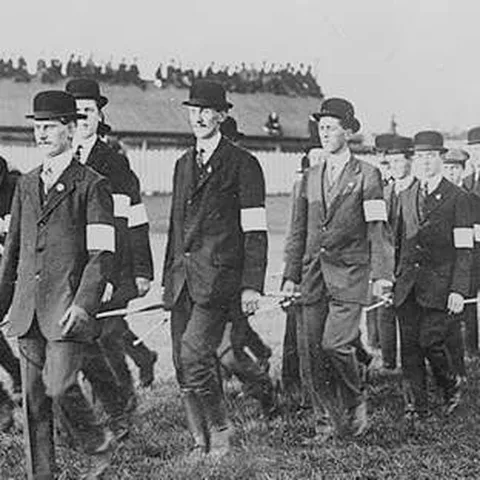
So Home Rule was big and was looking more and more inevitable with the majority of nationalists on board with the plan. This stressed out the unionists who ended up starting a citizen’s army and drilling, threatening to fight to defend the union with Britain. Led by Edward Carson they formed the Ulster Volunteer Force. This formation of the UVF actually normalised the idea of a military approach to the political situation at the time, when most of Ireland wasn’t really thinking in this way.
In fact historian Michael Laughan jokingly argues in his lecture series that Edward Carson should be honoured and given a statue for his work in bringing about the Irish Republic. The UVF upped the stakes and basically set the precedent for what would come next. Without them arguably none of it would have happened. And what comes next? Well it’s the Irish Volunteers led by Eoghan McNeill. They were set up in December 1913 by the Home Rulers as the direct response to the UVF.
Most of the day-to-day lads in the Irish Volunteers were Home Rulers who didn’t want to go to battle. Their goal was to simply defend Home Rule once it was brought in. But more extreme IRB members joined and the IRB very quickly took over the command structure. Though to confuse things the volunteer leader McNeill was never a member of the IRB. So you have this secret organisation called the IRB and the Home Rule Army called the Irish Volunteers.
But the two groups overlap with a lot of IRB members joining the Irish Volunteers and quickly rising up the ranks. Confusing. But the long and short of it was there is now a nationalist army who are getting more and more ready to fight. And that’s kind of all thanks to the UVF. Around this time Cumann na mBan or the Women’s Council was also founded. Brought together from a number of different women’s groups their stated purpose was to assist in arming and equipping a body of Irish men for the defence of Ireland and to form a fund for these purposes, imaginatively to be called the Defence of Ireland Fund.
Led by Countess Constance Markievicz they became hugely influential throughout the Rising and the events that followed. They are often painted as just messengers and nurses but they bloody well fought with a lot of women acting as snipers and the like. We’re going to discuss Cumann na mBan in greater detail later. It’s important to acknowledge how integral women were to the republican movement and how progressive it initially was in this respect. But that’s for later.
So you had the UVF and the Irish Volunteers both drilling and getting ready for a fight. Then in a bid to placate the ever more aggressive unionists partition was suggested in Westminster. This was the idea of keeping a part of Ulster separate from the rest of Ireland. The plan was to give Ulster home rule within home rule. A government in Belfast that sat under the government in Dublin which then in turn sat under Westminster.
How much of Ulster would be partitioned was up for debate. Maybe 9 counties, maybe 6, maybe just the 4. That idea of 4 counties comes from the demographics of the area. 5 of the 9 Ulster counties were Catholic and Nationalists while only 4 had a Protestant majority. Regardless, Carson was actually against the whole idea. He was a Southern Protestant and didn’t want any of Ireland separated from Britain.
And at this point it was put forward as a temporary issue, one that would only last for 6 years. Kind of like a reverse backstop. And that wasn’t good enough for Carson and the unionists. The Nationalists were not huge fans either, especially those in the IRB. But Redmond supported it as he believed a temporary partition was better than nothing. So this version of the home rule bill was passed in 1914.
Carson stormed out of the House of Commons and people were genuinely worried he was about to lead the UVF in a rebellion against the British army. This is something that really wouldn’t have gone down too well. Imagine trying to sell to the British public a war against a group of people fighting to stay in the union. That’s not a good look. Yet the British government was forced to prepare the army against the UVF.
And that’s where they hit a kind of little snag. A situation that became known as the Curragh Mutiny. Some say it was a conspiracy, some say it was incompetence. Either way it was just a complete clusterfuck. The British army in Ireland were very conservative and the vast majority of the command structure were unionists. A lot of them were not particularly fond of the idea of fighting against other Protestants.
So to get them on board the government gave verbal orders to Sir Arthur Padgett, the Irish commander in chief. The fact they were verbal is kind of important. It’s either a huge mistake or a clever ploy to avoid having the orders on paper. And so what was he ordered? Well Padgett was told to tell his men in the Curragh army base that anyone living in Ulster or the relatives in Ulster would not have to take up arms against the unionists. A bit weird but I guess you can kind of see the logic.
But then in a bit of a rambly speech Padgett went off book and on top of this offered his men a choice. They could either fight or resign and give up their pensions. Soldiers aren’t meant to be given a choice and if he just ordered them rather than asking they probably would have gone along with it. It was pretty much a mutiny of his own making. The British government when hearing this freaked and retracted on his offer.
Then a group of officers who were against fighting the unionists got pissed and demanded that the cabinet promised that the army wouldn’t be used in Ulster. Crazily they were told okay and this time they got it in writing from the war cabinet. The prime minister Asquith was furious. The government had lost control of the army and he then made the major mistake of claiming in public that a civil war was now a possibility.
This then freaked out the king who basically said not on my watch. And so yeah what can I say, a clusterfuck. So then in July 1914 the king invited everyone around to his house. Conservatives, liberals, unionists and home rulers all were brought to Buckingham Palace to nut the whole thing out. They got nowhere. As Winston Churchill who was there at the meeting put it, they got lost in the muddy byroads of Tyrone and Fermanagh.
With a week left in parliament Prime Minister Asquith was in a bit of a pickle. Home rule had to be enacted, the people had voted for it, the House of Commons supported it, the House of Lords had used all their vetoes. But if it was passed there was a very real chance it could tear Britain apart. The whole thing went right up to the wire. No one agreed on anything, every compromise had been turned down and time was running out.
Sound familiar to anyone? Well hopefully not too familiar. Brexit might be bad but what came next was much worse. The greatest war the world had ever seen kind of worse. World War One changed everything and Asquith actually saw it as a lucky break. A short war would distract from the problem in Ulster and bring everyone together and it kind of worked.
Home rule was passed with no partition or anything just with the provision that it would wait until after the war to be enacted and then an amendment would be added to figure out Ulster. Redmond and the home rulers celebrated and encouraged the Irish Volunteers to fight in the war but this then caused a split in the Volunteers. The majority, about 140,000, stuck with Redmond calling themselves the National Volunteers and signed up to the war effort while just under 10,000 refused and kept the name the Irish Volunteers.
Some serious people’s front of Judea versus the Judeans people’s front shit going on there. But all you really need to know is that the Irish Volunteers, kind of led by a number of IRB men, now believed that home rule had become too watered down. They were worried by the idea of partition and hated the thought of fighting for Britain. They decided something had to be done.
Which is the perfect time to introduce Pádraig Pearse. Pearse was a school teacher who believed strongly that the Irish needed to be speaking Gaeilge. He joined the Volunteers and through that the IRB. Pearse is important for a whole number of reasons. One of those being how he created a narrative that linked cultural nationalism to Fenianism. His charismatic rhetoric was kind of the last puzzle piece that tied the cultural guys and the Fenians together.
It painted a picture of a properly Irish independent Éire that was a completely separate cultural and political entity to Britain. His vision would be hugely influential on those fighting in the War of Independence. But it’s also important to point out that Pearse had a slightly perverse love of warfare and violence. It’s arguably not his fault, he was a creation of his time. A time when militarism was on the rise and soldiers were revered.
But he was a fanatic and very much on the fringes. His shocking description of World War I is a pretty good example of this. He said the last 16 months have been the most glorious in the history of Europe. Heroism has come back to the earth. The old heart of the earth needed to be warmed with the red wine of the battlefield. Such a gust homage has never before been offered to God as this. The homage of millions of lives giving gladly for country.
So yeah look, a touch of a fanatic. And this was the guy who would be leading a Rising. A Rising that by Easter Monday 1916, when it started, was doomed to fail. He knew it would fail but wanted to make a blood sacrifice for Ireland. Or at least his romantic ideal of Ireland. Which brings us to the 1916 Rising itself. It deserves its own podcast but as there were a whole heap of great documentaries on it at the centenary, we’re going to skip over it. Blasphemy I know.
But instead we’re focusing on the vision set out by the rebels as well as the aftermath of the Rising. But you do still need a quick one sentence summary. So the 1916 Rising was a rebellion led by the IRB that lasted for about a week over Easter before being quashed by the British. Despite a huge lack of experience, a tiny force of only about 1500 men and women, and some very poor military decisions, the rebels held out for six days.
It’s said that Pearse ordered a surrender when he realised how many civilians were being killed. For all his talk of bloodshed, when push came to shove, he was kind of too much of a nice guy for the realities of it all. Plus by the time the rebels surrendered, they were very much defeated. The Rising completely altered Irish politics and the trajectory of Irish history. It took the views of a tiny minority and catapulted them onto the centre stage.
And as well as this, important for our purposes, the Rising was when the Irish Republic was first proclaimed. The proclamation laid out social aspirations for the new country but was still quite vague on the shape of the nation. There was some brief talk among the rebels of putting a German prince as head of state and obviously there was a lot of rhetoric around the Irish Republic but generally everything was left up in the air.
Why was it left up in the air? Well for one, it was intentionally vague to keep the disparate forces fighting in the Rising from arguing. And two, because well, to the organisers of the rebellion, it seemed very very unlikely they were going to survive long enough to have to deal with the niggly details of running a country. The proclamation and the Rising was a symbolic act designed to fire up the nation rather than actually succeed.
And boy did it work. Well actually not initially. But that’s for next time when we’ll look at how the British’s mishandling of the Rising led to a total shift in public opinion and a huge rise in a more extreme form of nationalism. Thanks for listening, subscribe wherever you get your podcasts and if you’re enjoying it tell your friends, it’ll really help.
You can also get in touch with us through thehistoryofireland.com or follow us on Facebook. If I made a mistake, let me know. The History of Ireland was written and produced by me, Kevin Dolan. Additional research and fact checking by Robert Babington, music by Liam Doyle and production help from Aoife Murphy. This podcast was recorded on the lands of the Wurundjeri people of the Kulin Nation. Sovereignty was never ceded.