Episodes Irish Revolution Season 1 — The Revolution
Fascists & County Councils
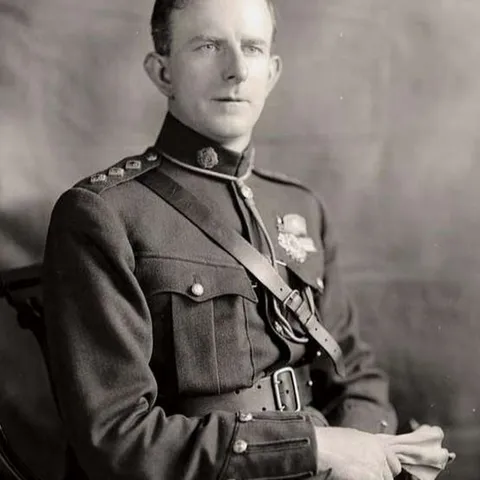
1920 was a year that really saw The Irish War of Independence tilt into full swing. But just as important as the military aspect, was the politics and one often overlooked side of this was the local elections that were carried out in January and June of 1920. As well as that we introduce Eoin O'Duffy – a Republican hero and Ireland's answer to Mussolini.
In the episode I make a shameless plug for my band's new EP. You can check it out at the link below, if you're so inclined.
Listen to Four In The Morning – Safe Happy Scared
Support The History of Ireland by donating to their Tip Jar: https://tips.pinecast.com/jar/historyofireland
Transcript
Welcome to the History of Ireland. Before I start this week’s episode, I’m going to go for a bit of a shameless plug. Part of the reason I’ve been so busy outside the history of Ireland is that my band Four in the Morning have just released an EP. So if you’re interested to hear what I do when I’m not rambling about Irish history, I’ll throw a link in the description and you can have a listen. Yeah, the EP is called Safe Happy Scared, the band is called Four in the Morning, and you can listen wherever you listen to music. After you’ve listened to all your podcasts of course. But anyway, enough of that, let’s move on with the show.
In the previous episode we looked at one of the last big moments of 1919, the ambush of Lord French. This week we get into 1920, a year that really saw an escalation in violence on both sides. When historian Charles Townsend discusses the War of Independence, he breaks it into three distinct phases. Now obviously things were never as clear cut as this at the time, but it does help us to get to grips with where we’re at in the conflict.
So far we’ve been in the thick of phase one. This was categorised by a long period of low level operations between late 1918 and late 1919. It’s everything we’ve been discussing so far. The boycott of the RIC, smaller raids, attacks on individual policemen, etc, etc. And so we’re coming to the end of that phase now. At the beginning of 1920 we move into Townsend’s second phase, as the IRA up the ante and start attacking the actual RIC barracks. To combat this and the depletion of the RIC forces, the British then introduce the Black and Tans and a policy of reprisal, both of which we’ll be looking at in a later episode. And then, just so we have it, the third phase begins around August 1920, when the British introduce the Restoration of Order in Ireland Act, and things really start getting hairy for the IRA. But that’s getting ahead of ourselves. That’s a vague outline of the conflict, to give us an idea of where we’re currently at.
And, just as the violence was heating up throughout 1920, so too was the political side of the movement, thanks to a series of local elections. Which is what I want to focus on in this episode, as well as introduce two guys who go on to form Ireland’s second largest party, Beanna Gael. I know, I know, you want to get to the barracks burning, but bear with me lads, county council elections can be interesting, I promise.
Now, there were two sets of elections, one for councils in urban areas and one in rural areas, held in January and June respectively. These municipalities and county councils were pretty important to Sinn Féin. Ireland had, and still has to this day, a very strong sense of local government. The county council is where you go to get things done. It’s how the public dealt on a day-to-day basis with the government. They were the ones tasked with actually running the country at a ground level. Yeah, that Dáil was all well and good, but controlling the county councils and actually working to help people at a local level would make the Republic much more tangible. Like the Dáil courts, they were a chance for the Republic to solidify itself as a real, live, grown-up country. And the British knew this.
The elections themselves had been postponed since 1917 and once they couldn’t be postponed any longer, the British brought in proportional representation in a bid to stop Sinn Féin gaining seats. But this kind of backfired on them. Arthur Griffith had been arguing for proportional representation for over 20 years and so it was a solidly established Sinn Féin policy. A fact that the British seemed to have totally and utterly overlooked. Who has time to actually listen to what policies your enemies support? Come on.
This then led to a bit of a weird one and as one newspaper at the time put it, instead of opposing a change declaredly designed to cripple its power, Sinn Féin willingly helped in its development. This made Sinn Féin look great. They were able to argue that they had succeeded in getting through one of their policies and the British couldn’t do all that much about it. So they went into the elections pretty well positioned.
Plus it helped that Sinn Féin had a long history of local politics. From their inception they’d done much better on a local level than they ever had in Westminster. This is down to the fact that the IPP, remember those guys? Just didn’t have as strong a stranglehold over the local councils. And by 1911 Sinn Féin acted as a fairly significant opposition party within these local councils. It also probably helped that they showed up to the meetings. Their policy of abstention didn’t apply to the local councils.
Now in 1920 the guy in charge of Sinn Féin’s approach to local government was William T Cosgrave. He was one of the most experienced politicians in Sinn Féin and had been a member since way back in 1909. By 1920 he had over 10 years experience working at local government level. He’d also been a member of the Irish Volunteers since 1913 and had fought valiantly in 1916. Though it should be pointed out that unlike a lot of the senior Sinn Féiners he’d never joined the IRB. Because, much like his friend Dev, he was against the idea of a secret society.
In a 1917 by-election he was elected as a Sinn Féin TD while in prison and had been re-elected in the 1918 elections. He was quite good friends with De Valera and when Dev was putting together his cabinet he made Cosgrave the local government minister. He was vital in turning the Republic into a real functioning government. The local government department spent 1919 working on a milk distribution scheme, housing issues and poor law reform.
But as the 1920 elections came around he readied the department to get campaigning and introduced a pledge to all candidates that read I recognise the Republic established by the will and vote of the Irish people as the legitimate government of Ireland. This kind of pledge had not really been around in 1918 and it was clear that these elections would act as a further referendum on whether the public supported Sinn Féin’s actions as well as demonstrating that they could lead at a local level. But Cosgrave was careful with how Sinn Féin approached the elections, fielding only 700 candidates in the urban elections out of a potential 1600ish. And by all accounts the elections had less of the energy of 1918.
But that didn’t mean Sinn Féin didn’t do well. First in January there was a huge turnout and between them and Labour who had also about 700 candidates, 62 out of 99 urban councils and 9 out of 11 municipalities fell under Republican control. In the rural elections in June they did even better. By that stage the IRA was pretty much oppressing any opponents in a lot of rural areas and this coupled with Sinn Féin’s popularity meant they gained control of 29 of the 33 county councils.
Now I mentioned the IRA’s antics not to discredit the election. It was clear that both the IRA and Sinn Féin very much had the public’s approval at this point, especially in rural areas. But it’s also important to note that this kind of thing did go on and the IRA was not against a little bit of voter suppression. In fact at this point in history voter suppression was pretty much guaranteed even during peacetime. So yeah, they were just really doing what was expected.
Anyway Sinn Féin won a mandate and as the Irish Times put it the local administration of the south and west of Ireland is in the hands of a party which publicly repudiates British government. While the Irish Bulletin spelled things out a little more simply. They just said the Dáil government has the allegiance of 83% of the Irish people. Not a particularly great situation for the Brits.
So it was within this political climate that the IRA increased their activity. As we carry on into the War of Independence it’s vital to note that without the public support the IRA simply could not have functioned. They needed people to hide weapons, places to stay and a population willing to keep their mouth shut when the British came knocking. But it’s also worth remembering that even though Sinn Féin had support of 83% of the country as we’ve always said there was a range of political views rallied together under the Sinn Féin umbrella.
Perhaps this is best illustrated by Eoghan O’Duffy a guy who conveniently enters our narrative in January 1920 as he leads one of the very first attacks on an RIC barracks. But who as well as that had a, how would I put it, an interesting career post-War of Independence. Through the GAA O’Duffy had joined the Irish Volunteers in 1917. So far so normal. He then went on to rise through the ranks and by 1920 was in charge of the Monaghan Battalion of the IRA. We’re going to explore what he did leading the battalion next episode but for now let’s skip ahead a bit so you can get a better idea of the kind of man O’Duffy was.
Throughout the War of Independence he proved himself again and again. In 1922 O’Duffy was even made Chief of Staff of the IRA and after the war he’d go on to head up the Garda Síochána the state’s new police force. Basically he had a reputation during the war as someone who just got stuff done and if he’d been shot or had died at this point he’d probably have left a pretty impressive legacy. But he didn’t die and so things get a little wobbly and he managed to leave his legacy barely solidly in tatters.
How do you tarnish an esteemed wartime legacy? Well by becoming a Nazi sympathising fascist. Yeah that’ll do it. Ireland was never in a bubble and just like how Russian Communism inspired the likes of the Limited Soviet in 1919 by the 1930s the country was influenced by what was going on in Europe namely the rise of Mussolini and Hitler. O’Duffy became fairly infatuated with the two men. He even formed his own fascist group known as the Blue Shirts. Fiercely anti-communist and pro-catholic O’Duffy and the Blue Shirts were obsessed with the idea of keeping Ireland pure, religious and virile. But these public ideas of a virtuous Ireland were not really reflected in how O’Duffy lived his life. He was apparently quite the heavy drinker at this point.
And though they didn’t have a huge amount of support the Blue Shirts weren’t negligible and they teamed up with Cosgrave to found Fianna Gael, Ireland’s second biggest party. They’re actually in power right now. But initially they did quite poorly in elections and O’Duffy lost a lot of his influence. He broke away from Fianna Gael and ended up forming his own proper fascist party which just never really got off the ground. Though O’Duffy did take a small contingency of Blue Shirts off to fight for Franco in the Spanish war. Because you know, why not?
And just to make an even more interesting enigma of a man On top of this there are some rumours that O’Duffy was actually gay and living firmly in a closet full of blue uniforms. Some argue that it’s this internal conflict that left him so fanatical in his later life. But I don’t know, you can never trust armchair psychology on a man that’s been dead for over half a century. So let’s take that with a grain of salt.
He’s just a fascinating guy and a prime example of how Sinn Féin was a mashup of different ideologies tied together by nationalism. To some he’s a hero of the war of independence and vital in the foundation of both the state and one of Ireland’s leading political parties. And to others he was Ireland’s answer to Mussolini and we were lucky we avoided him gaining any real power. I think it’s fair to say he was a bit of both. A republican hero who was also a fanatic with some pretty horrible views. People are never straightforward are they?
Next episode we’re going to cut back to 1920 when O’Duffy was simply in charge of the Monaghan Brigade of the IRA and planning to up the ante on the British. Sovereignty was never ceded.