Episodes Irish Revolution Season 1 — The Revolution
The Men Behind The Black & Tans
This episode we ask the question, who created the Black and Tans?
The men behind the British policy in 1919 and 1920 did not want to believe they were at war in Ireland and instead chose to push the narrative that Sinn Fein and the IRA were a simple "murder gang". So rather than sending in the army they further militarised the police in Ireland. Yep, in this episode we look at how David Lloyd George and Winston Churchill created one of the most hated groups in Irish history.
Support The History of Ireland by donating to their Tip Jar: https://tips.pinecast.com/jar/historyofireland
Transcript
Welcome to the History of Ireland. So we’re back after a bit of a Christmas break. A quick recap on where we were at. We’re into 1920 and the War of Independence is well and truly underway. Last episode we looked at how the IRA upped their aggression and began driving the RIC out of barracks all over the country. Over the next few episodes we’re going to examine how the British retaliated.
This means that, weirdly for a history podcast, we’re ever so slightly topical. Over the last few weeks in Ireland there’s been a bit of a furore over the government’s plans to commemorate the RIC and the black in towns. Here’s my opinion on it all. I’ve made it clear previously that I generally think the RIC pre-1916 get a bit of a bad rap. Yes, they definitely acted brutally at times, broke up rebellions and were the arm of British oppression. But from the research I’ve done, they were also just regular Irishmen who thought they were helping their communities. But do I think they need commemorating? Probably not. Maybe rethinking in the collective consciousness, but not commemorating. After all, they were still the arm of the oppressor.
And you’ll notice I say pre-1916. In my head I kind of separate the RIC pre-1916 and post-1916. Because as we get into the War of Independence proper, there’s a real shift in the organisation. Both in terms of how it carries itself, how it’s viewed and who it recruits. We’ve already covered how Sinn Féin othered the RIC, as well as the increased violence towards them. But this week I want to look at how British policy and the addition of new reinforcements drastically changed the RIC. These reinforcements? Well, they were the British cabinet’s terrible solution to the IRA’s increased aggression and became known as the Black and Tans.
100 years after their creation, the Black and Tans are still hated in Ireland. And that’s what the whole furore was about. They’re so hated that the Irish government had to cancel their commemoration. And they were right to. Over the last few weeks the Black and Tans have been frequently compared to the Nazis and the Stasi. The idea of commemorating the RIC and by extension the Black and Tans is abhorrent to most Irish people. And I would agree. So yeah, there’s that.
Over the next two episodes we’re going to examine the foundation of the Black and Tans and explore why they are still so despised. For Irish listeners familiar with their history and the Tans, hopefully you’ll get a better sense for how they came into being and who they were. And for non-Irish listeners, as we travel into 1920 and start to examine how the Black and Tans carried themselves, you’re going to learn why they still incite such hatred. So, let’s dive in.
In 1919 and 1920 the British really had no idea how to deal with the quote Irish problem. Part of this is down to the fact that the guerrilla style of warfare that was being developed by the IRA was totally alien to the British. They were used to static armies fighting on behalf of states and fairly straightforward theatres of war. This idea of small attacks, assassinations and hit and run tactics just did not sit comfortably with them. They were just very unsure how to act. Because of this, the idea to deploy the Black and Tans developed kind of slowly and a bit haphazardly with numerous people against it from day dot.
So to explain why that is and to understand how we get to the Black and Tans, it’s important to introduce and reintroduce the main players on the British side. The men making the decisions that would drastically affect the people of Ireland.
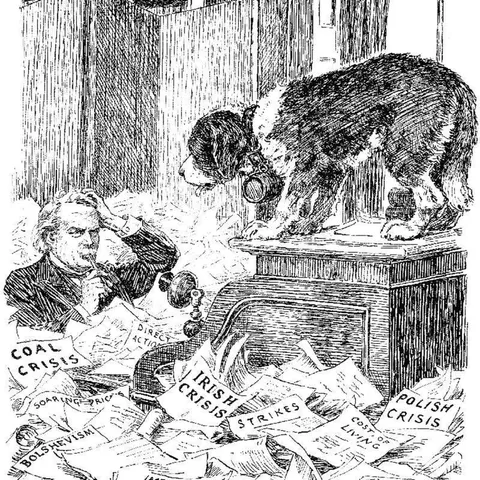
Obviously, there was David Lloyd George, the British Prime Minister. A liberal, Lloyd George was extremely charming, persuasive and exceptionally cunning. He was 56 by 1919, sporting a famously shaggy moustache and unkept hair. He was fondly referred to as the Great Welsh Wizard and it’s said people were struck by quote the incomparable genius of his lively blue eyes. Yeah, he was a serious political mastermind who was a genius in getting to the heart of complex problems. He had helped win the war for the British and spent 1919 reshaping the post-war world at the Paris Peace Conference.
Ironically, in Paris he was seen as a defender of the oppressed minorities and an advocate for self-government among small nations. He was trying to build a peaceful post-war world and to do this he used, as one historian described, a policy of studious concession to the forces of nationalism in the Middle East and India, accompanied by one of conciliation in Europe and peace at home. Which is frankly completely at odds with his approach to Ireland.
Sinn Féin must have seemed bloody annoying to Lloyd George. He was a patriotic Welshman who agreed that Ireland should have more say over Irish matters. He’d been pro-home rule for decades and as we know he’d been trying to bring in a home rule bill for a while now. The one that still included a six county Northern Irish split. But this was never going to fly with Sinn Féin. And it seems that this would only dawn on Lloyd George late in 1920. He still believed the majority of the Irish wanted home rule and that if he could simply shut down the violent minority, order could be restored. So that’s Lloyd George, the Welsh wizard.
Now let’s look at the men he had working for him. First there’s our old friend Lord French, the Lord Lieutenant in Ireland. He’d so far been pretty much the top dog on the island. He’d been dealing with Sinn Féin and the IRA for years at this point. He wanted them wiped out and believed the army should go in and destroy the IRA. As well as this French wanted non-Irish personnel to be hired into the RIC. Though the man in charge of the police, Inspector General Sir Joseph Byrne, was against the idea. Byrne was worried about the kind of recruits that they would receive and believed such recruits would be impossible to control. But French, though he couldn’t fire him for political reasons, asked for Byrne to be stripped of any real power. Lloyd George agreed, stating that Byrne had quote, clearly lost his nerve and that it would be better for his health if he stepped down. French replied darkly that quote, it would be necessary to increase considerably the number of people to be sent away for the benefit of their health. Lovely as always was French.
Ironically though, in May 1920, French was also pretty much sidelined. As we’ve discussed in previous episodes, he’d been working with Ian McPherson, the Chief Secretary of Ireland and was generally assumed that they’d done a pretty terrible job. For example, Lloyd George had sent a civil servant to examine the Irish governing apparatus. The man reported back saying that Dublin Castle administration does not administer and that it was quite obsolete.
So Lloyd George decided to mix things up. In April of 1920, French’s powers were stripped back while the role of Chief Secretary was increased. Hammer Greenwood replaced Ian McPherson as Chief Secretary, while military control of the country went to General Neville McGrady, who went by his very soldierly simple nickname, Make Ready.
By all accounts, Hammer Greenwood may not have been up to the task at hand. A Canadian, he was seen to give a little bit of transatlantic legitimateness to the British approach in Ireland. But apparently that’s all he did. His contemporaries described Greenwood as a crude thinker who could only deal with one idea at a time. In fact, most people kind of hoped his intellectually superior wife Margaret would make most of the decisions. Should have just given her the job then lads, maybe.
McGrady, on the other hand, was a switched on experienced leader, one who had led the London police and put down mine strikes in Wales. He was a well kept military man with one of those big old school English general mustaches. Lord George and his advisors viewed McGrady as a quote, soldier with a civilian mind, perfect for handling the mess in Ireland. Having said that, McGrady hated Ireland and in one letter stated, I loathe the country you are going to and its people with a depth deeper than the sea and more violent than that I feel against the Germans. Yeah wow, don’t hold back there Neville. And then within a few hours of his arrival in Ireland he wrote, I was honestly flabbergasted at the administrative chaos that seems to reign here.
The plan had been for him to take control of both the army and the RIC, but he believed the RIC were past saving and so turned down the joint appointment. However, he then failed to get his preferred candidate into the position and instead the job went to General Henry Hugh Tudor. This caused quite a confusing split between the British military and the RIC, which would have drastic implications.
Tudor would go down in Irish memory as Black Tudor, for reasons we’ll get into later. He was a career soldier who was brought in to do the quote, dirty job of cleaning up Ireland of the troublesome criminals that were the IRA. It’s pretty telling at this point that the man in charge of the RIC was of a military rather than police background. How did he get the job I hear you ask? Well, he was a long time friend of Winston Churchill, who had served with him years ago in Bangalore.
Yeah, his friend Winston Churchill, who was now Lloyd George’s minister for war. It always amazes me how many big events Churchill was involved in throughout the 20th century and how bloody long his political career was. 46 at this point, though he did not yet look the grumpy old Churchill we’re used to seeing, he was definitely a hardliner. He’d be main minister for war in January 1919, putting him in charge of the British garrison in Ireland and the Irish police. He viewed Sinn Féin and the IRA as quote, a gang of squalid murderers and was especially annoyed by the leniency shown to hunger strikers. He wanted a firmer hand used against them, hence he brought in his old mate Tudor.
With me so far? Cool, then finally we should mention Sir Henry Wilson. Churchill was the politician in charge of the army, but the actual top military man was an Irishman called Sir Henry Wilson. He was the chief of the imperial staff and Lloyd George’s main military advisor. Born in Longford, Wilson was a committed Unionist and another career soldier. He’d fought in the Boer War and helped lead the British in World War One. He was a stern, hawkish man who looks exactly like every caricature of a British World War General you’ve ever seen. Just like Churchill, he had no time for Sinn Féin and believed firmly that they were a murder gang who needed to be repressed. He had a very different take on how best to do it. Like French, he wanted the army brought in.
So those are the main players who’ve influenced over British policy in Ireland throughout the War of Independence. There’s a bunch of other people we could mention, but I think you can all agree that’s enough names. Let’s quickly recap. We have David Lloyd George, the liberal, conniving Prime Minister known as the Welsh Wizard. Sidelined and angry Lord Lieutenant. General Macready, or Make Ready, a man who hates Ireland, has a great nickname and is in charge of the army in Ireland. General Henry Hugh Tudor, the man put in charge of the police in May 1920. And General Wilson, an aggressive Unionist and military advisor to Lloyd George. And a middle-aged Winston Churchill, the politician in charge of both the police and the army who believed the IRA needed to be forcibly destroyed. I know, I know, that’s a hell of a lot of names. But I think it’s important to get to know the men behind British policy because what they decide on next is frankly abhorrent. Let’s figure out how they got there.
There were three main approaches the British could take. Option one would have been to begin political discussions with Sinn Féin and try and arrange a truce. At this point no one was in favour of this. Lloyd George still believed moderates could be won over and Home Rule could work, as long as the extremists were dealt with. Sinn Féin had been made into an illegal entity, despite the fact that they were elected officials, and to treat them any other way at this point would be disastrous.
Option two would have been to bring in the army to use against the IRA. Frankly, at the end of the day, the British could have easily won the War of Independence if they just sent the army in. Macready, once he arrived in the country, was in favour of this approach. He initially wanted the army to take control and proposed the creation of eight garrison battalions under military rule across the country. But this was turned down, as quote it would be represented as the beginning of a reconquest of Ireland. And this total war approach just was never on the cards. Bringing the army in would legitimise the conflict with the IRA and create a proper war. When you’ve spent the year advocating for small nations, it’s not a great look to invade the little country you’re backdoor. The public wouldn’t have stood for it, the Americans wouldn’t have stood for it, and I don’t think Lloyd George ever wanted to do it. Once this became clear, Macready decided that the only solution was a political one and wrote to General Wilson that, quote any drastic measures would leave a fresh wound on the already scarred body of this blooming island of yours. He really did hate Ireland.
This then brings us to option three. This option was to not treat the conflict as a war and instead stick to the idea that the IRA were nothing more than criminals. The term murder gang is what they kept using. But it was clear that the RIC was totally and utterly failing. Which is why French wanted the English recruits. But the cabinet took this one step further and decided to augment the RIC with a huge influx of new recruits to form a special counterinsurgency force.
Some say this was all Churchill’s idea, but it seems more like it slowly developed within the cabinet. The way Churchill describes it, the cabinet, quote, decided, or rather drifted into a decision, to meet force with force, or to be more exact, to meet terror with terror. Drifted into a decision. That’s Churchill’s own words. The phrase is shockingly cavalier. Basically, what Churchill was advocating and what the cabinet drifted into was a policy of reprisal carried out by a hastily recruited and poorly trained, heavily armed paramilitary group.
Some argued against it. General Wilson hated the plan, describing it as a panic measure of raising 8,000 scallywags. In his diary he wrote, I can’t imagine what sort of officers and NCOs we can get. I can’t imagine what sort of men they’ll be. No one will know anyone. No discipline. No espirit de corps. No cohesion. No training. Macready agreed with Wilson, arguing that the RAC were too weak in the circumstances now prevailing in Ireland to control the kind of men who would be recruited. But Tudor, the man who by May 1920 was in charge of the RAC, was on his friend Churchill’s side. When he arrived in Ireland, he further militarised the RAC by upgrading their weaponry. Again, against the advice of Macready and Wilson.
In the end, Lloyd George listened to Churchill over Macready and Wilson. The fact he had been forewarned about the risks around the force that he was creating makes what happens next even more egregious. So remember that as we continue and look at what the new force did in Ireland. Remember that Lloyd George, Churchill and the others quote, drifted into the decision. Because next time we’ll look at who this new unit of men were, how they got their name and how they brutally upped the ante in Ireland throughout 1920.
Thanks for listening. Subscribe wherever you get your podcasts and if you’re enjoying it, tell your friends. It’ll really help. You can also get in touch with us through thehistoryofireland.com or follow us on Facebook. If I made a mistake, let me know.
The History of Ireland was written and produced by me, Kevin Dolan. Additional research and fact-checking by Robert Babington, music by Liam Doyle and production help from Aoife Murphy. This podcast was recorded on the lands of the Wurundjeri people of the Kulin Nation. Sovereignty was never ceded.