Episodes Irish Revolution Season 1 — The Revolution
Who Were The Black & Tans?
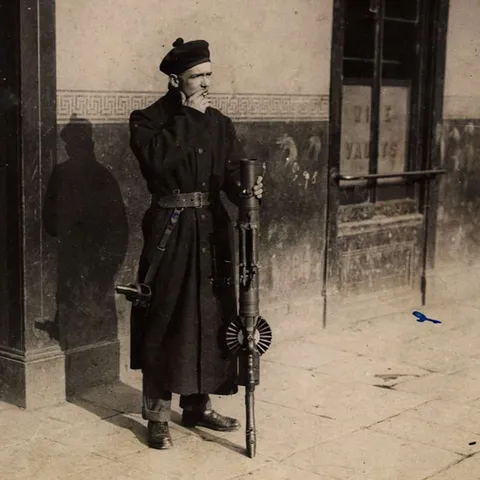
In this episode we examine the men who made up the notorious Black & Tans and the impact they had when they first arrived in Ireland. There has been a lot of discussion around these men in the last few months so it was fascinating to dive in and see who they really were. Criminals? Shell shocked war vets? Or just opportunistic mercenaries? Like all things, the answer is always more complicated than it seems but is vital in understanding what happened next in the War of Independence.
Support The History of Ireland by donating to their Tip Jar: https://tips.pinecast.com/jar/historyofireland
Transcript
Welcome to the History of Ireland. Back in 1920, there was this political cartoonist by the name of David Lowe. Originally from New Zealand, Lowe became famous for making fun of the Australian Prime Minister during World War I. From there, he moved on to Britain. Once in England, he continued his anti-establishment cartoons and created one in particular that really helps me in figuring out both Lloyd George’s political situation and his approach to Ireland.
It’s a classic old-school newspaper cartoon. All line drawings, cartoonish figures and labels so you can tell what each bit represents. In this one, Lloyd George is seen riding a two-headed donkey, led by a big, fat, Churchill-looking Tory. The two-headed ass, as it became known, represented the coalition government. It was an insult that really stuck. The joke was that due to the confusing liberal-conservative-unionist coalition, the government’s policies were a bit of a mess. And as well, it’s kind of a perfect way to describe how Lloyd George’s government approached Ireland. Their refusal to acknowledge, quote, the Irish problem as a war, but their insistence on wrapping up the militarisation of the RSC, is a weird bit of doublethink that could only have been carried out by, yeah, I guess you could say a double-headed ass.
Today, we’re going to look at how this double-headed ass actually went about instigating their new policy in regards to Ireland. Yep, it’s time to properly introduce the Black and Tans. Before we go any further, let’s explain why these new recruits to the RSC actually became known as the Black and Tans. With names like this, it’s always hard to pinpoint an exact origin. With names like this, it’s always hard to pinpoint an exact origin. But as far as I can discern, here’s the story.
The first written example of the name is found in an article from the newspaper The Limerick Echo. The article was written by Christopher O’Sullivan, so we’ll give him credit for coining the nickname. As the story goes, at a train station he met a belligerent man dressed rather oddly. O’Sullivan writes he shared the compartment with, quote, wearing the black cap and tunic of the Royal Irish Constabulary and khaki trousers of the British soldier, who spoke with a pronounced English accent. He continued in another article, saying, Most certainly he bore no comparison whatsoever with our RIC and heaven help Ireland with this latest innovation in the cause of peace. You see, the Scarteen Hunt were a well-known foxhound group around the area. The not-so-subtle allusion to the violent hounds would not have been missed by O’Sullivan’s readers. The name was then further cemented in the public imagination when a comedian from Ennis, Mike Nono, referenced the article and made a quip about the name at one of his shows. From there the name stuck and the oddly clad new recruits became known as the Black and Tans.
The reason they were so oddly dressed was due to quite a bad shortage of the RIC’s bottle green uniforms. The story goes that seamstresses across Ireland were now refusing to work in RIC uniforms. So instead, the new recruits were issued military khaki. The men were then forced to wear a hodgepodge of dark green and khaki, or black and tan. Hence the name.
Recruitment for the group began in January 1920. It’s important to remember that they weren’t really a separate unit. They were simply new irregular recruits for the RIC. It’s just due to the nickname that we get the sense they were their own group. And then this is further confused by the Auxiliaries, a group who were a newly created unit. But don’t worry about them for now, we’ll be introducing them later.
Over the course of the war, between early 1920 and July 1921, about 13,000 new recruits were added to the RIC. Considering that the RIC was only about 10,000 men to begin with, shows how much these Black and Tans took over the force. As historian W.J. Lowe puts it, It is hard to imagine the RIC executing a systematic reprisal policy against civilians without these new irregulars.
A recruitment drive was carried out throughout Britain. We actually still have copies of the ads. They’re pretty simple. Do you want a job? The headline shouts. With a subhead telling readers, You can join the RIC, the finest constabulary force in the world. And it was advertised as a pretty sweet gig. Opportunity for promotion, a full month’s paid leave, free accommodation, and 10 shillings or 50 pence a day. Which was pretty bloody good pay for a policeman back then.
After the War of Independence, Pierce Beasley, Sinn Féin’s propaganda artist extraordinaire, described the recruitment of the group as such. The Black and Tans were largely driven from the criminal classes, and authentic cases were discovered, where they’d been released by a beneficent government from penal servitude, incurred through revolting crime, to enable them to bring the lights of English law and order to Ireland. They were in short, dirty tools for a dirty job.
Now look, there’s no proof to back this up at all. And the more research done into the recruitment, the more it seems like it’s a case of classic propaganda. In fact, we have a quote from the RIC constable working in London at the time, arguing against this assertion. He said, quote, A canard has been put about. We recruited criminals deliberately. We had a police report on every candidate, and accepted no man whose army character was assessed at less than good. End quote. The case can definitely be made we shouldn’t take an RIC constable at his word. But no research has been able to corroborate Beasley’s stories of criminals being purposely employed.
So if they weren’t criminals, who were they? Well first of all, the majority were English and Protestant. There was a smattering of Scots and Welshmen, and even a few Americans. And actually, a surprising fact that jives with the popular narrative, is that there were Irish Black and Tans. Some say 5%, others say 19% of the recruits were Irish. It’s probably somewhere in the middle to be honest.
But regardless of where they were from, the majority were likely to have fought in World War I, with over 65% of the Black and Tans noted down as veterans. This is no real surprise. These were young men, their average age was about 26, who’d fought in one of the most horrific wars in history, and they’d come home with no real prospects. By some counts, there was more than 150,000 unemployed veterans in Britain at the time. Signing up to the RIC was a chance to make money, and do what they’d been trained for. Gladstone and Churchill were looking for an army in all but name, and these vets were the perfect pool from which to recruit from. Though it did have issues.
We get a good glimpse into what these men had lived through thanks to Douglas Duffy, a member of the Black and Tans who wrote a memoir. Duffy served in the Merchant Navy during World War I, joining when he was 13. While at sea he was torpedoed twice by German U-boats, and in one of those instances was the only crew member left alive. He was 16. While the ship was sinking and his crew were drowning all around him, he prayed and promised himself if he survived he would join a monastery. Which is exactly what he did. But he only stayed for about two years, and left due to constant fighting with the abbot.
So then, at age 19, he didn’t know what else to do. He was out of the Merchant Navy, the war was over, and he had given up on the life of a monk. That’s when he saw one of the adverts for the RIC. For an ex-navy guy with no prospects, the idea of a cushy RIC job seemed pretty appealing. The way he tells the story, he decided to join on a Monday morning, and quote, The following Friday at dawn I was steaming into Dublin Castle with a rubber stamp marked on my arm. He lied, saying he’d fought with the rifle brigade, so as to avoid extra training. And as quick as that, he became a Black and Tan.
So, although the RIC weren’t hiring from criminals, it’s also clear that they weren’t particularly strict in terms of vetting, and instead were hiring veterans who had seen some pretty horrible stuff. This is sometimes used as justification for what the Black and Tans would go on to do. They were disturbed, shell-shocked soldiers. Young men suffering from PTSD, before the term was ever coined. A generous take could be that they were victims of WWI, who should never have been deployed back in the field. And if we were to approach it with class in mind, it’s clear these were generally lower class men who’d been sent off to fight in WWI, and now again, due to financial struggle, were being sent into the firing line.
When Duffy arrived in Dublin, apparently the first thing he saw were four coffins draped in the Union Jack being sent home. The British were ready for these young vets to die, and in fact began to order coffins from wholesalers to avoid retail prices. Classy as ever.
So yeah, with all that in mind, maybe dirty tools for a dirty job is a correct descriptor. Even in Piers Baisley meant it in a very different way. I don’t say any of this to excuse their behaviour or defend them. You’ll learn as we go on that what they did was abhorrent, and explaining it away as simple PTSD is maybe a bit of a cop out. But I think it’s important to be aware of the context and where these men were coming from. One of the dark and fascinating parts of history is trying to understand how one group of people can treat another so violently. And their background, though definitely not the whole story, does provide insight.
Anyway, new recruits were trained in either Phoenix Park or Gormanstown, County Mead. Though I think we can use the term trained fairly loosely. Over about a month they received pretty basic instructions in policing and were sworn in as temporary RIC constables. Then on the 28th of February we start to get news reports about the new recruits. The Mead Chronicle wrote, Some eight or ten members of the Royal English Constabulary marched to Navon on Tuesday. They were in a sort of hybrid uniform, blue overcoats with khaki trousers peeping out beneath.
These new recruits were not particularly liked by the old members of the RIC, and it very quickly became clear the typical RIC disciplinary code was not enough to control these men. And three weeks was not nearly enough time to turn them into policemen. Once they landed on the ground they acted, unsurprisingly, just like soldiers, quickly alienating the Irish across the board. Helped along by the Irish Bulletin, they very quickly gained a reputation for drunkenness, indiscriminate shooting and intense brutality. It’s even said they were violent other policemen.
This was in stark contrast to the IRA. As one English general described it, the IRA were transparently sincere and single-minded idealists, highly religious for the most part, and even with an almost mystical sense of duty to their country. They fought against drunkenness and self-indulgence. As a class they represented all that was best in the country. The IRA seemed to be particularly free from ruffians of the professional type. Behind their organisation there is the spirit of a nation, of a nation which is certainly not in favour of murder, but which, on the whole, sympathises with them and believes that members of the IRA are fighting for the cause of the Irish people.”
Now look, that’s not to say the IRA were angels who never committed any atrocities, but it is interesting to see that this is how they were viewed by even some of the British. Despite being constantly branded as a murder gang, the IRA were winning the propaganda war, and the introduction of the unruly, violent and ill-disciplined Black and Tans only helped the IRA in Sinn Féin’s propaganda efforts.
In the coming episodes we’re going to explore how these two forces clashed over 1920 and how the violence escalated. And I know, in this episode I’ve spoken a lot in generalities about what the Black and Tans did, without really going into detail. That’s purely because I wanted to focus on who they were before we get into what they did. As we carry on into 1920 we’ll explore both sides and focus on numerous instances of Black and Tan brutality. But for now, let’s leave it there.
Thanks for listening. Subscribe wherever you get your podcasts and if you’re enjoying it, tell your friends. It’ll really help. You can also get in touch with us through thehistoryofireland.com or follow us on Facebook. If I made a mistake, let me know.
The History of Ireland was written and produced by me, Kevin Dolan. Additional research and fact-checking by Robert Babington, music by Liam Doyle and production help from Aoife Murphy. This podcast was recorded on the lands of the Wurundjeri people of the Kulin Nation. Sovereignty was never ceded.