Episodes Irish Revolution Season 1 — The Revolution
Tudor's Beasts: The Auxiliaries Arrive
Transcript
Welcome to the History of Ireland. Have you ever read H.G. Wells’ novel The Island of Dr. Moreau? Or at least seen The Simpsons Halloween rip-off? It’s a wonderfully Victorian story of an experiment gone wrong. About the strange Dr. Moreau who creates a group of half-human, half-animal beasts. The novel follows a poor shipwreck survivor trapped on an island gone mad. An island where the beasts eventually escape from Dr. Moreau’s control and run amok. Why mention it? Well, for one it’s a great book. But mostly it’s because historian D.M. Leeson uses Dr. Moreau’s creation to describe the Auxiliaries. A hybrid force of beasts created in an ill-conceived experiment who caused havoc throughout Ireland. Now, it’s a little bit of an inflammatory comparison. And if nothing else throughout this podcast, we’ve learned that things are never as clear-cut as they seem. But I do love the poetics of it. So let’s dive in.
First of all, I know what you’re thinking. A new force of men sent into Ireland to fight Sinn Féin? Yeah, we did this already, Kevin. Remember, you had two episodes all about the Black and Tans. Let’s move on. Yes. By July 1920, the Black and Tans had already been in Ireland, causing trouble for a few months. And, as we know, things were getting more and more violent throughout the summer of 1920. Increasingly, the Black and Tans, working in large groups out of barracks across the country, were struggling to combat the hit-and-run guerrilla tactics of the IRA. And so a new force was created to bolster the Black and Tans, who were bolstering the RIC. And though they often get lumped in with the Tans, they were very much their own unique entity. A new force of elite officers who would take the fight to the IRA. A force created separately, recruited separately, and ran separately from the Black and Tans. They were called the Auxiliary Division of the Royal Irish Constabulary, or simply the Auxiliaries. And their creation is a bit murky, but let’s try and tease it all out.
In February 1920, Lord French, who we know had been crying out for RIC reinforcements since late 1919, also asked for a specific kind of unit. He demanded that 300 demobilised army officers should be appointed to organise the defence of barracks and command in case of attack, but not to interfere with ordinary police duties. As we know, at the time this idea was shot down in favour of simply reinforcing the RIC with English recruits, who became known as the Black and Tans. However, over the course of the year, as things began to deteriorate, the idea was re-proposed. This time by someone much more influential than French. At a cabinet meeting on the 11th of May, Churchill made a proposal described in meeting notes as follows, With a view to relieving the continued demands on the military forces, and to raising a force more suitable for the present emergency in Ireland, the Secretary of State for War undertook to submit to the cabinet a scheme for raising a special emergency gendarmerie, which would become a branch of the Royal Irish Constabulary. This, despite all its elegant language, was again turned down.
But Churchill’s friend General Tudor ran with the idea. And two months later, on the 6th of July 1920, after getting approval, he announced that he had, quote, just recruited 500 ex-officers and a number of ex-soldiers which formed a fine body of men, and he felt that given the proper support it would be possible to crush the present campaign of outrage. Tudor’s idea stole a little bit from both French and Churchill. As French had proposed, the force would be made up entirely of ex-military men from the officer class. And no doubt influenced by Churchill, Tudor’s men would be positioned as an elite force of, quote, temporary cadets. What temporary cadet actually meant is a little unclear. Basically, just that they weren’t really RIC officers, but rather a unique sort of special set of recruits who wouldn’t deal too much in policing, only in combating the IRA. It was a bit of a weird experiment, and they were seen as a hybrid mix of an elite army squad and a police force. Hence Leeson’s Dr. Moreau comparison from earlier.
Tudor also wanted to ensure that this force was mobile and ready to hit back at the IRA’s guerrilla tactics. He stressed the, quote, importance of having a mobile police force to send to threatened points and to work disturbed areas. The auxiliaries would be kitted out with a series of trucks and cars, allowing them to quickly traverse the country and stamp out any guerrilla attacks by the IRA. And for a country that had just fought a very bogged down, static world war, the idea of this mobile elite was kind of radical. It was a bit of an experiment.
So Tudor had a vague plan and approval for his strange new force. All that was left to do was start advertising. This one from the Times gives a good idea of what Tudor was looking for. It said, Ex-officers wanted. £7 a week, free uniform and quarters. Must have first class records to join Auxiliary Division Royal Irish Constabulary. 12 months guaranteed. £7? That was crazy. It was twice as much as what Black and Tan would have made and was very enticing to the huge number of unemployed veteran officers who’d come back from the Great War only to find themselves smack bang in a recession. So that July it was easy to find the 500 men Tudor initially wanted. But the force was never huge, maxing out at about 2,000 men. However they were brutal and used as propaganda on both sides.
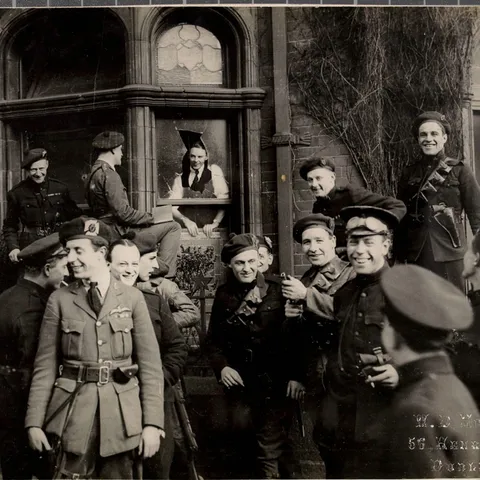
And much like the Black and Tan they very quickly embedded themselves in popular culture. Part of this is down to their strange uniform, or lack thereof. They quote, were chiefly distinguished by their lack of uniformity. Generally they wore military khaki or green with a mix of police and military uniforms. As one Auxie Bill Munro put it, really there was no uniform regulations and we could turn out in a mixture of army, RAF and naval uniforms provided we wore the regulation cap. Ah the cap, the strangest bit of the whole ghetto. David Nelligan, our beloved spy in the castle, describes them as such. Generally they wore khaki tunics belonging to their army service, complete with decorations, military riding breeches and a Glengarry woolly cap. I have no idea how they came to wear this curious headgear. I suppose some quartermaster discovered a dump of them in some store or perhaps bought them via good rate off a wholesaler.
The cap seems to really be the only consistent and defining piece of the uniform worn by the Auxies. And it was a bit random. They were Tam O’Shanters, which for those of you not up on your Scottish fashion, are basically a traditional flat bonnet. When you picture a cliched Scotsman, he’s wearing one of these hats. Why the Auxiliaries had them is completely and utterly unclear and I tend to agree with Nelligan that some quartermaster must have just found a bunch lying around. They also had TC for Temporary Cadet stitched into their shoulder straps. But no one on the ground really seemed to know the significance of the TC. And as Nelligan puts it, the Auxiliary’s own interpretation of those letters is unprintable. What a tease Nelligan. Now all I can do is imagine what TC would have stood for.
One theory for the caps was that it positioned the unit as an elite tough squad as the Highland regiments were well known for their bravery. This was compounded by the fact that the Auxiliaries were encouraged to wear leather bandoliers and thigh holsters. Simply to make them look like badass Americans. As our Auxiliary Bill Munro wrote, some of us were influenced by western films and wore our revolvers in holsters, low slung on the thigh, which looked very dashing but which were the cause of quite a number of shot off toes as the enthusiasts attempted to emulate the cowboys of Texas. Sounds very elite.
The haphazard uniforms made things difficult and they’re actually stories of flying columns and Auxiliary patrols getting mixed up by both sides. There’s one very confusing incident where Auxies were blamed for attacking a convent when it was actually the IRA who’d mistaken the convent for a barracks. Or another incident when an Irishman revealed to a flying column that he was a spy after mistaking them for an Auxiliary patrol. So yeah, the uniforms were a tad confusing.
But more important than the uniforms is who was actually wearing them. The recruits were all from the officer class and the majority were ex-Royal Air Force. But interestingly, most of them were not what you’d imagine when you think of posh upper class British officers. They were more likely to be working class men who’d risen up through the ranks in World War I and their average age was 35, making them much older and more experienced than your normal black and tan. But some argue that a lot of the wartime experience was unhelpful in Ireland. Due to the nature of World War I, most men had fought in the static trenches in France. One officer, Douglas Wimberly, compared the war in Ireland to something more akin to the patrols quote, deep behind the Red Russian Front and said that it was his time in Russia that helped him survive Cork. He continued, One rode down the forest tracks with a feeling, all the time, that one might be ambushed. And ambushes did occur. This kind of, what might almost be termed, boy scout warfare, again taught me some military lessons, which I found useful later both in Southern Ireland and on the northwest frontier of India. It was all so entirely different to the continuous lines of trenches we were used to in France.
And those not lucky enough to have had Wimberly’s past experience were not particularly trained up or prepared for what was going on in Ireland. In fact, much like the Black and Tans, they were simply rushed into the conflict so as to sure up the members of the RIC. They began arriving towards the end of July 1920 and trained at the Curragh, with their headquarters being placed at Beggars Bush Barracks in Dublin. As Bill Munro puts it, we spent about six weeks messing about. What little we got of instructions had very remote relationship to the work we had to do in the country. Theoretically, we were put through a shortened police course, having impressed on us the meaning of a misdemeanor and a felony, our powers of arrest, and what we could and could not do. There was a certain amount of arms and bombing practice, but all very sketchy, with instructors being drawn from our own number. And there seemed to be no real focus on training the men for the mobile approach they were being asked to undertake. As Munro explained, some of the drivers were sitting behind the wheel for the first time and barely knew how to change gears.
So after the six weeks of training, in around September 1920, the auxiliaries were sent out throughout Ireland to act as a counter-insurgency force. Their goal was to hunt down the IRA, and what they lacked in training, they made up for in brutality. Tom Barry of the IRA Cork Brigade describes how they would arrive into a town. They had a special technique. Fast lorries of them would come roaring into a village. The occupants would jump out, firing shots, and ordering all the inhabitants out of doors. No exceptions were allowed. Men and women, old and young, sick and decrepit, were lined up against the wall with their hands up, questioned and searched. No raid was ever carried out by these ex-officers without their beating up with the butt ends of their revolvers at least half a dozen people. They were no respecters of persons and seemed to particularly dislike the Catholic priests. They quickly became notorious. They would drink, steal, murder and flout the law in their eagerness to terrorise the Irish population. And though the Black and Tans are arguably remembered and hated more due to their catchier name, it was the auxiliaries that carried out some of the most despicable atrocities of the war.
The deputy adjacent general noted the following in what he saw as a defence of the auxiliaries. Quote They had all the wind up, blood up, and did what they used to do in the trenches in France. In the circumstances, you cannot hold them criminally responsible. They are not fit to be policemen. But are any auxiliaries? Even General MacReady begrudgingly admitted in his memoirs that those companies that had the good fortune to have good commanders, generally ex-regular officers, who could control their men, performed useful work. But the exploits of certain other companies under weak or inefficient commanders went a long way to discredit the whole force. This we know was a recurring theme with the British. They ignored the systematic issues that were really at the root of the violence caused by the auxiliaries and instead blamed it on a few bad apples. Sounds familiar to those of us living in 2020, doesn’t it?
Regardless of whether it was a few bad apples or a system of sanctioned reprisals, the auxiliaries would go on to brutalise the Irish people between their formation in 1920 and the end of the war. This is not the last time you’ll hear of them and in future I plan to dedicate whole episodes to some of what they carried out.
The historian A.D. Harvey sums up his article on who were the auxiliaries by describing them as follows. School boys would become killers instead of going to university. Working class men disorientated by wartime promotion to the status of officers and gentlemen. Fractured personalities whose childhood maladjustments had found temporary relief in the war and whose outward stability depended on the psycho reassurance of a khaki tunic on their back and a Webley 455 on their hip.
Now, it’s a cliché to explain away both the tans and the auxiliaries action as the work of psychologically damaged men. And as we know, this argument goes a long way to getting the British establishment off the hook for its policy of reprisal. However, I do think it’s important to try and understand these men as well as contextualise them and the impact of World War I should not be understated. It’s easy to paint them as beasts, to fall into the poetics of Dr. Moreau and discuss General Tudor’s crazed experiments of hybrids. It helps us all feel better about humanity. But these were men, not animals. Men, due to the circumstances they were subjected to, due to the government they were working for, due to their own warped view of the world, did some pretty horrible things during the Irish War of Independence. And, while I mention it, it’s equally important to point out that the auxiliaries did not have a monopoly on wartime horrors. The IRA could be just as bad.
But interestingly, Harvey, like Leeson, also compares the auxiliaries to a certain kind of beast, though his are much scarier. As he puts it, their misconduct in Ireland is more easily understood when one reflects that in Germany it was men of this sort who flocked to join the Frey Corps, the right-wing paramilitary bands which flourished in the early days of the Weimar Republic. Hybrid experiment gone wrong? Proto-fascists? Damaged war vets? A response to the IRA’s own violence? Or simply an effective arm of the British reprisal system? It’s important to keep all of those definitions in mind in future episodes as we explore the auxiliaries and their actions in the War of Independence.
Thanks for listening. Subscribe wherever you get your podcasts and if you’re enjoying it, give us a review on Apple Podcasts or tell your friends. It really helps. You can also support the show, buy merch, and get in touch all through our website thehistoryofireland.com Or you can follow us on Facebook or Twitter. It’s always great hearing from you guys. And if I’ve made a mistake, please do let me know. The History of Ireland was written and produced by me, Kevin Dolan. Additional research and fact-checking by Robert Babington, music by Liam Doyle, and additional help from assistant producer Aoife Murphy. This podcast was recorded in the lands of the Wurundjeri people of the Kugel Nation. Sovereignty was never ceded. The History of Ireland was written and produced by me, Kevin Dolan. Additional research and fact-checking by Robert Babington, music by Liam Doyle, and additional help from assistant producer Aoife Murphy. This podcast was recorded in the lands of the Wurundjeri people of the Kugel Nation. Sovereignty was never ceded.