Episodes Irish Revolution Season 1 — The Revolution
The Connaught Rangers Mutiny
Transcript
Welcome to the History of Ireland. At the very top of India, about six hours from Delhi, in the northwest state of Punjab, is the industrial town of Jalandhar. Supposedly named after a very handsome demon king, today Jalandhar is largely made up of Sikhs and is a huge manufacturer of sporting equipment. Back in 1920, it was simply another city under the rule of the British Empire. It’s here, just under 7,000 kilometres from Ireland, that this week’s story takes place. Don’t say I never take you anywhere.
It’s one last event from the summer of 1920 that I want to dive into. With a little bit of a sprinkling of some Indian history from 1919, I hope you don’t mind me the digression. The story raises lots of questions about Irish colonialism and Ireland and Indian independence and it’s kind of just too fun to ignore. Let’s jump in.
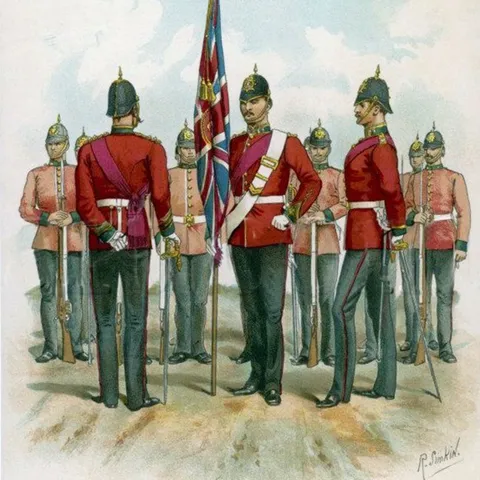
It all centres around the Connacht Rangers, so we better introduce them. The Rangers were a regiment of the British Army with a long and well-regarded history. Formed way back in 1793, they’d fought in the Napoleonic Wars, the Second Boer War, World War I, and had even been mobilised against the 1916 rebels. Like a lot of British regiments, the Rangers were all but destroyed in World War I, facing heavy casualties at the Battle of the Somme and in the German Spring Offensive of 1918. But recruiting continued and in 1919 the Rangers had two battalions of relatively new recruits. Once the War of Independence broke out, they were quickly sent away from Ireland, with the first battalion placed in Dover and the second sent to, you guessed it, Jalandhar in India, or as it was known by the British at the time, Jalundur. It seems from Dingle to New Delhi the British have a way of butchering place names, though to be fair I can’t really blame them as I’m probably mispronouncing Jalandhar myself. The idea was that by sending the two regiments of Irishmen out of Ireland, the army would reduce the risk of divided loyalties becoming an issue. I don’t think I’m giving anything away by telling you that this plan didn’t really work.
Our story starts on the 27th of June 1920, a very hot and sticky Sunday. Joe Hawes, one of the Rangers, had recently been back home to County Clare and had seen first hand what was going on in Ireland. In particular he told of quote, his indignation and humiliation at the breaking up of a hurling match by British soldiers. Hawes was only 26 but was a veteran of World War I and a proud Connaught Ranger. What he saw in Ireland made him reconsider his position. He wasn’t the only one. All the men had heard reports of what was going on back home and it was making them uncomfortable. A lot of them were new recruits and it’s interesting they had joined the Connaught Rangers even though many of them had Republican leanings. Anyway that’s how five of them found themselves sitting in the 40 degree heat discussing a fairly radical move for a group of young soldiers.
Now there’s actually archive RTE footage of an interview with Hawes where he describes what happened that night. It’s fascinating and worth a watch, I’ll post it online. Hawes said the conversation went as follows, quote, We were having just the usual chat, discussing Ireland, the state of things and what we were doing out in India. I said to them, well we’re out here in India, we’re doing the very same job as the British are doing in Ireland, suppressing the Irish people. We’re out here to suppress the Indians. We’re doing the very same job. They said, I think you’re right. And I said, well is it not up for us to do something about it? What can we do they said. Yeah, sure we can do a lot of things. We’ll lock ourselves in for the night and we’ll walk over to the guard room in the morning and we’ll hand ourselves up. And we’ll refuse to soldier any longer for the British government until such time that they withdraw their troops from Ireland and give Ireland her freedom. End quote.
Now before we go any further, I want to quickly, and I mean very quickly, go into the situation in India at this point in history. To put it lightly, in 1920 the Punjab was in a fairly precarious position. A year before, on April 13th 1919, the region had been shocked by the Jallianwala Bagh Massacre. This occurred in Amritsar, just over an hour from Jalandhar. Like any foray into other histories, this is going to be a very very simple overview. Massacre really deserves its own episode from someone much more well versed in Indian history than I am. But basically, the British army fired rifles into a crowd of unarmed Indian men, women and children who were peacefully attending a freedom movement rally. The British admit that 379 people died, while the Indian National Congress puts the figure closer to 1000. Either way, that is a horrible number of deaths and it shook the entire country. Many in fact argued that it was a decisive step towards the end of British rule in India.
And interestingly for our story, it was overseen by an Irishman. Michael O’Dwyer, a Catholic born in Tiberary, was Lieutenant General of the Punjab at the time. He supported the shootings and introduced a backdated martial law to ensure it was legal, which doesn’t really seem like it should be allowed. As he put it, quote, Jesus Christ. O’Dwyer is kind of a fascinatingly horrible man. He was pro-home rule for Ireland, but hated the violence that 1916 and the war of independence had brought to the country. He believed something similar would happen in India, and basically didn’t trust India with democracy, saying, quote, The demon of democracy should not be introduced to India with its infinite variety of races, creeds and traditions. And he had no remorse for the massacre, saying, quote, It never lost me half an hour of sleep. Just because you believe in one nation’s right to rule doesn’t mean you couldn’t be a horrific racist. Who knew?
Generally, we like to ignore the contradictory hand Irishmen played in British colonialism. It doesn’t really sit well with our view of ourselves. But there were Irishmen happy to engage in racist colonialism across the world. O’Dwyer is just one horrible example. And in a weird bit of Inception-esque racism, some of the British establishment actually blamed the massacre on the fact that O’Dwyer was Irish. They called him a rough little Irishman, and argued that had we had Englishmen in their places, the trouble would not have arisen, or would not have reached anything like the same dimensions. It was an easy way for the British to get themselves off the hook and blame the whole thing on the Victorian notion of the quick-tempered, unruly Irish. But anyway, for our purposes, it’s just important to know that the Punjab was in a state of turmoil, the Indian independent movement was gaining traction, and an Irishman had been in charge while the whole ugly debacle unfurled.
Just before we go on, it should be pointed out that O’Dwyer would actually be assassinated in 1940 by Udham Singh, a man who became a hero in India for his actions. And look, I can’t say I feel too sorry for O’Dwyer. It’s very hard to imagine that the Jallianwala Bag Massacre would not have been mentioned by the Connacht Rangers on that Sunday night in 1920. But regardless of whether it was or not, they decided they wanted to make a stand. Though it’s important to note that generally they were striking due to what was going on in Ireland, not what occurred in India. How much they wanted to help Indian nationalism is a complicated topic that I’ll come back to later.
So, on the morning of June 28th, after an evening of debate, Halls, with cigarette in hand, quote, coolly informed his commanding officer that the men would not return to their duty until all British soldiers had left Ireland. As Halls tells it, they then went down to the local Indian seamstress and had them stitch together a tricolour, which was then ran up the flagpole. Initially the protest was steadfast and peaceful. Hundreds joined the initial five mutineers and soon they had taken control of the barracks. They wore Sinn Féin rosettes, sang rebel songs and waved the aforementioned newly stitched tricolour.
The next day, on the 29th of June, the Rangers sent messengers to their other two garrisons at Solon and Jutug. The men of Jutug declined the invitation to join the mutiny, but those at Solon were very much on board. The messengers had taken the train to Solon, at 20 miles away, situated in the stunning foothills of the Himalayas. They then hid in the forest outside the barracks until midnight. They managed to evade the sentries and sneak into one of the huts, where they asked the Solon men to join them. The messengers were quickly arrested, but they were successful in convincing the Rangers at Solon to join the mutiny. The men handed in their guns and took on an air of passive resistance.
The Solon mutineers were led by James Daly, who had a brother in Jalandhar. Daly was said to be a remarkable man. Only 21, he was assertive and very cool under pressure. Daly quickly decided that handing over the weapons had been a bad idea, and on the evening of July 1st, he and around 70 men armed with bayonets attempted to regain control of their rifles. This move from passive resistance to a more violent approach did not go over well. And what changed Daly’s mind about the arms is unclear. Maybe the 21 year old just got antsy. Whatever the reason, Daly and his men arrived at the munitions store, and he allegedly shouted at the men guarding it, saying, If you want to know who the leader is, I am, James Daly, number 35025 of Tyrell’s Pass, County Westmeath, Ireland. The mutineers attacked, and in the confusion that followed, the loyal soldiers shot and killed two men, Patrick Smythes and Peter Sears.
The move from passive resistance to an outright attack with actual casualties immediately escalated the situation. The mutineers were forced to back off, and within two days, both the barracks at Jalandhar and Solon were under the control of loyal regiments. In the end, 61 men were charged with mutiny and court-martialed, while 14 were sentenced to death. But as it happened, only one man was executed. Not Joe Halls, the clairman who’d instigated the whole thing, but rather James Daly, the self-appointed leader from Westmeath. On the 2nd of November, 1920, the 21 year old was shot at sunup. He was the last soldier of the British army to be executed for military offence. And in his last letter to his mother, he wrote, I wish to lord that I had not started on getting into this trouble at all, but it is all for Ireland.
And that was the end of the admittedly short-lived Connacht mutiny. Though relatively small, it did cause quite a stir in Ireland. Unsurprisingly, James Daly very quickly became another martyr for Sinn Féin’s cause, and the whole mutiny was used as more propaganda. For years, there were songs, plays and poems written about the men. While in India, the nationalists praised the mutineers. The Fata newspaper in Delhi pointed out that the mutineers had adopted Gandhi’s principle of disobedience. While a nationalist Indian paper in America even ran a short story about a gallant Irish soldier named Shane O’Neill, who ditched his uniform for quote, native costume, and began leading an Indian separatist cell. The story ends with him saying, What’s sauce for the goose is sauce for the gander. If freedom is good for Ireland, it ought to be good for India. Total and utter fiction, but fascinating to see how even Indian nationalists saw that there was some propaganda value in the mutiny, and how the Irish revolution was inspiring people abroad.
And it is important to look at the Connacht Ranger mutiny in terms of Indian independence rather than just Irish. Most Indians would not have really seen a difference between the Irish and the British. But Indian nationalists did see Ireland as sort of a test case, and the British knew this. It’s arguably why they executed James Daly. As Stephen Lally, one of the mutineers, put it much later, I thought we might as well kill two birds with one stone, and if we could get the Indian national movement with us, it would mean a great victory, not alone for Ireland, but India as well. We could have officered the native ranks, and in a very short time, India would have gained her freedom.
Now there are two interesting things from this quote. One, do you notice how Indian nationalists, were going to officer the natives? Little dodgy. But also secondly, this was exactly what the British feared. If the rangers had convinced Indian troops and the British army to mutiny, it would have been a much bigger problem than just if a few Irish lads decided to do it. And as we know, due to the Jallianwala Bagh massacre, the British in Punjab were in a precarious position. When asked about the execution of James Daly, Lord Chemsford, the viceroy at the time, said the following, We should find ourselves in a position of great difficulty in the future, with regard to Indian troops, if, in the case of British soldiers, we did not enforce the supreme penalty where conditions justified it. The historian Thomas Bartlett puts it like this, The fact was that the mutiny of the Connacht Rangers had mildly shaken British rule in India, not Ireland, and the mutineers had to suffer accordingly.
Which brings us back to whether or not the British were right. Which brings us back to whether or not the mutineers actually supported Indian independence as Lally argued. If they did, they went about it in a funny way. They never tried to make contact with any of the Indian nationalist movement, and Bartlett argues that they may have actually acted so passively not because they were copying Gandhi, but rather because they didn’t want the local population taking advantage of the disturbance. It’s very hard to make a call on it one way or the other, but look, I like to believe Lally and Halls when they say they hope to support Indian independence, even if it’s just the optimist in me. And regardless of whether or not the mutineers were pro-Indian or not, generally the Irish and Indian nationalists did see each other as allies against the British. In fact, it’s said that Eamon de Valera and Joella Harlaniru, who would go on to become the first Prime Minister of India, often wrote letters to each other.
So that’s the Connacht mutiny. A rather strange and arguably inconsequential event, but one that opens up all these interesting questions about Ireland and colonialism, as well as links between Ireland and India. Over the years after the mutiny, there was actually quite a lot of work done to get the bodies of the three men who died in India back to Ireland, namely Patrick Smythe, Peter Sears and of course James Daly. And it wasn’t until 1970 that all three men were reburied in Glasnevin Cemetery. Joe Hawes, at the age of 77, attended the ceremony, pronouncing that James Daly was as brave a man as had ever stood before a firing squad. A quote I think that James Daly would have appreciated, and a pretty good way to end the story.
Just before I go though, I’d like to thank Rangan Srinivasan for providing invaluable context to the Indian side of the story. Anything I got right is thanks to him, and anything I pronounced incorrectly, well, that’s all down to me. Thanks for listening. Subscribe wherever you get your podcasts, and if you’re enjoying it, give us a review on Apple Podcasts, or tell your friends. It really helps. You can also support the show, buy merch, and get in touch all through our website, thehistoryofireland.com Or you can follow us on Facebook or Twitter. It’s always great hearing from you guys. And if I’ve made a mistake, please do let me know. The History of Ireland was written and produced by me, Kevin Dolezal. Additional research and fact checking by Robert Babington, music by Liam Doyle, and additional help from assistant producer Aoife Murphy. This podcast was recorded in the lands of the Wurundjeri people of the Kulin Nation. Sovereignty was never ceded.