Episodes Irish Revolution Season 1 — The Revolution
Pt 2: The Evening of Bloody Sunday
Transcript
Welcome to the History of Ireland. So the morning of Sunday the 21st of November 1920 had seen the biggest operation undertaken by the IRA in Dublin during the war. And anyone who knows their history knows that the day was far from over. But to understand what happened next we need to go to Tipperary a little while earlier.
You see, writing to the Freeman’s Journal the Tipperary county footballers made a fairly bold statement. A rivalry had developed between themselves and Dublin and they claimed they were the better team. They wrote in the newspaper We therefore challenge Dublin to a match on the first available date on any venue and for any object. Dublin accepted the challenge and it was decided to go ahead with the game on Sunday the 21st of November. It would be a challenge match and the plan was to raise funds for both political and philanthropic reasons. 20% of the sales would go to injured players while some would go to the IRA and the rest would go to the Republican Prisoners Dependence Fund.
The game was organised by the Gaelic Athletics Association or the GAA. Most Irish listeners will tell me that’s very obvious and doesn’t mean to be spelled out but we’ve got people listening from everywhere and I want to make it clear. The GAA was founded in 1884 to preserve and promote Irish games. There was a huge overlap between Republican sensibilities and members of the GAA. It was also a perfect place to recruit men for the IRA, the IRB and Sinn Féin. But the GAA was not a political body and tried to keep itself removed from the political situation at the time. Only about 0.00006% of GAA members were active in the IRA. That is tiny and it’s interesting in the context of Bloody Sunday because the GAA were very much in the centre of what happens next.
On Saturday 20th the Tipperary team headed up to Dublin for the match. The team took the train with the lads hopping on at various stations across Tip. At Ballybrofie and Leash a regiment of British soldiers also boarded the train. Apparently one of the soldiers made quote unseemly remarks to a priest and a Tipperary lad stepped in. A row broke out between the footballers and soldiers and that row quickly turned into a full on fight. One player in what is most likely a bit of an exaggeration tells of quote playing handball with a half a dozen of these soldiers. When we finally had them all down for the count we took two of them up and pitched them out through the carriage window.
It’s important to point out that only two of the team, Tommy Ryan and Michael Hogan were IRA members. This fight was definitely more a case of amped up young lads than a republican attack but the footballers were still worried that they would arrive into the station in Dublin to a sea of policemen. Luckily for them this didn’t occur but the fight would still have drastic consequences.
Hogan and Ryan the two IRA lads spent the night at a pub on Foley Street and heard rumours of the plan for the next day. As Ryan puts it, we were not told any details of what was being done, we just heard that there was a big job coming off in the morning. But the two men took no part in the morning’s violence. However, confusingly there was a Tom Ryan who was involved and shouldn’t be mistaken for Tommy Ryan. This Tom Ryan thought he’d take part in the hit in the morning and then head off to watch the match later that afternoon. But Ryan was part of one of the IRA groups who came upon an empty house and so he simply continued on his way to Croke Park. He’s important to mention though and it’s easy to mix him up with Tommy Ryan so I just wanted to clear that up right here.
After the attacks, Dublin became a hive of nervous activity. The British were shocked and those working for the British flocked to Dublin Castle to take refuge. The attacks had shaken them. No one knew if more attacks were to come, whether they’d be hit next and there was a huge appetite to capture the perpetrators. There’s even a story of one man shooting himself in his room thinking that he’d betrayed one of the victims by revealing their address.
The city was locked down and General MacReady began making plans to capture the gunmen. He’d heard reports of the incident with the Tipperary team on the train and it seemed that the British believed the tip team were actually a group of assassins using the game as cover to get up to Dublin. The next day newspapers would report that a band of assassins had come up from Tipperary to carry out the shootings in Dublin on the Sunday. So MacReady decided to send his men to the match to carry out a search operation.
Meanwhile the GAA were questioning whether to go ahead with the game at all. They knew how these things played out. The IRA attacked and the British carried out reprisals. With an expected 10,000 attendees going ahead with the game was a huge risk. The IRA agreed and an hour before the game was set to start three men from the Dublin Brigade came down to Croke Park to advise that the match should be called off. They’d heard rumours of what MacReady was planning.
But cancelling was complicated. For one thing it could implicate the GAA in the morning shootings. Something the GAA definitely did not want happening. They never wanted to get tangled up with the politics of everything or be seen as connected to the IRA. Secondly, the crowds were already gathering. Luke O’Toole, the manager of the grounds, argued that asking people to leave would cause a panic and lead to a crush in the turnstiles. The GAA were also basically just a little complacent. The thinking was that even if the British did come to the match it wouldn’t be the end of the world. Hindsight is 20-20 and as one GAA council member Jack Schulz has put it raids were common but we never anticipated such a bloody raid.
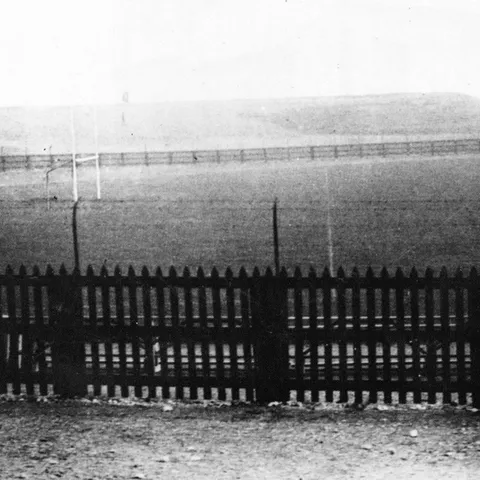
So the game went ahead kicking off at 3.15. Apparently from the offset it was clear that it was going to be a tight game and both sides were equally matched. But we never got to find out if Tipperary really was better than the Dublin side. Ten minutes after the game had started a dozen or so armoured lorries arrived. Black and tans, auxiliaries and the British military all took positions around the grounds.
MacReady had given the following orders. There is a football match between a Tipperary team and a Dublin team taking place in Croke Park this afternoon. You will surround the grounds and PK all exits. All male persons will be stopped and searched. Anybody attempting to get away elsewhere will be shot.
As the British arrived anyone outside the grounds began to run inside for safety. The British chased after them hopping over the turnstiles. They then fired off three shots which caused panic throughout the crowd and among the other soldiers still outside. Later the British argued that someone shot at them first but bar a single eyewitness who spoke at a British military trial nothing backs this up. And it’s generally agreed by historians that the British fired first.
But hearing the shots the British forces outside believed the IRA had started attacking. With this in mind they charged in and started shooting indiscriminately. An eleven year old boy William Robertson who had climbed a tree to watch the game looked back to see what all the commotion was. He was immediately shot through the chest and died two days later. He was the first Irish casualty of the day.
Then a second shot is fired. This one hits ten year old Jerome O’Leary who’d been up on the canal walls also watching the game. Like William he died as well. Things then go from bad to worse. People start to flee and the British soldiers who’d been ordered to shoot anyone running do just that firing into the backs of the crowd. The Freeman’s Journal described it saying the whole place was a mass of running and shouting men and shrieking women and children.
The next casualty was fourteen year old John William Scott. As historian Michael Foley puts it he was so severely wounded in the chest questions were asked in the House of Commons the following week about whether he’d been bayoneted to death. Scott was quickly followed by Joe Trenon who was shot twice trying to hop the back wall to escape.
That back wall was about two metres high and Patrick O’Dowd, a fifty-seven year old labourer from Dublin was helping lift people up over it. He would lift people up and get them over to safety. As he was doing this he was shot in the head.
Next you had Jane Boyle a Dublin supporter who was engaged to a Tipperary man. The two had gone to the game and I can imagine them spending the morning teasing each other in that way couples from rival teams do. Her fiancé was holding onto her hand as they rushed through the crowd. Suddenly he felt her grip loosen. She’d been shot and killed. Her fiancé buried her in her wedding dress on the day they planned to be married.
So imagine the scene. Five to ten thousand people surrounded by armoured trucks bullets flying, people running any direction they can to escape. But the British were still determined to search people and were trying to contain everyone within the stadium. So as the crowd tried to flee to safety three more people, James Teehan, James Matthews and James Burke were all crushed in the stampede and died. Around this time Tom Hogan a teenager from Limerick was shot in the arm. Later it had to be amputated. He too died due to the infection.
Meanwhile on the pitch the players had thrown themselves to the ground and were trying to stay low and slowly crawl off the grass. Most of them escaped unharmed but as they were crawling they heard one Tipperary player, Michael Hogan exclaim, I’m shot. His IRA buddy Tom Ryan not Tommy Ryan, the Tipperary player remember heard Hogan and rushed back to save him. But as Ryan lifted him up Hogan moaned, Jesus, Mary and Joseph I’m done. Ryan whispered an act of contrition into Hogan’s ear but as he did so, he too was shot.
Hit in the stomach, Ryan managed to escape and make it to a hospital. Surrounded by his family he slipped in and out of consciousness telling them everything that had happened. But later that night he joined the list of casualties. Michael Hogan’s body was left on the pitch. Blood pooled around his blue and gold Tipperary jersey. Later a priest and a group of men recited the rosary over his body. The Hogan stand was named in his honour.
The shootings had only lasted two or three minutes but 278 rounds of ammunition were fired and 14 people died. But still, this is not the end of Bloody Sunday. Tomorrow we’ll look at the last murders of the day and try and unpack all of this horror. www.thehistoryofireland.com