Episodes Irish Revolution Season 1 — The Revolution
Pt 3. The Evening of Bloody Sunday
Transcript
Welcome to the History of Ireland. Over the last two episodes, we’ve outlined the two main events of Bloody Sunday. The IRA’s attack in the morning and the brutal reprisal by the British in the afternoon. But there’s still one more piece of violence and a few more names to be added to the list of casualties from Bloody Sunday.
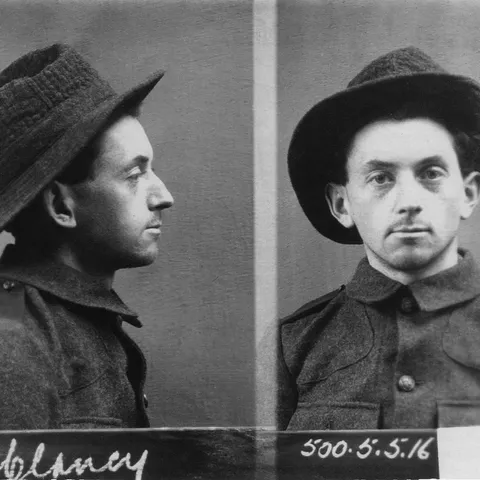
As I mentioned, the night before Bloody Sunday, Vaughan’s Hotel was raided by the British. I want to go back there just for a moment. Collins, Dick McKee, Padder Clancy and a few others had attended a meeting at 35 Lower Gardiner Street to discuss the final list of targets with Carl Brewer. After the meeting, they headed to Vaughan’s, a popular Republican haunt in the city. They went upstairs to one of the rooms to enjoy a drink and maybe go over the last few details of the operation.
However, Christy Hart, the hotel porter, had become suspicious of one of the guests. And Mr. Edwards had been staying in the hotel for three days. That night, he’d made a series of late-night phone calls and left the hotel rather mysteriously. This was strange because it was after curfew after all. So, Hart came up to Collins and said, I think, sirs, you ought to be going. The men snuck off and it seems the porter had been right. Because the hotel was raided just moments later.
Now, also staying at the hotel that night was Conor Clune, a Clare man and a member of the Gaelic League. He was up in Dublin to meet another Irish language enthusiast, John O’Connell, and Piers Baisley. When the raid had occurred, he was sitting having a drink with Baisley. Everyone scattered except Clune. It’s said he was simply forgotten about in the rush. And unfortunately for the poor man, Clune was arrested.
Dick McKee and Pat O’Clancy had escaped. But they had been followed by John Shankers Ryan. Shankers was an ex-British soldier who was given the task of trailing the two men and marking the door of their houses. Then at around 1.30am, the auxiliaries burst through the door and arrested the two lead organisers of what was about to go down that morning.
So now, sitting in Dublin Castle, you had Dick McKee, Pat O’Clancy and Conor Clune. Two of the most influential IRA men in Dublin and one poor old Gaelgar. We know what happened the next morning and then in the afternoon. The attacks on the south side of the city shook the British. They were then ordered to search the crowd at Croke Park and that turned into an ungodly mess.
After the incident at Croke Park, the British found no weapons and had captured no one linked to the morning’s attacks. Without trying to dramatise things too much, it seems like they were furious. And the only people they resembled perpetrators were McKee, Clancy and Clune. But the three lads managed to sneak keys from the British guards while he slept.
They then carefully snuck through Dublin Castle, avoiding any British forces. Despite the fact it would have been heaving like an upturned angry anthill. They stole a gun and as they climbed the steel tipped fences, they began shooting back at the British soldiers who had just copped on to their escape. In the defence, the British soldiers fired, justifiably killing all three of these guilty escapees. Or at least that’s what the British at the time wanted everyone to think.
But even those who were pro-British found this story very, very hard to swallow. Instead, historians believe the reality was a lot sadder and more brutal. Simply put, the three men were tortured and beaten to death by the angry and frustrated British forces. The death of Clancy and McKee was a huge blow to the IRA and to Michael Collins personally. As one man who’d taken part in the morning’s killings put it, their arrests knocked all the good out of it. We had no sense of jubilation as the enemy had evened up on us.
But I feel Conor Clune’s death is the real tragedy here. He really was just in the wrong place at the wrong time. And he suffered the consequences. I’m not saying McKee and Clancy deserved what they get, Jesus, no one deserves that. But they were at least involved in the fight. Clune was another total innocent. And no one really paid him much mind.
Collins was distraught though when he heard about the murder of his two friends, Clancy and McKee. After the attacks, Collins was the most wanted man in the British Empire. And McKee and Clancy’s funeral would have been crawling with British detectives. Yet still, Collins attended. Towards the end of the ceremony, he broke off from the crowd, used one of the conference’s arrests and wrote in his very messy handwriting the following. In memory of two good friends, Dick and Padder, two of Ireland’s best soldiers.
Now, it’s at this point it’s important to ask whether the IRA’s attacks can be judged as a success or not. Remember, 14 men were assassinated. But this was a far cry from the 35 on the list agreed to by Colin Brewer. And Collins was said to be disappointed that the operation hadn’t killed more men. As historian Michael Foy puts it, Some targets were unexpectedly absent but other planned actions failed due to the incompetence or lack of enthusiasm of volunteers.
It’s also hard to judge how many were actually British operatives. To this day there are arguments about how many of the 14 were quote unquote guilty. But we do have a list of the men killed and here’s a little bit of what we know. The highest ranking British agent killed was Hugh Montgomery. He would definitely have been guilty of spying on the IRA.
Next you had Peter Ames who served in MI5 and George Bennett, another leading intelligence officer. They were said to be leaders of the Cairo gang and again were probably guilty. You then had Aidan Wilde, Henry Anglis and Donald Maclean. Their resumes suggest they would have been spies but it’s hard to know. And then there was William Newbury, a barrister who’d worked against the IRA. There was also two auxiliaries, Francis Garness and Cecil Morris, who’d attended to the scenes of the crime and were captured in the ensuing firefight and shot up against a wall. So that’s seven men who you could argue were all guilty.
But then there was Charles Dowling and Captain Begully. I’d put them in the maybe pile. They were both ex-British officers. But Dowling suffered recurring dizzy spells from his time in the war and Begully only had one leg. It’s unlikely that either were top notch British spies.
And then finally you had John Fitzgerald, Patrick McCormack and Thomas Smith. Generally historians agree that these men were innocent. Thomas Smith was a father of eight. Thomas Smith was a father of eight. And nothing more than one of the landlords of one of the houses the IRA raided. Though he was friendly with the British he was definitely not a spy. And there was no reason for him to be shot.
John Fitzgerald was a British soldier from Tipperary. So maybe not totally innocent but again definitely not a spy. It seems he was mistaken for Clement Fitzpatrick who was definitely a spy. And fled Ireland five days after Bloody Sunday.
And finally there was Patrick McCormack. McCormack was a vet who’d served with the Royal Army Veteran Corp in the First World War. Again he was said to be mistaken for someone else. His mother wrote to Richard Mulcahy after the event saying quote. I am 75 years of age and naturally I felt deeply the loss of my only support in life. But I feel more deeply still that charges of dishonourable conduct against his country could be preferred against him by people who’ve always known him to be a supporter of the national aspirations of the Irish people.
Mulcahy was told by Collins to reply saying. There was no particular charge against him except that he was an enemy soldier. An enemy vet like come on. Not quite the same thing as a dastardly and dangerous British spy. I feel like those men are just like Clune. Someone caught in the wrong place at the wrong time. And arguably the attacks in the morning were just not worth it.
The killings did not destroy the British intelligence network in any way shape or form. And British intelligence continued quite successfully after Bloody Sunday. But Republicans described it as a huge success. And it has gone down in popular memory as another example of the IRA’s daring do. But when you’ve dragged innocent men from their beds and shot them in front of their wives. I guess all you can do is argue that it was justified.
As Anne Dolan puts it. The dead were all spies. Because murder could not be part of the founding myth of a nation. Because murder could not be part of the stories that many of these men felt had to be told. You should look up her article Killing and Bloody Sunday November 1920. It goes into huge detail about the men who were involved in the shooting.
In fact she’s fast become one of my favourite historians. And if you watch any of the Bloody Sunday documentaries going around at the moment. Her input is always smart, considered and just really well thought out. I almost wish we were related.
With Dolan’s quote in mind. It’s interesting to hear how Michael Collins later defended his actions. It’s a striking quote. And quite the insight into how he and others liked and viewed the operation. And some say it’s him being a little overly defensive. He said this.
My one intention was the destruction of the undesirables who continue to make miserable the lives of ordinary decent citizens. I have proof enough to assure myself of the atrocities which this gang of spies and informers have committed. Perjury and torture are words too easily known to them. If I had a second motive. It was no more than a feeling such as I would have for a dangerous reptile. By their destruction the very air is made sweeter. That should be the future’s judgement on this particular event. For myself my conscience is clear. There is no crime in detecting and destroying in wartime the spy and the informer. I’ve paid them no attention. The spy and the informer. I’ve paid them back in their own coin.
So that finally brings us to the end of Bloody Sunday. Overall 32 people died. Both sides immediately tried to start winning the propaganda war. And the events made headlines all over the world. The British were very quick to lock into a story. Though important details changed throughout the next few days. Their view was a series of retired officers had been shot in their pyjamas by a brutal gang of Irish assassins.
As Hamer Green would put it when speaking to Parliament. I hope that this series of cold blooded and carefully planned atrocities will bring vividly before the house and the public the cruel reality of the Irish situation. We are fighting an organised band of paid assassins. And if Bloody Sunday had ended with the Republican attacks in the morning. The British may have come away with a propaganda victory.
But it was harder for the British to spin the attack in Croke Park. Speaking in America De Valera compared it to the Amritsar or Jillian Nawalbaig massacre in India in 1919. And it’s interesting to take a moment and think about Bloody Sunday in the context of the wider British empire. The two attacks were very similar. With British armed forces firing into unarmed crowds. Though it’s so important to remember how much worse the Jillian Nawalbaig massacre was. The death toll there was at least 379 people. But that’s not to take away from Bloody Sunday.
The Freeman’s Journal a very pro-Republican paper called the attacks a classic sample of government reprisal. The innocent were shot down in blind vengeance. But even British newspapers like the Daily News and the Manchester Guardian refuted the idea that the IRA had fired at Croke Park. As the Guardian put it. What did unquestionably happen is that the auxiliary police rushed through the two main entrances carrying the turnstiles with them. They fired as soon as they got inside.
And in the end the British reprisals at Croke Park overshadowed the IRA’s attacks. And as we’re seeing repeatedly this turned the public opinion both in Ireland, Britain and around the world against the British government. It shook everyone’s confidence in the idea that Lloyd George had murder by the throat or really Ireland in any kind of control.
The British approach after the day changed in two ways. Outwardly it cracked down even further arresting over 500 Republicans including the acting president Arthur Griffith. They declared martial law across much of Munster and they intensified reprisals throughout the city. But at the same time behind the scenes soon after Bloody Sunday Lloyd George began slowly putting out feelers to try and engage Sinn Féin in a bid to come to a political solution. This slow move towards peace talks is not something Lloyd George would have considered even six months earlier. Maybe not even a month earlier and it shows how much Bloody Sunday shook the British psyche.
I think it’s important to end with the innocent victims from the day. Conor Clune, the innocent men killed by the IRA and of course the members of the public who died in Croke Park. Eight of the victims were buried in unmarked graves and it wasn’t until 2016 when thanks to the GAA and their relatives gravestones were erected. They just wanted to go to a football match. Clune was just an Irish language enthusiast and the other men were just in the wrong place at the wrong time. And yes you can argue it was all for a bigger cause but at the end of the day it was just bloody violence and innocents who died.
Sadly Bloody Sunday is often described as the start of the violent endgame of the War of Independence and before 1920 is out we’ll see even more violence from both sides.
The History of Ireland was written and produced by me, Kevin Dole. Additional research and fact checking by Robert Babington, music by Liam Doyle and additional help from assistant producer Aoife Murphy. This podcast was recorded on the lands of the Wurundjeri people of the Kulin Nation. Sovereignty was never ceded.