Episodes Irish Revolution Season 1 — The Revolution
Boy Oh Boy A Boycott
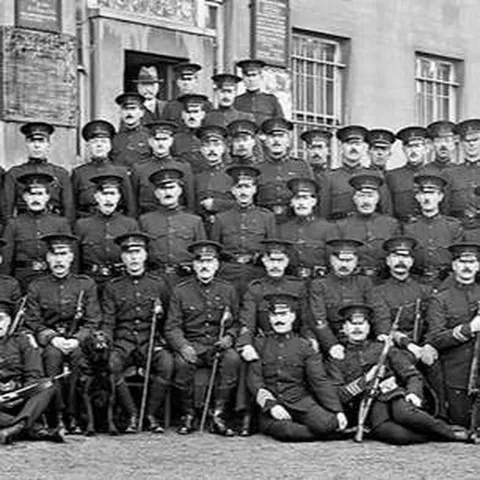
After successfully stopping conscription Sinn Fein and the Irish Volunteers started increasing pressure on the British. This led to an inevitable clash with the Royal Irish Constabulary.
In this episode we investigate the RIC, looking at how Sinn Fein turned the public against them and how this was an integral first step towards all out hostility.
Support the show through Patreon for bonus content and ad free listening!
Transcript
Welcome to the History of Ireland. When we left things last time, it was the middle of 1918 and Sinn Féin were having a pretty sweet year so far. The conscription crisis had proven they could stand up to the British and had driven more and more people towards their brand of nationalism, including the church. Sinn Féin had gone from the very fringes of political life to the pre-eminent Irish political power, replacing the Irish political party in the process. Home Rule was all but dead and Sinn Féin’s absenteeism was now a legitimate political approach. On top of this, Sinn Féin had started slowly operating as a separate government entity by standing up to the ranchers and getting involved in land disputes. It was a busy, busy time for the lads.
Their next target was the RIC, or the Royal Irish Constabulary, the local Irish police force. The RIC had first been set up in 1814 by Robert Peel, at the same time as the British police force. They earned that royal in their name after squashing the Athenian Rising of 1857. Then by the start of the 20th century they had about 11,000 men spread across 1,600 barracks. To put that in context, at their height the Irish volunteers had about 180,000 men. So yeah, the RIC were a little outnumbered.
Which is not so good for the RIC because Sinn Féin saw them as the physical embodiment of the British occupation and wanted to turn the population against them. And look, spoiler alert, they pretty much succeed. In the years that followed, the RIC have often been painted as the bad guys, seen as those who turned on their country to support an imperial oppressor. But I think seeing them solely in this light is just a bit black and white for my liking. So we’re going to try and look at them with a little more nuance.
The RIC were all Irishmen, picked for their intelligence, physique and good character. And though the upper echelons of the organisation were generally Protestant, their rank and file matched the demographics of the rest of the country. Often they were simply farmer’s sons working to support their family. Like everyone else they just wanted a good job. And it wasn’t an easy job to get. They had to work hard. In fact, it wasn’t uncommon for people to take grinds to bone up for the entrance exams. Plus once in you were expected to study the law, drill with weapons and patrol the streets.
In general, it seems like they did a pretty good job. Just like in England, the 19th century saw marked drop in crime once the RIC were introduced. And though they worked for the British, they weren’t devoid of national pride either. These guys were members of the community and keepers of the peace. Along with the local priest, they were often seen as informal leaders in an area. And being more literate than the general population, they’d even help with forms and paperwork and stuff. I’m sure they saw themselves as the good guys. Probably because a lot of them were pretty good guys.
A great example of how they were really just as Irish as anyone else is Thomas St George McCarthy. He was an RIC district inspector based in Tipperary and a huge fan of hurling. He worked hard to support the sport and became one of the six founding members of the GAA. Unfortunately, like a lot of RIC men, he was pretty much written out of history and was only commemorated by the GAA in 2009.
This treatment of RIC men is not unusual and they were often distrusted. And because at the end of the day, they were the physical embodiment of the British occupation. And it was their job to hamper anything that could lead to independence. An interesting example of how the Irish related to their local police in comparison to the British was the nickname they were given. Both taken from the name of their founder, Robert Peeler. The English police force were known as Bobbies. The RIC? They were Peelers. One is friendly, nice and endearing. The other is, well, the Peelers.
Because of this distrust, the RIC men couldn’t be stationed in their home counties, so that their families would be safe from anyone with ideas of retaliation. They stayed in big barracks, which literally became bastions of British rule. And in fairness, they were also pretty much used as spies across the entire country. Every month, each station would submit a report detailing the goings on in an area and the mood of the people. Though we’ve already discussed how, well, poor the British information gathering was, the RIC guys definitely managed to quash insurrection after insurrection simply by keeping their ear to the ground.
And the whole thing just got worse and worse, especially after 1916, as the RIC began to clash more and more with the newly radicalised groups. The sense of a civilian force keeping the peace for the locals began to erode and was replaced with the idea that the RIC men were an army of oppressors. Sinn Féin had a big hand in this, and throughout 1917 and 1918 began to push for a boycott of the men of the RIC.
The Irish love a good boycott. I think it just appeals to our passive-aggressive side. In fact, we pretty well invented the term, the name coming from Charles Boycott, a land agent who was ostracised by his community for kicking people off the land he managed in the 1800s. The idea of boycotting the police, well, that had been bouncing around for a few years, but in 1918 it really kicked off.
Sinn Féin, Cumann na mBan and the Irish volunteers all worked to have the local community ignore the RIC men with hopes of having them resign. They were intimidated and ignored, as were their families and any business seen to deal with them. Cumann na mBan went as far as to encourage mothers to take their kids off the street if they saw a policeman coming. And one of their founding members, Mary McSweeney, even argued that no decent girl would walk on the same side of the street as them. Poor lads.
The church, meanwhile, came out and said any Catholic RIC man who enforced conscription would be excommunicated and have the curse of God follow them in every land. Yeah, those old school priests don’t mess around.
There are varying accounts about how well the boycott worked in its intended aim of forcing men to resign, but we do know it was very successful on two fronts. First of all, it was hugely demoralising for the RIC. These were men who had previously had a relatively good relationship with the community and now suddenly were completely severed from those around them. Stuck, holed up in their barracks for fear of attack and ignored on the streets if they did go out. To quote one source, their lives were a misery.
Secondly, and more importantly, the boycott and Sinn Féin’s approach to the RIC successfully turned the community against the police. It was a huge blow to the British state’s legitimacy and its administrative capabilities. Suddenly the face of Britain, the guys on the ground representing the crown, they were locked up in their barracks for fear of attack and basically twiddling their thumbs.
But most people at this point, even as late as 1918, didn’t believe in an armed rebellion. From a very practical point of view they just didn’t think it was possible to beat the British Empire. 1916 had kind of proved that. But by showing that the RIC could be crippled like this, it showed that the British weren’t as all-powerful as previously considered. It highlighted the British Empire’s vulnerability in Ireland and showed that the Irish could work together to fight back, albeit passively at first.
The whole thing shifted the public’s view of the RIC. They went from being members of the community to an army of occupation, one made up of those who were traitors to the national cause. And once things start to kick off, this distinction will make it a lot easier for those fighting for independence to use violence and deadly force against the men of the RIC. They’d been successfully painted as another. Turned into henchmen in a movie. The baddies who get shot down time and time again by our valiant heroes.
And this slow offensive against the RIC is typical of the Irish-Anglo War or the War of Independence. There was no definitive start date. Instead, the situation just got more and more violent. This increased animosity and eventual aggression against the RIC was one of the first steps.
I find it a bit hard to get my head around the RIC. Like, to decide how to view them. On one hand, it’s really hard not to feel sorry for the guys. They were just lads looking for a good job. But that excuse never really holds up for long and they were also the arm of the British occupation. So what happened to them was arguably necessary so that Sinn Féin could achieve the independence they were striving for. But yeah, the poor blokes.
This is as good a time as any to address the whole subjective nature of a lot of this history. As they say, one man’s terrorist is another man’s freedom fighter and I reckon it works both ways. One man’s cop is another man’s occupying force. I’m trying to base this whole podcast on as reliable sources as possible. But as often is the case with modern history, different people have different views of what happened.
Irish history especially. People have written entire books on topics I’m condensing into a short little podcast. The aim is to give you guys a deeper understanding of Irish history without drowning you in the details. Plus, all this history is still being lived. You know, a lot of the mess that is Brexit and the Northern Irish backstop stems from this period in history. Like, some will say the War of Independence is still going. Some will argue it should never have happened. A lot of people will fall somewhere in the middle. And most don’t pay it any mind. That’s not even approaching the Civil War and discussing how there’s still echoes of the split in the Republic of Ireland’s politics.
So yeah, I’m not going to get too bogged down in all this or address my views or biases, though they’ll sneak through. But it’s just important to remember the subjective nature of history, especially in an Irish context. That’s all to say, even though in our story the RIC are the bad guys, it’s important to remember, like in all history, that they were people too. People who didn’t see themselves as the baddies. They were victims of the times as much as anyone else. Anyway, that got a little too philosophical.
Next time we’re jumping into the summer of 1918 and going out on the election trail. Thanks for listening. Subscribe wherever you get your podcasts, and if you’re enjoying it, tell your friends. It’ll really help. You can also get in touch with us through thehistoryofireland.com or follow us on Facebook. If I made a mistake, let me know.
The History of Ireland was written and produced by me, Kevin Dolan. Additional research and fact-checking by Robert Babington. Music by Liam Doyle. And production help from Aoife Murphy. This podcast was recorded on the lands of the Wurundjeri people of the Kulin Nation. Sovereignty was never ceded.