Episodes Irish Revolution Season 1 — The Revolution
Oh No We Won't Go
By 1918 Sinn Fein were on the rise. Home Rule had come to a stand still and the population had become more and more radicalised. All Sinn Fein needed was one last thing to unify the country against the British.
Did someone say conscription? Yep, that'll do.
This week, we look at the Conscription Crisis of 1918 and hear one of the big hits from that year.
Thanks to Ciaran Boyle for extra help with the music this episode. You can listen to his great EP, About Time here or follow him on Facebook.
Support the show through Patreon for bonus content and ad free listening!
Transcript
Welcome to the History of Ireland. Like a certain agreement to leave the EU, Home Rule had come to a staggering halt. And then at the same time, thanks to the British response to the rising, the Irish population was feeling more nationalistic and republican by the day. And while all this was going on in Ireland, World War I raged in Europe and had gone on longer with more casualties than anyone had ever imagined. The British government under David Lloyd George was desperate for men. And so the idea of conscription in Ireland was put forward in 1918.
Even among the British themselves, conscription had been a thorny issue, splitting the Liberal Party when it was introduced in 1916. And so conscription in Ireland had just been considered too messy. Around 140,000 Irishmen had joined the British Army voluntarily at the behest of John Redmond and the Home Rulers. But as the war went on, this was seen as more and more of a bad idea and was hated by Sinn Féin and the Fenians, who had always said Britain’s difficulty was Ireland’s opportunity. So it just shows how bloody desperate the British were at this point in the war to be considering Irish conscription. And rightly so, in fairness.
On the 25th of March 1918, the Germans had broken through the British lines. And four days later, a bill to bring an Irish conscription was written up. The Chief Secretary for Ireland, Henry Duke, argued against the move, saying it would, quote, Duke literally said we might as well recruit the Germans. He was not a fan of conscription, and he really was the guy you should be listening to. As the Chief Secretary, he was probably the most powerful man in Ireland at the time. Duke sat on the British cabinet and was in charge of running the whole country. But Duke was ignored. Much like Maxwell, who cautioned against the executions after the Rising before him. Instead, the British Parliament listened to his predecessor, Walter Long. Long had served as Chief Secretary for ten years before Duke and was seen as a bit of an Irish expert. Said to have a paternalistic view of the Irish, he announced that the Irish will talk, shout, or perhaps get up to a fight or two. But they’ll know when they’re beaten. Yeah, look, let’s see who turns out to be the expert, shall we?
Duke ended up being removed from office, and no one else really wanted to take the job. So instead, three commissioners were set up. One military, one civil, and one legal. The military commissioner was Lord French, who took up the role of Lord Lieutenant. This was the king’s representative in Ireland, and the top dog. French is an interesting guy, coming to the role from interesting places. He wasn’t one to mess around. A hero in the Boer War, he became the Commander-in-Chief in Europe for the first half of World War I. However, he clashed with the French general, and then clashed again with the Secretary of War, Lord Kitchener. After a number of defeats and failures, which, in fairness, were probably not his fault, he was asked to step down. He was demoted to Commander-in-Chief of the Home Forces, and then kind of demoted again to Lord Lieutenant of Ireland. So, by the time he got to Ireland then, he was a man determined to prove himself, and rearing for a fight.
As well as to ensure conscription occurred, he had a number of different goals in Ireland. First, he wanted to tighten controls on the press, who he saw as being too outspoken. Secondly, he wanted to arrest those spreading discontent, i.e. the Sinn Feiners who were riling up the population and turning them against the British. Thirdly, he wanted to make arrangements so any Irish city could be besieged in under an hour. And then, last but not least, he wanted to set up aircraft bases throughout the country so as to, quote, put the fear of God into those playful young Sinn Feiners. Yeah, what a lovely guy.
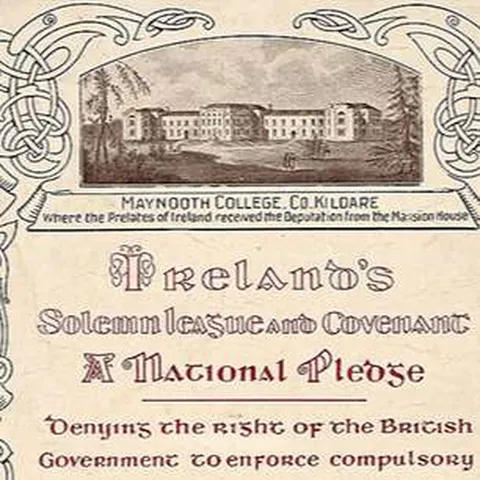
Once conscription was announced, the Home Rule Party were very much against it, and abstained from attending Westminster. This is significant because it gave weight to that tactic that Sinn Fein had been using since 1907. The IPP were now using a tactic they had previously mocked Sinn Fein for, them and pretty much everyone else. Conscription also ended the relative neutrality of the Catholic Church. Though a lot of young priests had joined the IRB and Sinn Fein, the body as a whole had kept out of things. But with conscription on the cards, they firmly took an anti-British stance. They came out and stated that conscription was an oppressive and inhuman law which the Irish people have a right to resist. They also announced that on Sunday Mass, an anti-conscription pledge would be put forward for all men. This solidified the Church and Sinn Fein’s relationship, hugely bolstering Sinn Fein’s strength.
And by all accounts, that Sunday, April 21st, 1918, saw the kind of excited nationalism that would have made the 1916 rebels proud. Over 100,000 people signed the anti-conscription pledge, and £250,000 were raised, no small amount in those days. Cumann na mBan were at the front line of this, issuing pledges, organising events, and leading the whole push. They even arranged a Lá na mBan, or the Women’s Day, as a women’s strike in support of the movement.
So, with all that going on, the British brightly balked. To save face, they didn’t abandon conscription completely, still keeping it as a thread up their sleeves until the end of the war, but for all intents and purposes, it was dead. This was seen as a huge win for Sinn Fein, and the British cemented this further by arresting 73 Sinn Fein members on May 17th, under a fabricated pretense they had been working with the Germans. This played right into Sinn Fein’s hands, helping solidify them as the pre-eminent opponents of the British. It also helps that there was no evidence to suggest that Sinn Fein had been working with the Germans, though some Sinn Feiners definitely would have liked to. On top of this, it really backfired on the British, as it was mostly the public moderates of Sinn Fein who were arrested, leaving the more radical members in control. Countess Markievicz, ever the badass, summed the arrests up saying, My present address alone, Holloway Jail, will make an excellent election address. Sending you to jail is like pulling out all the loud stops on all the speeches you ever made. Our arrests carry so much further than speeches. Yeah, badass.
So 1918’s conscription crisis really worked in Sinn Fein’s favour. Their absentee methods stopped being seen as a joke, the Catholic Church came on side, and they were seen to have put the British back in their box. A good year all round, and they were only just getting started.
Since the Rising in 1916, Sinn Fein had become the party for Republicans who wished to fight the British. And since the Rising, these Republicans had become more and more practical. As one British general put it, they were exhibiting discipline to the degree which is the most dangerous sign of the times. Even drinking was being curtailed. This was because in the past, loose lips had led to information being leaked. The Irish could sober up when needed apparently, much to the chagrin of the British intelligence officers.
As well as all this, a new cohort of leaders had taken over the movement, and they were much more practical than the poetic leaders of the past. Gone were flowery nationalistic rhetoric replaced by simple to the point speeches. And more importantly, gone was the fragmentation that had besieged the Fenians for decades. Sinn Fein basically took control of the Irish volunteers to become a single political military force ready to take on the British. The success of the Conscription Crisis was proof of this. They still remained remarkably vague about what an Irish state was going to look like, but this was out of necessity and was used to their advantage. To them, independence was all that mattered. Everything else could be figured out later. Therefore, unlike previous Republican groups, it was their methods more than their specific beliefs that distinguished them. This stopped fragmentation and needless arguing, keeping everyone focused on independence.
Because there definitely was a split. Right through to the upper echelons of the party. You had the old school passive resistance style Sinn Feiners, teamed up with the home rulers who had now jumped on the bandwagon. And neither of them were too happy with the more militaristic approach of the new wave of Sinn Fein leaders who’d come from the horizon. But somehow, the movement managed to walk the line of being loose enough for everyone to work together, but not so loose that nothing got done.
As the Conscription Crisis went on, there was one other important factor helping win people over to Sinn Fein’s banner. A low-key ranch war. As the British war effort ramped up, more and more food started getting exported out of the country, leaving some very hungry mouths. The famine was still too fresh in the collective consciousness for this to be tolerated. So Sinn Fein stepped in and started trying to rectify the situation. They appointed a food controller, Diarmuid Lynch, who swiftly moved to stop food being exported. And he didn’t wait around. He was arrested pretty quickly for stopping a shipment of pigs, slaughtering them, and distributing the food among hungry households. This greatly endeared Sinn Fein to the public. Cahill MacDoul, who would go on to arrange the Irish National Anthem, even wrote a song called The Pig Push about the whole event. We’ll share a snippet at the end. It’s worth a listen.
Sinn Fein also started breaking up grazing land and distributing it among the local farmers. Crowds of up to 500 people would march under Sinn Fein banners and take land in the name of the Irish Republic. This is fascinating on three levels. Firstly, it’s one of the first examples of Sinn Fein starting to operate a separate government to the British. Secondly, trying to court the farmers and take a stand in these land disputes forced Sinn Fein to have a political point of view, other than just the desire for independence. Stepping in and controlling rent, stopping grazers, and giving land back all helped win over the very large agricultural population. Thirdly, and related to the previous point, was how it highlighted the fractures in the movement, and the limit to Sinn Fein’s abilities. Landless and landowning Republicans obviously kind of had different views on how to deal with land issues. But Sinn Fein was trying to keep both of them happy.
Plus, there was only so much Sinn Fein could do. For example, there’s one story where a Sinn Fein club in Ballintocher announced that a farm should be divided between deserving small farmers. But unfortunately, there was a huge crowd of small farmers who considered themselves deserving. Much too many to realistically split the land between. So, what did the Sinn Fein secretary do? He announced he would consider all applicants and decide the following week. He then promptly asked to be arrested by the local police, who obliged, before any decisions had to be made. Sinn Fein were figuring out that rhetoric is one thing, but the practicalities of governing is a whole different ballgame.
But okay, that’s enough for this episode. Next time, we’ll continue our look at Sinn Fein’s journey from insignificant party to an independent government. And what’s the next step? Boycotting the RIC. We’ll explore that next time, as well as explaining who or what was the RIC.
I met a friend the other day, and this is what he said Sinn Feiners, they are out again, the streets are running red The slaughter, it was dreadful, 34 of them are killed I never in my life, he said, saw blood so freely spill So says I to him, your dreadful tale, it fills me with dismay To have 34 Sinn Feiners bold and double and pass away No, it’s pigs, you fool, that’s killed, says he, myself I saw done It was Jeremy’s lynch that did the work, we the hokey, it was fun
We’ll have pig cheeks, pudding and pork chops, enough for you and me There’ll be rashers for the breakfast, we’ll have sausages for the tea
Oh the boys, they work like devils, though their lives were not insured And they sent the pigs to Donnelly’s on the motors to be cured But the peelers stood like fairies, or like dainty little elves But they moved no pigs at all, until they moved away themselves
We’ll have pig cheeks, pudding and pork chops, enough for you and me There’ll be rashers for the breakfast, we’ll have sausages for the tea
Though the great pig pushes over, other drives will come to pass We’ll comment to the G-men next, and then you’ll see some gas When the pigs they squeal the other day, they raise a dreadful din But they’ll hear the G-division squeal, as far off as Berlin And just imagine Johnny Barton, chopped up in hams and pork sticks next Sure his dainty little crubings would be tasty things to eat And though we’d miss his features, if he ever had them spoilt His cheek is soft and dreadful, and I’d like to see it boiled
We’ll have pig cheeks, pudding and pork chops, enough for you and me There’ll be rashers for the breakfast, we’ll have sausages for the tea There’ll be pig cheeks, pudding and pork chops, enough for you and me There’ll be rashers for the breakfast, we’ll have sausages for the tea There’ll be rashers for the breakfast, we’ll have sausages for the tea There’ll be rashers for the breakfast, we’ll have sausages for the tea