Episodes Irish Revolution Season 1 — The Revolution
Spies & Informers Beware
Transcript
Welcome to the History of Ireland. The political scientist Stathis Canovas argues that in wartime political actors seek, quote, the exclusive collaboration of the whole population. He goes on and argues that active collaboration is only needed by a small few, but exclusive collaboration is needed by the many. As he puts it, political actors prefer a low level of collaboration to no collaboration at all. I imagine he’s a fun guy at parties. But stripping away the political science jargon, what he’s basically saying is we don’t mind if you don’t help us much, as long as you help a little. And definitely don’t help the enemy.
And to me, this analysis seems pretty bang on when applied to the Irish War of Independence. The IRA didn’t need everyone picking up a gun. There weren’t enough guns anyway. But they needed the cooperation of the Irish people. And definitely needed to ensure no one worked with the British. As you’ll remember from the last episode, with situations like the Battle of Clonmoult, even just one person cooperating with British forces could have grave consequences for the IRA. As Canovas would say, exclusive minimal collaboration was the name of the game. And as the war became more and more violent in 1921, the IRA became increasingly aggressive towards civilians to ensure this exclusive collaboration. In this episode, I want to examine that relationship.
In terms of support for violence, we know that the Irish public had always trailed behind the more zealous members of Sinn Féin and the IRA. But as time went on, and British reprisals became more and more intense, the majority of the population backed the war. But things were never straightforward. Released in January 1921, the American Commission on Conditions in Ireland put it like this. Estimates before the Commission on the percentage of the Irish population which is favourable to the Republican government, either by act of ballot or in a state of mind, varied a good deal. But all were high.
One great example of the IRA’s relationship with the public was the arms levy that was brought in towards the end of 1920. A notice handed around by Tom Barry’s 3rd Cork Brigade explains it pretty well, saying, A collection is being made in this area by authority of General Headquarters of our Army to enable me to carry on the work of arming the volunteers in this brigade and so sustaining and increasing the fight waged against the enemy here. You are asked to subscribe a fair amount. It is for your own protection as well as for the national good. The enemy forces are running loose whenever they get an opportunity. They are murdering defenceless people. They are pillaging, burning, outraging wherever they go. Arms are needed to meet them and to beat them. Money is required to get the arms. That is the plain statement of the case. It is no appeal. It is just a request to every man and every woman who believes in Ireland to help the Army of Ireland carry on the fight. During the next week collectors appointed by the officer in charge of the area will call on you.
As the notice mentioned the IRA tried to be fair with their levy, calculating how much money they took from people based on their wealth. A rich landowning farmer would be asked to give a lot more than a poor labourer. And the public, much like with the Dáil loan of 1919, gave generously. It paints quite the romantic picture. This idea of a guerrilla force funded by pennies, voluntarily given up by poor Irish farmers, dedicated to the cause of freedom. It’s enough to make your eyes well up, your shirt turn green and your uncle belt out a Ron Levene. And this is very much how the IRA saw things. As one IRA member in Mayo described it, the local people were very good indeed. They subscribed generously to the funds and other collections.
But there is a very different way of looking at this arms levy. You see some IRA men explained that threats of drastic action had to frequently be used to secure payments of those levies. In some cases we commandeered goods. This second viewpoint argues that many people were not happy with handing over money to these guerrilla fighters and that the IRA basically coerced people into donating, labelling anyone who didn’t cough up as a supporter of the British and threatening them accordingly. As another IRA member put it, this arms levy was compulsory, at least in the country, and the majority subscribed more through fear than love. There were no exceptions made. Everyone had to stump up, if not in cash, in kind, if not directly, indirectly.
The logic here was that the IRA needed money regardless of whether people were willing to pay up or not. If you refused to pay they simply took property that could be sold on later. The IRA were very against just outright stealing money, though what they ended up doing amounted to the same thing. This probably had something to do with all the negative propaganda about them being a murder gang and criminals, they really had a chip on their shoulder about that.
And sometimes the IRA went even further than just stealing property or threatening people. There’s one story from Skibbereen of a man who not only refused to pay but encouraged his neighbours not to pay either. The IRA ended up threatening him with a revolver, tying him up, blindfolding him, cutting his beard and torturing him with a razor. Doesn’t sound like someone subscribing generously to me. And in fact stories of threats were so widespread that Richard Mulcahy had to make a statement condemning that taking property from or attacking the person of any non-Republican who refused to subscribe.
Like always it’s a bit of a complicated mix of the two stories. Some were more than happy to pay, while others, even if they weren’t pro-British, were angry with the amount expected of them. Or were pro-Chin Bang but still anti-violence. There’s actually a great letter from one man to Arthur Griffith which highlights the complexities and is a fascinating insight into people’s state of mind and the IRA’s behaviour. It read, We have recently received notices to pay to officers of the IRA sums of money up to £2.10, to buy arms etc. We should like to know are those orders from headquarters or have they the power to act on their own initiative. Having nothing against the Republic as such but resenting raids on our houses by armed and masked men, articles taken, not arms, being dragged from our homes, revolvers fired over our heads, we naturally would like to know are we supposed to support acts of this description by subscriptions.
Those who refused to pay the levy were threatened and occasionally attacked but rarely killed there and then. However refusal to pay would instantly make the IRA dubious of you and there are a number of cases of people who refused to pay up in 1920 being executed as informers in 1921. Which brings us to the IRA’s handling of informers, or those they deemed as helping the British.
You see, as well as the arms levy, towards the end of 1920 and the beginning of 1921, the IRA also began intensifying the executions of anyone they believed to be informers or working with the British. For example, from early July to mid-October 1920, the IRA abducted, killed and concealed the remains of at least 11 civilians across Ireland. But from October 1920 to June 1921, they really ramped things up, killing about 180 people. As historian Juice Augustine puts it, the more serious fighting that developed at the end of 1920 made informing increasingly life threatening to the IRA. As a result, punishments became harsher, resulting in several, sometimes unwarranted, executions. Overall, there were 196 reported IRA executions across the country, with the majority of those attacks occurring in the last six months of the war.
As well as the timing, the geography of IRA executions is kind of fascinating, and like a lot of the IRA’s tactics, came down to local leadership. The Cork IRA were the most brutal towards civilians, and saw the highest number of civilian murders in the country, with 76 executions occurring across the rebel county. To put this in perspective, Tipperary had the second highest number of executions, at 16, while in Dublin there were 13 civilian executions, which just shows how much more violent towards civilians the Corkonians were. And it kind of makes sense, Cork was a hotbed of activity, but it seems the Cork IRA leadership were also just a little bit trigger happy, and across the country the level of IRA activity didn’t always match the number of civilians executed. For example, the Clare IRA led a strong military campaign, which saw the death of 45 members of the crown forces, but they only executed 3 civilians, while in Meath they actually killed more Irish civilians than British forces, executing 4 locals and only inflicting 3 British fatalities. Bit of an own goal there Meath.
It should also be stated that some historians have argued that the IRA simply used the accusation of Informer as a means by which to target Protestants in sectarian attacks. But I just say this because it’s one of those things people have been arguing about for a while. However, the latest data doesn’t really back up this assertion, as 72% of civilians killed were actually Catholic.
The reason for these executions was simple. As one Cork IRA intelligence officer put it, civilian spies were considered by us to be the most dangerous of all, and unless they were quickly and severely dealt with, would create havoc in our organisation. While Michael Brennan, the IRA commander in Clare, put it a little bit more straightforward, saying, a wholesale wiping out policy for people associating with the enemy seems to me to be essential. It was all about creating that exclusive collaboration. By killing Informers you obviously stopped them passing information on to the British, but it also acted as a warning to others, convincing everyone to avoid working with the British, even if they weren’t actively helping the IRA.
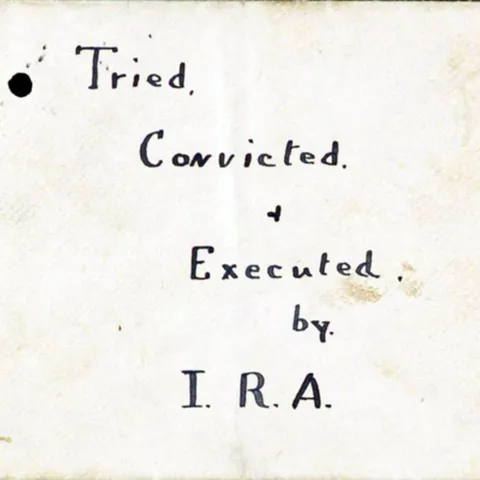
And to ensure this, the IRA would often place the bodies of executed civilians out in the open where everyone could see, and then labelling them with cards saying things like spies and informers beware, the IRA. Or, convicted spy, this is the penalty for those who associate with the auxiliary cadets, the black and tans, and the RIC. These labels were often printed in the paper, partly as a gruesome bit of news, but also to further act as a warning to anyone who might consider speaking to the British. It’s said that the labels also acted as a means of instilling legitimacy on the killing. Notes would state things like, tried and sentenced and shot by IRA. Civilians and the IRA themselves took solace from, as one IRA man described it, the belief that a spy had received the fairest treatment available in the circumstances.
Whether the accused always received fair treatment is pretty hard to figure out, but seems kind of unlikely. In general, the IRA were relatively fast and loose with their intel. Many commanders believed spies had to be wiped out as quickly as possible. There simply wasn’t the resources to arrest alleged spies and put them on trial. Instead, they were often shot with very little but circumstantial evidence backing up their guilt.
Which brings us back to the Battle of Clonmoult. Afterwards, the IRA singled out David Walsh, an Irishman who had fought for the British and had returned with severe shell shock, or as we would probably say PTSD. After the embarrassing and costly defeat of Clonmoult, the IRA wanted to blame someone. As historian Brian Hughes puts it, informers often acted as a convenient scapegoat for IRA incompetence. As we know, there were a number of errors made by the IRA in the Clonmoult situation, but by blaming it all on an informer, the IRA were able to protect their reputation. So they cornered David Walsh and accused him of being the informer behind the Clonmoult defeat. Other than his position as an ex-British soldier, it’s unclear why he was singled out, but later research seems to suggest that he was wrongly accused. Regardless, Walsh was interrogated by the IRA and told that if he admitted to the crime, he would be deported. Walsh, under the circumstances, thought this was a pretty good solution and so he confessed. However, instead of being deported, the IRA simply shot him on the spot.
These executions leave a bit of a bitter taste in one’s mouth. It’s one thing to ambush British invaders, but killing civilians is a very different kettle of fish. However, it’s hard to argue with the necessity of it. We’ve discussed at great lengths the importance of information, and the IRA were so very outgunned that they couldn’t afford to give the British any advantage, no matter how slight. So, like so much of this war, it’s a grey area. It was a violent necessity, and oftentimes innocent people were hurt.
Now, keen-eared listeners will notice I’ve completely and utterly neglected to discuss any women in this episode. And that’s because I want to dedicate a whole episode to the often overlooked story of the violence inflicted on women during the War of Independence, both by the IRA and the British forces. But, we’re going to leave that until next time.
Additional research and fact-checking by Robert Babington, music by Liam Doyle, and additional help from assistant producer Aoife Murphy. This podcast was recorded on the lands of the Wurundjeri people of the Kulin Nation. Sovereignty was never ceded.