Episodes Irish Revolution Season 1 — The Revolution
The Battle at the Farm House
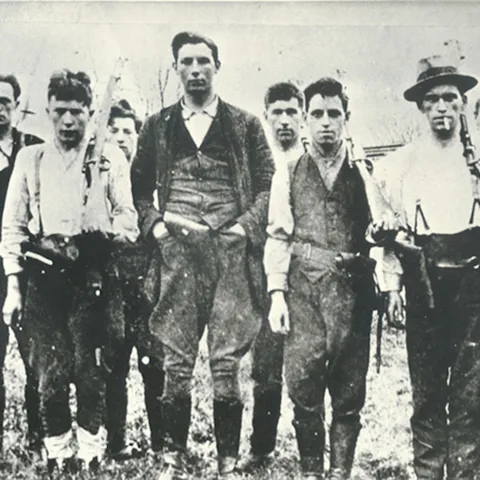
In this episode we explore how the violence War of Independence ramped up in 1921 and explore how one safe house in Clonmult turned out to be anything but safe.
The image from this episode is borrowed from The Battle of Clonmult by Tom O'Neil.
Transcript
Welcome to the History of Ireland. We spent last episode among the politicians of the Irish movement. Exploring the political maneuverings of Éamon de Valère on his return to Ireland at the end of 1920. Today we’re going to head back out into the field and investigate how the fighting across the country continued to increase throughout the beginning of 1921.
At this point in the year, huge swaths of Ireland felt like a military camp. People described barbed wire everywhere. With military checkpoints, armed soldiers and lorry loads of auxiliaries all becoming a common sight. And though the IRA were under more pressure than ever, it worked hard to continue their offensive. With a number of ambushes occurring throughout this period. Regardless of what Brugha, de Valère, Collins and Mulcahy were arguing about, the men on the field just kept doing what they were doing.
For example, on February 2nd, four auxiliaries died in a quote well planned ambush by the Longford IRA at Clonfin. On February 3rd, 11 more Black and Tans were killed in Drumkeene, County Limerick. And on the flip side, on February 15th, three men from Tom Barry’s Cork 3rd Brigade were killed in a disastrous failed ambush of a train in Upton. Barry wasn’t leading the attack, but the Flying Column had planned to hijack the train and steal weapons from the 20 or so soldiers on board. Unfortunately, around 50 extra British soldiers had hopped on at a previous stop and the ensuing firefight was brutal. As well as the three IRA men who died, ten civilians were killed by either the IRA or the British.
If I was to go into every single attack or ambush that occurred throughout this time period, this podcast would get very, very, very long indeed. In fact, historians have counted 118 ambushes or incidents that resulted in British casualties between January and June of 1921. And that’s only the ones that resulted in casualties. There were a hell of a lot more failed attempts or attacks when no one from the British side was killed.
Today though, we’re going to focus on one of the worst defeats faced by a Flying Column and use it as a diving board from which to explore the IRA’s approach to informers in the next episode. Little sneak preview there. The incident in question is referred to as the Battle of Clonmoult. Though, as you’ll see, like most of the War of Independence, it has very little in common with your usual battle. It occurred just five days after the failed train attack in Upton and the two combined to be quite the psychological blow to the IRA. Tom Barry referred to this period as 12 of the darkest days. Let’s explore what happened.
At the centre of the Battle of Clonmoult was the Flying Column of the 4th Battalion of the 1st Cork Brigade, led by a man named Dermot O’Hurley. The Flying Column had formed in September 1920 and had spent the winter of 1920 raiding throughout the area, making life as difficult as possible for the British forces. There were around 30 plus men in the group, which was the typical size for Flying Columns at this point in the war, and they quickly became some of the most wanted men in Cork. They were constantly on the move, working out of safe houses, and it was a risky life. In fact, on December 11th, the group narrowly escaped a safe house when it was surrounded by the British. They managed to fight their way past the soldiers and escape off into the countryside. At Clonmoult, well let’s just say they wouldn’t be as lucky.
On January 6th, the Flying Column took up residence in an unoccupied farmhouse in Clonmoult. It was a small little building, designed with only one door so as to keep the heat in and the cold Irish winter out, and this would prove quite important. The young lads spent six weeks holed up in the little farmhouse, using it as a base of operations from which to attack the British in the area. Spending that long in one spot was unusual for Flying Columns at the time, and as historian Tom O’Neill puts it, the fact that they were there for so long, contravened the normal activities of these IRA formations. And while the Column was based in the farmhouse, it’s very important to bear in mind they were possibly at the top of the Crown Force’s most wanted list.
And so with this in mind, the Column was eventually given orders to move on from the safe house on February 20th. Unfortunately, the British were already on to them. On the morning of the 20th, Diarmuid O’Hurley headed out with two of his senior most officers to carry out some reconnaissance of a potential ambush site. 20 men were left at Clonmoult safe house and told to pack up so as to be ready to move on that evening.
At around noon, the local British forces received information from an informer that members of the Flying Column were seen up towards Clonmoult. The soldiers readied their gear, and at around 2.15, 12 men were sent out with the informer to investigate the area. Interestingly, the informer initially brought them to the wrong house, and things may have been fine, except for the fact that two Flying Column men, Michael Desmond and John Joe Joyce, were out drawing water from a well. As the soldiers continued to search the area around the first house they’d been brought to, they bumped into Desmond and Joyce. The two men were shot on sight.
Knowing they were on the right track, the British forces then continued on to the next house in the area, arriving at the Clonmoult safe house around 3.15. In a whopping example of poor discipline, the Flying Column sentries, whose job it was to watch for British soldiers and warn the rest of the group, were inside packing their bags. So the British were able to come right up to the house undetected. By the time the Flying Column men realized anything was wrong, the house was totally surrounded.
At this point, there were 17 Flying Column members inside the house, as well as four men who’d been delivering supplies to the Column. Now remember, the small farmhouse had literally only one door, one way in and one way out. This made it easy for the 12 British soldiers to surround the building. This was another mistake made by the IRA. Over the six weeks they’d been there, it would have been simple enough to create an escape route. But they’d failed to do so.
So imagine the scene. 21 men trapped inside the thick walls of an old cork cottage. 12 British soldiers outside with their weapons focused on the one door. The tension slowly mounting. Suddenly, Captain Jack O’Connelly, who’d been left in charge of the Column, barged out of the door along with five other IRA men, and they began fighting their way free. But just at this moment, eight more British soldiers arrived. O’Connell managed to escape, but three of his men were shot and killed, and one man was forced back into the house.
Initially, the two groups were to stalemate. The British didn’t have enough men to storm the 17 in the house, while the IRA had no means of escaping. However, the equation quickly changed. The British called for reinforcements, and at 5.20, two truckloads of auxiliaries arrived. You can imagine their hearts sinking as the Flying Column lads heard the puttering of those army trucks in the distance.
Soon after, the British set fire to the thatched house in a bid to flush the men out. As the fire burned hotter and hotter, the IRA men tossed their weapons into the flames, rather than give them up to the British. The ammunition exploded, and the Flying Column was forced to tumble out into the front garden. They surrendered and were lined up against the wall of the cowshed to be searched.
But instead of searching the men, the auxiliaries suddenly opened fire and killed seven of the IRA right there and then. Some say this was in retaliation for the events that had occurred at Kilmichael. Luckily for the others, a British soldier quickly intervened and stopped the shooting. It’s interesting to see the division between the two groups of British forces. The auxiliaries were looking for revenge, while the soldiers remained a little more disciplined. In the end, eight more men were taken prisoner, with two of those later hung.
The attack at Clonmalt all but destroyed this particular Flying Column, with twelve men dying overall. Remember, the IRA only had about a thousand active soldiers, and to all but lose a Flying Column like this was a huge blow. And it’s important to again stress that the Battle of Clonmalt, if it can even be called a battle, is just one of the hundreds of events that occurred throughout the country in this period. It highlights how much pressure the IRA were under.
More and more British forces were being sent throughout the country, and with martial law implemented throughout Munster, the gloves were well and truly off. In the five months between January and June 1921, over one thousand people were killed, IRA men, British forces and civilians. More than at any point in the rest of the war. After the attack, the IRA began targeting informers more and more. This led to an increase in the IRA attacking and killing civilians. And in the next episode, we’ll look at these informers, and explore the darker tactics used by the IRA.
Thanks for listening. Subscribe wherever you get your podcasts, and if you’re enjoying it, give us a review on Apple Podcasts, or tell your friends. It really helps. You can also support the show, buy merch, and get in touch all through our website, thehistoryofireland.com. Or you can follow us on Facebook or Twitter. It’s always great hearing from you guys. And if I’ve made a mistake, please do let me know.
The History of Ireland was written and produced by me, Kevin Dole. Additional research and fact-checking by Robert Babington, music by Liam Doyle, and additional help from assistant producer Aoife Murphy. This podcast was recorded on the lands of the Wurundjeri people of the Kulin Nation. Sovereignty was never ceded.