Episodes Irish Revolution Season 1 — The Revolution
The Fighting Men Sit Still
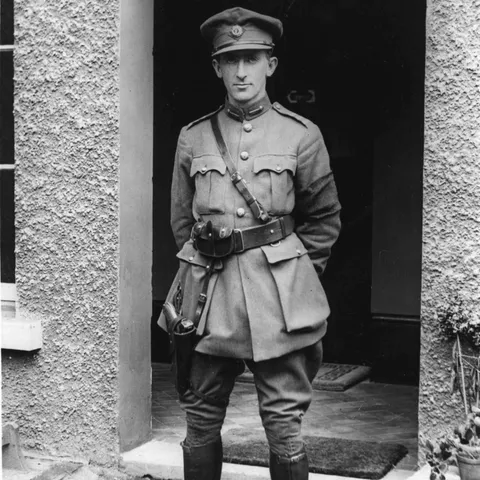
In this episode we ask what did the men of the IRA and their leaders got up to during the Truce period? The answer starts to shed light on the division within the movement and help us lay down the foundations for one of the saddest parts of Irish history.
Image is of Richard Mulcahy.
UCD Digital Library, CC BY-SA 4.0 <https://creativecommons.org/licenses/by-sa/4.0>, via Wikimedia Commons
Transcript
Welcome to the History of Ireland. The truce was a strangely complicated time for Sinn Féin and the IRA. The certainty of war slipped away as the complexities of peace became clear. Last week, we followed De Valere over to London for the first rounds of negotiations. Today, I want to look at what was going on at home while he did this.
What’s kind of crazy is that August 1921 weirdly feels very similar to August 2021. Ireland was opening back up again after years of chaos. There were crowds of British soldiers and Irish civilians cheering on horses at the Curragh. The GAA was able to hold matches again and markets sprang to life throughout the country for the first time in over a year. As wet pubs open back up, or you head off to a gig or to a match, think that those in Ireland 100 years ago were feeling something vaguely similar. The joy of a returning sense of normality. As one historian, Joseph Curran writes, the people of the south and west of Ireland longed for peace in 1921 as much or even more than they longed for freedom. The truce was therefore a godsend. But there was the constant worry that it would all collapse.
Interestingly, there was no singular document that both groups had signed. Instead, newspapers reported separate truce requirements for both the British and the IRA. There was to be quote, no movements for military purposes of troops or munitions, except for maintenance, as well as no provocative displays of force, no use of special agents, and no interference with the movement of Irish persons, military or civil, and no pursuit of messengers or lines of communication or connection. Meanwhile for the IRA, there was to be quote, no provocative displays of force, armed or unarmed, there was to be no interference with government or private property, and there was an agreement to discontinence and prevent any action likely to cause disturbance of the peace which might necessitate military interference. Basically, no movement of British troops and no messing with British property or just acting the maggot. And generally it seems that this was adhered to and there’s no real clashes between the British or the IRA.
But the truce did have a strange psychological effect on the IRA, one that shouldn’t be ignored, especially considering the events of 1922. For one thing, the longer the truce lasted, the less the wider population was likely to support a return to violence. They had very much backed the IRA during the war itself, but now, well, the wider population was keen to see the politicians find a peaceful solution with the British. This worried some of the IRA, who were ready to go back to fighting if terms offered by the British were not up to scratch. What would happen if the British offered up something that the IRA was unhappy with, but the wider population preferred to compromise instead of descending back into violence? Students of Irish history know this would become much more than a rhetorical question.
On top of this, the British had freed a huge number of those arrested during the conflict, described as quote embittered comrades. While locked up, these men often times became even more extreme. This added a flood of die-hard republicans to the mix back in Ireland. This was added to the fighters who became more militaristic as well, and those who fought looked down on the politicians and the public. Writing in the Atlas of the Irish Revolution, our old favourite Michael Laffin puts it like this, Laffin goes on to quote an IRA leader, Sean Moylan, who told it all, there would be none of us here if there were not gunmen. Now obviously Moylan was right, and the country owed, and still does owe, the men who’d been on the front lines a huge debt of gratitude. But though it positions itself as an army of the people, some of the IRA had always had a bit of a tendency to do their own thing. And in the truce period we start to see this crop up again. As one historian puts it, the nominal control of local units during the war became even less meaningful, while the personalities and opinions of local commanders assumed ever greater importance.
It’s said that many of the IRA faced a strange feeling of loss. The truce left some feeling like they had unfinished business, or worse, that they’d been defeated. This manifested itself in a breakdown of discipline. As Mulcahy would later put it, the prolonged truce was very bad in every way. Excess of one kind or another arose out of the relaxation of strain, and a certain amount of demoralisation took place. It was said there was quite an increase in drinking and unruliness, which forced Richard Mulcahy to introduce training across the country, both to keep veterans busy and to manage the increase in new recruits. In fairness this was also just good tactics. Using this break to build up the army’s capabilities made sense. But there were other more subtle forces at play as well. Sean Moylan, the same guy who Laughan quoted earlier, had this to say, The discipline which physical danger imposes had disappeared, and men had to face the more subtle danger of fleeting flattery and adulation. For a few weeks there was a certain joyous abandon, the natural reaction from the strain and tensions of the previous years. But with the real fighting men, this phase passed quickly.
So take an influx of extremists just out of prison, flattery from all sides, a disdain for politicians, boos, and the feeling that somehow their war had been cut short, and you get a problematic mix. This is not to say that all of the IRA struggled throughout the truce, or even that the majority did. Many were happy to be done fighting and pleased that things were going a more peaceful route. But all of this was kindling being laid down for what was to come.
And it was not helped by the fact that the Minister for Defence and the leader of the IRA’s GHQ, Cahill Brewer and Richard Mulcahy respectively, were at each other’s throats throughout much of 1921. As Charles Townsend puts it, For reasons that are still obscure, Cahill Brewer decided to assert his ministerial authority during the truce. Mulcahy’s biographer believed Brewer, quote, resented the fact that Collins and Mulcahy were associated in the public mind with the IRA and decided that it was time to break their hold on the army. I’ve said it before that in fairness Brewer had a point. He rightly wanted to ensure that he as the elected minister should be in control of the IRA. Otherwise they would technically not be answerable to the people. And funnily Mulcahy and Collins agreed with this on paper. But they also had no time for the frankly fairly inept Brewer.
In August of 1921 this all came to a head over a situation with a typewriter salesman called Robbie. Poor Robbie had been forced out of the country due to some dodgy information and so Brewer and Mulcahy decided that the poor lad should be allowed back into Ireland. This was passed on to Collins and his intelligence department but apparently they didn’t act on it quickly enough for Brewer’s taste. Brewer wrote to Mulcahy tearing into Collins and even went as far as to hint that he would have him fired. He said, The handling of this case from start to finish displays an amateurness that I thought we had long ago outgrown. On the chief of staff’s return I intend to see about putting our department of information on such a footing that things of this kind cannot occur in future.
Mulcahy was not pleased. He actually waited a few weeks and then wrote back saying, The tone of your letter of the 30th July is very unfortunate and must have a very destructive influence on the harmony and discipline of the staff. Unless something can be done to eliminate the tendency to revert to this tone when differences arise I cannot be responsible for retaining harmony and discipline among my staff. Brewer took this quite rightly as a threat and wrote back, Before you are very much older my friend I shall show you that I have little intention of taking dictation from you. He then demanded all the information that was available on the case of Robbie the typewriter salesman to be handed over in 24 hours. Considering how hard it was back in the day to send and gather information this was a fairly unreasonable request and when Mulcahy was unable to meet the deadline Brewer fired him.
If this all sounds stupidly petty it’s because, well, it really was. The two men seemed like they were just finding reasons to needle each other and I know as historians we’re not meant to take sides but Jesus Brewer always comes across as a bit of a tosser doesn’t he? Mulcahy and Collins had led the IRA to as close to a victory as anyone could reasonably expect. They led farmers and hurlers up against the British Empire and here was Brewer getting involved after the fighting to argue over some bloody typewriter salesman? Come on man. I don’t like Brewer. I know I shouldn’t say it but I just don’t like him.
Anyway Mulcahy wrote to de Valera in a manner that kind of feels like the 1921 Irish Republican version of I’m telling dad. He laid things out in no uncertain terms. The continuance of the present relationship between the Minister for Defence and myself must, I fear, lead to the destruction in a very short time of the vigor and discipline of the staff and I feel it my duty to ask that the position be estimated and adjusted without delay. I cannot usefully discuss any matter with the Minister for Defence. Yet it’s not a glowing review is it? In the end de Valera stepped in and ensured that Mulcahy wasn’t fired. The Longfellow kinda knew that Mulcahy was an effective operator. But dev was never able to fix the relationship between Mulcahy and Brewer. The two bickered constantly throughout the truce period and Brewer would fire Mulcahy at multiple points.
Now I can hear you asking. Who cares? So the two lads didn’t like each other. Why do we need to read their angry letters to each other? Well for one it’s important to realise that just because they had been successful in reaching a truce things were not harmonious in the Irish camp. Splinters were already beginning to form, both between the more militaristic IRA men on the ground and between the leaders themselves. I feel it’s also important to get a sense of the relationships between the leaders of the Irish movement at this point of the conflict. The politics of all of this were shaped by these individuals and their relationship with one another. As we dive into the treaty negotiations this becomes more and more apparent.
Next episode we’re going to take one more step towards those historical treaty talks and explore further the beliefs, ideas and relationships of those involved. Thanks for listening. Subscribe wherever you get your podcasts and if you’re enjoying it give us a review on Apple Podcasts or tell your friends. It really helps. You can also support the show, buy merch and get in touch all through our website thehistoryofireland.com or you can follow us on Facebook or Twitter. It’s always great hearing from you guys and if I’ve made a mistake please do let me know.
The History of Ireland was written and produced by me, Kevin Dole. Additional research and fact checking by Robert Babbington, music by Liam Doyle and additional help from assistant producer Aoife Murphy. This podcast was recorded in the lands of the Wurundjeri people of the Kulin Nation. Sovereignty was never ceded.