Episodes Irish Revolution Season 1 — The Revolution
Who Where The Plenipotentiaries?
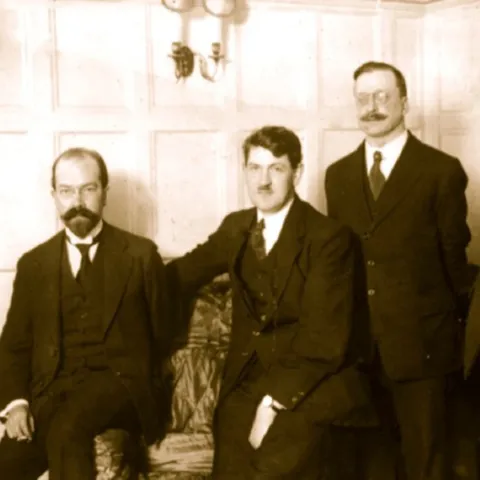
In this episode we continue our examination of the plenipotentiaries, who they were and why Dev chose them.
Image: George Gavan Duffy, Michael Collins and Arthur Griffith.
Transcript
Welcome to the History of Ireland Last episode we introduced the Plenipotentiaries The men chosen to represent Ireland at the forthcoming treaty negotiations with the British We also asked a question as to why Dev wouldn’t be joining them Now I don’t know if we found an answer to that But today I want to dive into three things a little deeper One, why each of the Plenipotentiary was chosen Two, where they sit politically And three, the direction, or lack thereof, that they were given by Dev and the Dáil Sound good? Cool
Let’s start with Arthur Griffith Being Minister for Foreign Affairs and previously having held the office of Acting President He was a pretty obvious choice Plus he had been in contact with the British discussing a truce as far back as December 1920 Politically he is generally viewed as a moderate Someone not obsessed with the idea of republicanism And not too worried about symbolic issues Remember Griffith had started as a dual monarchist And really only cared about the practicalities of independence It wasn’t until much later that his party Sinn Féin was basically co-opted by the republicans So yes Griffith was practical moderate And just wanted to get Ireland some kind of independence so it could figure things out from there
Next was Michael Collins Dev pointed out that Collins was Looked upon the British as the leader of the fighting men And he continued no delegation of which he was not a member would get the highest British offer That if he were absent the British would feel they still had to deal with him And still to conciliate him And that they would hold back something from the other Plenipotentiaries This is a totally fair argument and one that makes a lot of sense But I gotta say considering what’s to come it’s ever so slightly infuriating And remember Collins was no real soldier Instead he was a master organiser Very very intelligent and very good at dealing with people It makes a hell of a lot of sense that he’d be included There was also the added bonus that he was a near mythical figure in Britain And carried a lot of weight in the British press This is something we’re going to look at next episode
Those more prone to conspiracy theories though Pat Coogan would argue that Dev put Collins forward Because Dev knew a full republic was never going to be achievable And he wanted Collins, arguably his biggest rival, to take the fall The argument goes that Dev knew Collins was his greatest political threat And wanted to pin any compromise on Collins Therefore sullying him with future voters This to me feels a little like creating a good story after the fact But I mention it because well look it’s a theory that’s not totally without merit And as we go on I guess you can decide for yourself
In terms of what Collins actually stood for Well it’s pretty unclear Generally he’s put in the same camp as Griffith The two were staunch allies at this point Both seen as moderates and both willing to compromise to gain what they wanted In fact Dev believed the quote From my own weighing up of Collins I felt certain that he too was contemplating accepting the crown i.e. that he would be most likely happy with swearing allegiance If it got Ireland more independence Dev believed that having two moderates like this would quote Simply make them both, i.e. Griffith and Collins Better bait for Lloyd George Leading him on and on further in our direction I don’t totally understand the thinking here But my guess is that Dev was using Griffith and Collins Almost as the good cops in the situation But to balance this, well he needed a bad cop
And that brings us on to Robert Barton Dev explained that he chose Barton saying this He would be strong and stubborn enough as a retarding force To any precipitous giving away by the delegation Basically Dev was worried about Griffith and Collins And their moderate viewpoints And so put a hardline republican to balance them out A hardline republican who just happened to be immensely loyal to Dev So that’s Barton
Next was Eamon Duggan and George Gavin Duffy An IRB man Duggan was firmly on the side of Griffith and Collins While George Gavin Duffy having spent much of his time outside of Ireland during the war Seemed to have no strong ties to anyone in particular Dev dismissed their appointment as quote mere legal padding But Duggan would have quite an impact on the outcome by the end of it
Finally there was Erskine Childers Though not actually a plenipotentiary Childers was very influential Dev sent Childers because he hoped the quote An intellectual republican would give Barton his relative and close friend added strength Barton and Childers were cousins you see However this was complicated by the fact that Griffith absolutely hated Childers Going as far as to accuse him of being an English spy So there’s that
So you can see through all of this how much of a politician Dev was Both in I guess the positive and negative sense of that word He knew the strengths and weaknesses and the relationships between each person And used all of this knowledge to put together what he thought was a balanced team But it could be argued that what he had created was a kind of divided delegation You had moderates Griffith Collins and Duggan on one side And hardline republicans Barton and Childers on the other And I guess poor George Gavin legal padding Duffy floating somewhere in the middle
So how should we view this line up On the one hand you can see what Dev was trying to accomplish He couldn’t send just hardline republicans Because he knew the British would call off the talks if there was any mention of a republic But he couldn’t send moderates who might give away house and home just for peace Instead he sent a varied group of men with differing beliefs Who would temper each other and thus provide the nuanced view needed for such a complicated negotiation They would be able to string the British along Get as much of them as possible And when the talks inevitably collapsed De Valera himself would be able to step in and act as a literal peace broker Viewed as such it does come across as a brilliant plan And you can see why De Valera was viewed as such a political mastermind
However as always there is another way of looking at all of this It could be argued that what Dev had created was a divided delegation With grossly different views and no real clear mandate around what kind of outcome they were after And by choosing men with such differing views it would make it quite difficult for them to work together Plus there was the added confusion of whether they were real plenipotentiaries who could make a decision on the spot Or whether they needed to refer back to him and the doll And all of this is compounded by the fact that Dev was deciding not to go And as any fan of good political musical theatre will know You want to be in the room where it happens And Dev had chosen to take himself out of said room Maybe he really did think the talks would collapse And that the next round when he stepped in is when the real decisions would be made Or maybe he truly misunderstood the term plenipotentiary and thought the delegates would constantly refer back to him Regardless of whether you think this was political genius or a total mess And you can probably guess where I stand on it
Dev and the rest of the doll did not help with the instructions they then gave to the delegates Charles Townsend argues that Mary McSweeney was one of the few TDs to quote Try and pin down the objectives of the negotiations As Townsend describes it She insisted that they were going to England for one purpose only To secure British recognition of the Republic One TD Ernest Blythe describes how She stood up pointing her finger directly at me and saying If anyone here has a contrary opinion let him speak now or be forever silent But as Townsend explains This completely reasonable attempt to define what the Irish were asking for Was quote Sidelined by what has been called the casual misogyny That Blythe shared with many of his colleagues And in fact as Blythe himself said I only laughed at her
To digress a little bit It’s kind of important to remember That though we like to view the first and second doll as quite progressive What with members like Mary McSweeney and Countess Markievicz To say that there was sexism going on is a bit of an understatement This was still the 20s after all But casual sexism wasn’t going to stop someone like Mary McSweeney And she even asked Dev to include her in the delegation And he at least didn’t laugh her out of it But he just said You would not do Moira You were too extreme But ok
If McSweeney was too extreme Does that mean that De Valera clearly laid out to the doll And to the plenipotentiaries what he wanted Maybe his ideas around external association Which remember we discussed two episodes back Oh no No he didn’t In the debate to ratify the plenipotentiaries Ronan Fanning, Dev’s biographer Describes how Dev spoke to the doll In the manner reminiscent of a schoolmaster Talking to a class of dim pupils Dev started by saying that If they had asked Lloyd George to recognise the Republic He would say it would be an unreasonable request
Dev continued It is a question of whether any form of association with Britain Is one in which the Irish people could stand for I feel it is And my cabinet would have a definitive policy To put before the doll when the time came It was absolutely necessary To contemplate such negotiation Or else to end the truce They had to reconcile that position by negotiation or by force If they could reconcile it by negotiation It was their duty to do so When it came They would be able to deal with that question It would be harmful to take it up now
To translate this Devlish into English He’s basically saying There was no choice but to negotiate or fight And that they owed it to the Irish people To try and negotiate peacefully He also states that he has a policy He has a plan And this would be external association But that he’s not quite ready to share it with the doll Or the delegates So basically He’s kind of just sending them off blind It’s frankly crazy to me It all sounds like a recipe for absolute disaster And well those who know their Irish history Know that some kind of disaster was on the horizon
But for now we’ll leave it there Next episode I want to look at one delegate in particular The plenipotentiary the British public was most excited to meet The one plenipotentiary that nearly everyone in Ireland knows Yep We’re going to explore the myth of Michael Collins Thanks for listening Subscribe wherever you get your podcasts And if you’re enjoying it Give us a review on Apple Podcasts Or tell your friends It really helps You can also support the show Buy merch And get in touch all through our website thehistoryofireland.com Or you can follow us on Facebook or Twitter It’s always great hearing from you guys And if I’ve made a mistake Please do let me know The History of Ireland was written and produced by me, Kevin Dove Additional research and fact checking by Robert Babington Music by Liam Doyle And additional help from assistant producer Aoife Murphy This podcast was recorded in the lands of the Wurundjeri people of the Kugan nation Sovereignty was never ceded