Episodes Irish Revolution Season 1 — The Revolution
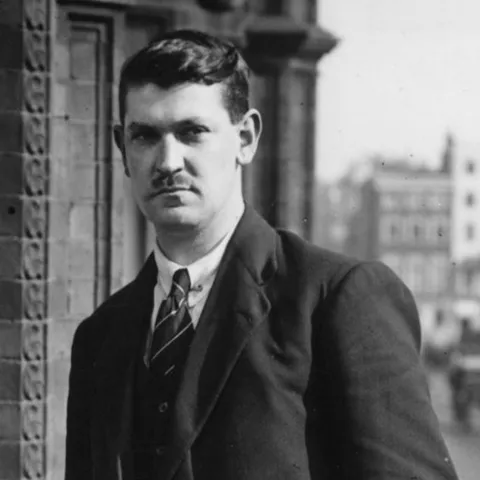
The Myth of Michael Collins
Transcript
Welcome to the history of Ireland. At one point in 1921, an American journalist was sent to Ireland to try and nab an interview with the elusive Michael Collins. He failed, writing back to his editor saying, no interview with Collins, did not find the man, found a god. Of all the six plenipotentiaries heading to London, Collins was the one the British public was most excited to meet. In fact, at this point of Collins’ career, he was one of the most famous Irishmen in the world.
It’s a story of a kid named James Crabtree, an eight-year-old from Lanchester, coming second in the annual fancy dress contest with a costume of Michael Collins. While later, a Frank Blewett, a nine-year-old from Cornwall, entered a sandcastle competition with a Michael Collins statue. And in August 1921, you had a greyhound named Michael Collins racing at Stockton. This is all to say that long before Liam Neeson did his impersonation of the man, Collins had captured the public imagination. It was much a mythical version of Mick Collins, as there was a real man. And arguably, this was at its height during the treaty negotiations.
Now, I’ll be the first to admit that I’m prone to falling into the trap of thinking more about the myth of Michael Collins than the real man. I like the guy, and anything I read about him just deepens my admiration. But it is important to examine this myth, understand why it was developed, acknowledge that Collins knew exactly how to use it to his advantage, and try and pull the real man out from the myth itself. So before we dive into the depths of the treaty negotiations, I want to explore how this myth developed. And I know, I know, you’re all desperate to get into the minutia of the treaty debates. And yeah, we will. But I read this fantastic book on Collins by Anne Dolan, still no relation, and William Murphy. They had an amazing chapter on just this topic. It’s always fascinated me. So here we are.
One reason it’s important to discuss Collins’ mythology is that it really did kind of set him apart from the other members of, not just the Plenipotentiaries, but the rest of the Irish movement. Éamon de Valera was a politician. He spoke well, and Americans loved him, but he was still a politician. While others, well, they never really became big outside of Ireland, or even outside of their local community. Collins, on the other hand, quote, made headlines from San Francisco to Sydney, and most places in between. One historian describes him as the first example of that 20th century phenomenon, the guerrilla celebrity. And they even go as far as to call him the revolutionary’s Princess Diana. It set him apart from the others. It made some dislike him, and it gave him a lot of power.
So why were these kids dressing up as him or making sandcastles of him? How did this happen to this lad from Cork? There are a whole number of reasons for it. Of course, there was the man himself. Collins was smart, energetic, ruthless, organized, and highly charismatic. And he had successfully led a team that beat the British intelligence at their own game. On top of this, he was de facto military leader of the IRA. Though you could argue that no one person ever led the localized Hydra that was the Irish Republican Army.
But Collins had the advantage that he was riding the wave of a growing mass media. During World War I, newspapers quickly learned that human stories sold way more than straightforward descriptions of events. And with photography becoming easier and cheaper to carry out, the news was able to lean into more human storytelling. With all of this, the early 20th century basically saw the birth of the modern celebrity. And Collins was perfectly timed to step into all of this. As Dolan puts it, he became a way to explain what the troubles in Ireland amounted to. A way to put a face to the violence the newspapers sometimes seemed at a loss to name.
Throughout 1920 and the first half of 1921, British newspapers began, quote, crafting Collins as the elusive IRA leader, bringing off yet another hairbreadth escape. As head of the intelligence operation, he kind of was the perfect person to be the face of this complicated, dark, dirty war that was going on in Ireland. Papers condemned the notorious Michael Collins. They wrote about the mystery of Michael Collins, or the mystery man of Ireland. They declared him the most wanted man in the world. He was written up as a modern outlaw, proving romance could still thrive in a world grown hopelessly humdrum. He was, quote, He was, quote, a master of disguise with about half a dozen doubles, and one newspaper called him the Moriarty of the Irish Republican Brotherhood.
The Guardian wrote in March 1921 that, when the horror and misery of the present years are forgotten, tales of Collins’ exploits would provide episodes of high romance as realistic as anything in Demass and Stevenson. Even his looks were extensively written about. Newspapers said he had raven wing black hair and typically Irish blue eyes, going as far to call him a rollicking figure of daredevil Irish romance. It’s the classic story, the Robin Hood figure up against the British establishment. Collins was able to embody everything that was going on in Ireland.
Of course, it helped that he was super energetic, charismatic, and did seem to be behind so much of what was happening in Ireland at the time. And of course, there’s some truth in everything that they were writing. He was running a secret intelligence network. He had worked really hard to avoid capture. But there’s clearly a hell of a lot of narrative liberties being taken. And I wonder if the global newspaper reading public would have been impressed by Collins’ actual exploits. Remember, he was an organiser. He was a bloody accountant by trade. And as many disgruntled IRA men would have told you, he rarely ever held a gun and probably never shot anyone. But I suppose you don’t sell newspapers writing about corkmen sitting at their desk writing letters and organising a national loan scheme.
So yeah, he became a heavily romanticised figure. And a perfect example of this fact versus fiction was the reported price on Collins’ head. Originally, it was said the bounty was £4,000. That figure shot to £10,000, then £20,000, and eventually settled at £40,000. That’s about €2.3 million in today’s money. But the actual figure on his head? Well, it was never more than £1,000.
The other reason that Collins was the one who kind of became the face of this daredevil version of the conflict in Ireland was that, well, he knew the importance of the legend and was more than happy to play into it. When one American journalist did finally get to meet Collins, Collins played the part of Ireland’s man of mystery perfectly. He arranged a coded series of knocks on the door before the journalist would be allowed in and proceeded to tell him ominously, I know you better than you know me. And the journalist was happy to go along with the story and wrote all about the cloak and daggers of meeting Mick Collins. And without that little bit of romance, it’s probably unlikely that that journalist got his story syndicated all over the world, which is what happened, further fanning the flame of Collins’ mystery.
You see, Collins knew what he was doing, and it did have a real-world impact, even affecting the men chasing Collins down. In 1921, one black and tan noted in his diary, he must be famous. £500 is being offered, dead or alive, for his capture, but all the black and tans and CID men from Scotland Yard can’t get hold of him. I was going to say, I hope he keeps free, but someone might see this before I get home, so that is better left unwritten. We have that little quote because the black and tan actually forgot to scratch out that bit that was better left unwritten. But yeah, the bloody men chasing him down were so enamored by the romance of the story that they didn’t want him caught. How brilliant is that? No wonder he was able to keep escaping and escaping, which just further fueled the legend.
Collins himself wrote that, I would not matter very much to anybody were it not for the things the English are saying about me. Now this is probably not quite true, but it’s clear the legend itself helped make Collins more important, and he knew this and played into it. When arguing with De Valera over whether or not he should go to the treaty negotiations, Collins had this to say, and frankly I think it explains the whole situation better than anyone else does. Here’s what he said, For several years, rightly or wrongly makes no difference, the English had held me to be the one man most necessary to capture, because they held me to be the one man responsible for the smashing of their secret service organisation, and for their failure to terrorise the Irish people with their black and tans. Brouwer has spoken of the English legend as having been altogether of newspaper manufacture. What difference does that make? The important fact was that in England, as in Ireland, the Michael Collins legend existed. He pictured me a mysterious active menace, elusive, unknown, unaccountable. And in this respect, I was the only living Irishman of whom this could be said.
If and as long as the legend continued to exert its influence on English minds, the accruing advantage to our course would continue. Bring me into the spotlight of a London conference, and quickly would be discovered the common clay of which I am made. The glamour of the legendary figure would be gone forever.
Collins knew there was power in the myth. But as we know, Dev was not swayed, and Collins was sent to London. Whatever the celebrity, Collins continued to play up to the press. He knew what he was doing. For example, he delayed his arrival by a day, both to build anticipation and separate himself from the other planet potentiaries. On his arrival, as crowds of people clamoured to get a sight of the most famous man in Ireland, he declared to the reporters, I have held up the British Empire and richly have enjoyed the adventures. He even had enough gumption that when he arrived in number 10 Downing Street and noticed a rifle, he grabbed it and called for a photographer to take his photo. Apparently, he loved the idea of being seen armed at the seat of British power. Could you imagine statesman De Valera doing that? No, but it was a brilliant piece of PR and again, the newspapers ate it right up.
And you can really see a sea change in the reporting around Collins at this time in October 1921. He transformed from being the evil mariarty of Irish republicanism or the leader of an Irish murder gang and instead began to be described as a charming, smiling, gallant hero. There was one story of how when travelling to London, the mail boat Collins was on collided with another. He was described in the newspapers as the coolest man on board, helping launch lifeboats to ensure everyone got home to safety.
This about face by the newspapers was a huge help to Lloyd George. You see, in the summer of 1921, the PM was worrying about sitting down with the enemy. He had said, the question is whether I can see Michael Collins, whether the British people would be willing for us to negotiate with the head of a band of murderers. But over the preceding months, he was slowly transformed from mass murderer to that gallant hero, saving people from lifeboats. There are even hints that maybe Lloyd George and Churchill encouraged the newspapers to create this softer image of Collins as the romantic daredevil rather than the evil genius.
And soon Collins became really the only point of interest for the newspapers and gossip columns covering the treaty. It was said that quote, his presence and his presence alone assured the negotiations good press. For example, the Plymouth Gazette wrote about the first day of negotiations and how civil servants were just as desperate as anyone else to catch a glimpse of the big fella. They wrote, the dignified windows of the foreign office facing the premier’s residence were filled with official heads intently watching the scene and high officials may have caught the stray of the rebels from the crowd beneath. All eyes were eager for a glimpse of the redoubtable Sinn Féin commander in chief, the elusive Mr. Michael Collins, whose athletic form and pugnacious features were soon picked out. It really does seem like they were focusing on the wrong things.
And this continued for most of the treaty negotiations. There were stories of the housekeeper that Collins and the plenipotentiaries had brought over from Ireland to mine them as they worked hard. There were tales of women bursting through crowds to try and get a kiss with Michael Collins. And the gossip columns were filled with rumours of who would be the first person to have Michael Collins come to one of their dinner parties. The stories had changed from him evading capture from British intelligence officers to evading dinner invitations from British ladies.
And it does seem that Collins’ theory that his legend would be reduced or changed once people actually met him was soon proved right. General Neville McCready really didn’t like him at all, saying he is a great disappointment, flippantly trying to get out of corners by poor jokes and bad taste. Churchill seemed to like him a little bit more and the newspapers always were questioning why the two of them would be left talking together for so long. The Guardian wrote of the negotiations saying British ministers who had accepted Dublin Castle’s theory of Collins as the bloodthirsty chief of a murder gang found themselves instead confronted with a severely practical politician tenacious in his demands.
So it’s clear that some of the sheen of Collins’ myth was worn away in the harsh realities of the negotiations. He went from a mysterious Moriarty figure to a practical politician. But the tragedy that would come in 1922 ensured that Collins the man would forever be overshadowed by Collins the myth.
Next episode we’ll move away from the gossip columns and mythology back to solid history. We’ll explore the tenacious demands and the actualities of the treaty debates and ask how the plenipotentiaries landed on signing a document that Collins himself described as being his death warrant. Thanks for listening. Subscribe wherever you get your podcasts and if you’re enjoying it give us a review on Apple Podcasts or tell your friends, it really helps. You can also support the show, buy merch and get in touch all through our website thehistoryofireland.com or you can follow us on Facebook or Twitter. It’s always great hearing from you guys and if I’ve made a mistake please do let me know. The History of Ireland was written and produced by me, Kevin Dole. Additional research and fact-checking by Robert Babington, music by Liam Doyle and additional help from assistant producer Aoife Murphy. This podcast was recorded on the lands of the Wurundjeri people of the Kulin Nation. Sovereignty was never ceded.