Episodes Irish Revolution Season 1 — The Revolution
The First Dáil
Transcript
Welcome to the History of Ireland So Sinn Féin had won the 1918 election with an overwhelming majority And now it was time to get started This was their chance to properly instigate Arthur Griffith’s absentee methods Lord French, the Lord Lieutenant of Ireland, didn’t believe they’d carry through with it He reckoned the new MPs, soon to be TDs, wouldn’t be able to resist the £400 wage But, as is often the case, the British misread the situation Not a single Sinn Féin politician went to Westminster or collected a wage Though Candice Markievicz was the one exception Apparently sneaking in to see her name on the brass plaque beside her coat hook As ever, this is kinda just badass And I think it’s allowable that the first ever woman MP wanted to see proof of her stark new position
But just because they weren’t collecting a wage from the British Doesn’t mean they weren’t quick to get to work The Sinn Féin members who weren’t locked up first met privately on January 7th, 1919 To sort of figure out what would happen next It was agreed to start a single chamber parliament called Dáil Éireann Which translates to the Assembly of Ireland Each member would be known as a Teachta Dáiln Deputies of the Dáil This gets shortened to TD, similar to MP Every TD present pledged to work for the establishment of an independent Irish Republic It was planned to base everything off, quote Established parliamentary procedures Which basically meant they’d be organising and running things just like the British had The irony of this wasn’t lost on people With a few complaining that the Dáil was simply Westminster put into Irish But look, haters gonna hate
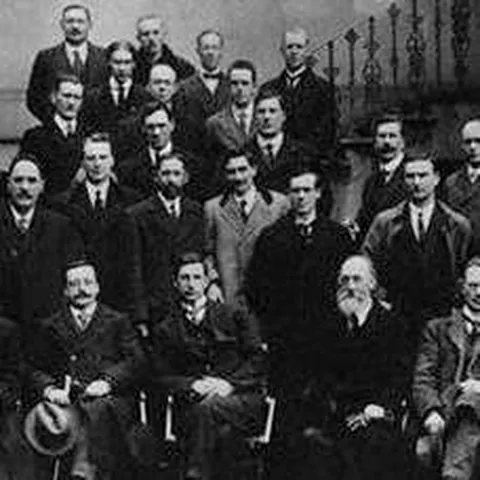
Once it was all organised in private It was time to put on a show The first public assembly of the Dáil occurred on January 21st, 1919 The whole thing was carefully staged by one of the TDs Pier Ash Baisley A playwright and an author Baisley knew how to put on a spectacle And made sure that everything ran smoothly
It was Count Plunkett who spoke first He was father of Joseph Plunkett The rising leader who’d married Grace Gifford The night before he’d been executed Count Plunkett is notable for being radicalised by his son Becoming heavily involved in the movement After the younger Plunkett’s death in the rising In English, Count Plunkett warned people not to cheer But then, after that The rest of the proceedings were carried out in Irish
Plunkett introduced Cathal Brugha As the Dáil’s first Count Corle Or Speaker of the House The TD for Waterford, Brugha, like many others Had gotten into Irish nationalism through the Gaelic League He also met his wife at an Irish class through this How cute! From there, he joined the IRB Led gun runnings and fought in the rising During the rising, he was shot in the leg And couldn’t retreat with the others He continued to fire on the enemy And was eventually found weak from blood loss Singing God Save Ireland while clutching his pistol Yeah, this guy was very much at the military persuasion And not one of Sinn Féin’s more moderate members
So Brugha was introduced as Speaker of the House And he then introduced Father Michael O’Flanagan To open the proceedings with a prayer O’Flanagan was the Vice President of Sinn Féin And so it kind of made sense to have him speak Especially as the President, Dev, was locked up But it also reiterated to the Unionists That an Irish Republic would be a Catholic Republic They’d been invited to the Dáil But none of them had shown up And this kind of gave them a good excuse not to
Once the prayer had been given The Dáil went about making three declarations The whole thing was described as Dull, but electric Which is probably the best review any Parliamentary proceeding can aim for The first declaration was the Declaration of Independence It was read in Irish, English and French And laid out that the English ruled by force and fraud And maintained military occupation It also ratified the Republic That had been established during the Rising
Next was the Message to the Free Nations of the World It stated, in a kind of Woodrow Wilson-style philosophy That Ireland deserved the right to self-determination Before the new world emerging from the war The message’s aim was to prove Ireland’s distinct nature to England Positioning Ireland as an ancient country With its own language, customs and customs Calling on the French, Americans and anyone who’d listen To see Ireland as a distinct and independent country
Finally, there was the Democratic Programme Which laid out the fledgling Republic’s democratic principles Finally, something that vaguely looks like policy It’d been drawn up by Labour leader Thomas Johnson Though Sean O’Kelley, a Sinn Féin TD, had reworked it quite a bit It was a pretty social democratic positioning Echoing the Liberal stance of the 1916 Rising Leaders It was a pretty social democratic positioning Echoing the Liberal stance of the 1916 Rising Leaders It was a pretty social democratic positioning Echoing the Liberal stance of the 1916 Rising Leaders It was a pretty social democratic positioning Echoing the Liberal stance of the 1916 Rising Leaders It laid out provisions for the feeding and education of all children The protection of the elderly And it stated that Irish sovereignty extended not only to all men and women And it stated that Irish sovereignty extended not only to all men and women But also to all the nation’s material possessions But also to all the nation’s material possessions In fact, the exact words, were all right to private property Must be subordinate to the public right and welfare Must be subordinate to the public right and welfare Yeah, sounds pretty socialist to me And in fact, probably a bit more socialist Than the wider Irish population would have been in favour of
And that was that It was, in fact, the very first Dal The actual importance of the three messages is debatable R.O.Y.1T.D. was quoted in saying They were extremely brief And didn’t do a huge amount to define or flesh out the nature of this new Irish State And didn’t do a huge amount to define or flesh out the nature of this new Irish State But that doesn’t mean the implications of these messages were ignored But that doesn’t mean the implications of these messages were ignored But that doesn’t mean the implications of these messages were ignored But that doesn’t mean the implications of these messages were ignored But that doesn’t mean the implications of these messages were ignored The plan, way back under Redmond, had been for Ireland to be rewarded The plan, way back under Redmond, had been for Ireland to be rewarded for having fought on the side of the British But Sinn Féin had kind of muddied the waters But Sinn Féin had kind of muddied the waters
There were a few issues First of all, the declaration of independence was seen by some as a bit of a misstep Led by Brewer and the other extremists’ enthusiasm Led by Brewer and the other extremists’ enthusiasm It meant that rather than let the peace conference happening in Paris that year adjudicate on a national claim it now forced them to recognise an already-existing republic it now forced them to recognise an already-existing republic a stance that would have been seen as aggressive towards the British a stance that would have been seen as aggressive towards the British A lot of the world would argue that the time for diplomacy was over A lot of the world would argue that the time for diplomacy was over They needed to take a stand and fight And look, it’s easy to see both sides of the argument
Especially as Dev, Griffith, and Plunkett Especially as Dev, Griffith, and Plunkett Who were appointed as the Dolls Delegates to the peace conference Never even managed to get their visas to visit Paris where it was happening This, maybe, could have been down to Griffith’s pro-German wartime propaganda This, maybe, could have been down to Griffith’s pro-German wartime propaganda that portrayed Germany as a free state fighting against the Imperial States of the world fighting against the Imperial States of the world But, yeah, it’s still tough that they didn’t get to go but, yeah, it’s still tough that they didn’t get to go It is kinda always easy to forget how pro-German a lot of the Irish nationalists were during WW1
And then when discussing the First Doll It’s important to point out who WASN’T there Because as we know Mostitch in Fane was in jail And so the First Doll only had 27 attendees Candace Mavkovich was locked up Dev was locked up as well as a whole bunch of other moderates Then you had Michael Collins, the TD for South Cork and as I’ve said before, soon to be a very prominent member of our story Though he was marked as present He ended up helping break Devil Air out of prison Yeah, more on that later
The joke you could make is that Sinn Féin was really taking their absentee method seriously But, the lack of importance had an important and serious implication Due to all the moderates being locked up The Doll very quickly became, as one TD declared it less a house of consideration than a regiment of battle This was reflected by Cahalbrew’s appointment as the Doll’s first president Yeah, as we’ve seen, he’s far from moderate
This then finally leads us into the start of the War of Independence But, that’s for next time Next time might be a little later than usual because I’m heading to Japan for the next few weeks to nerd out on the history of the Shogunate and the Meiji Restoration So for the sake of my sanity, I’m going to go with fortnightly releases for the next few episodes Hope you don’t mind We’ll get back to our regular scheduling soon Sayonara Thanks for listening Subscribe wherever you get your podcasts and if you’re enjoying it, tell your friends You can also get in touch with us through thehistoryofireland.com or follow us on Facebook If I made a mistake, let me know The History of Ireland was written and produced by me Kevin Dolan Additional research and fact checking by Robert Babington Music by Liam Doyle and production help from Aoife Murphy This podcast was recorded on the lands of the Wurundjeri people of the Kulin Nation Sovereignty was never ceded