Episodes Irish Revolution Season 1 — The Revolution
2am on a Tuesday PT1
Transcript
Welcome to the History of Ireland. First things first. Sorry for the little bit of delay. This episode has turned into a monster. So much so that I’m going to release one today and one tomorrow. Just so they’re still short and sweet, we can cover everything we need to. Let’s get into it.
In the fantastic book Treaty, Gretchen Freeman writes the following about the last days of the Anglo-Irish negotiations. “…over the past century, the story has been told and retold to the point where the outcome seems almost predestined. And yet nothing that happened on that whirlwind day was predictable. Least of all to the protagonists, who were swept up in a fast-moving chain of events that left them facing the worst of all moral choices.” Peace or war. As we tell ourselves the story of how the Anglo-Irish Treaty was signed, I think it is so important to remember this point. It was a hectic day. In fact, think about the busiest day you’ve ever had at work. After the busiest month you’ve ever faced. Imagine yourself tired, overworked, exasperated, pissed with your colleagues and with a deadline looming. Now imagine the fate of your entire country relied on the decision you were about to make. And keep that feeling in your head as we explore what happened on the 5th and 6th of December, 1921.
The Endgame In the last episode, we left our delegates late on the night of the 4th of December. The negotiations were reaching the endgame and were on rockier footing than ever. As dawn broke on Monday the 5th, the British began preparations to cut off talks. There was a statement written for Lloyd George stating that, after five months of negotiation and nearly two months of conference, the talks were ending. The British army was put on high alert and the leader of the Ulster Unionists, James Craig, was summoned to Downing Street. In his book, World Crisis, The Aftermath, Churchill writes that, in the end, after two months of futility and rigmarole, scarred by outrages in Ireland and breach of the truce, unutterably wearied, ministers faced the Irish delegates, themselves in an actual desperation and knowing well that death stood at their elbows. There had been a lot of bluffing and posturing in the past but this was really getting serious.
Meanwhile, in the Irish camp, the New York Times described how, all was apparently confused. There was much going and coming, much banging of doors and telephoning galore. None of the secretariat appeared to know whether they would have to make a hurried departure from London before the day was over. But Griffith and Tom Jones had kept back channels open and organised for a meeting between Lloyd George and Michael Collins. Collins, for his part, was reluctant to meet with Lloyd George and only agreed at the last minute, showing up late to the 9.30 meeting on Monday, December 5th.
So, at 9.40ish, Collins and Lloyd George sat down alone. Collins later reported on what happened, saying Lloyd George started by making the point that the negotiations had broken up due to the meeting with Griffith, Barton and Gavin Duffy. Collins described his response, I said I understood that. Lloyd George went on to say that the break was therefore definitely on the question of within or without the empire. At this stage he did not refer to allegiance except to say that he would be willing to consider any form of oath in order to meet or attempt to meet our wishes. Collins then tried to steer the meeting towards, quote, the North East. Lloyd George argued that Ulster would be forced to fold into Ireland due to economic reasons, regardless of what happened. Collins replied to this saying, the position was so serious owing to certain recent actions that, for my part, I was anxious to secure a definitive reply from Craig and his colleagues and that I was as agreeable to reply, rejecting as accepting.
He continued, if the North East remained part of the United Kingdom then the Irish Free State would save Tyrone and Fermanagh, parts of Derry, Armagh and Down by a boundary commission and thus avoid such things as the raid on the Tyrone County Council and the ejection of the staff. Another such incident would, in my view, inevitably lead to a conflict and the conflict in the nature of things would inevitably rapidly spread throughout Ireland.
So it’s an interesting line Collins walks here and you can see what he was hoping for. He basically lays out that if the Irish Free State did not get access to the predominantly Catholic areas of Ulster, well then it would be very hard to stop continued fighting, even if the Irish and British reached an agreement. Perceptive as ever was Collins and unfortunately he was pretty bang on the money with what he predicted here. With that clearly stated for Lloyd George he then suggested the oath which he had worked up with the IRB, which differed from Dev’s and Lloyd George admitted that he would be willing to compromise, just a smidge. They also briefly discussed submarines of all things and it was agreed a compromise could be met on British control of the ports. In the end the meeting lasted less than 45 minutes but it paved the way for one last stab at diplomacy. A meeting of the full delegations at 2pm later that day.
Collins for his part said that it went quite well. Lloyd George had agreed with his take on Northern Ireland losing territory and agreed to re-look at the oath. But interestingly a British civil servant wrote in his diary of Lloyd George’s state of mind after the meeting. He was excited and angry, said the Irish had gone back on everything, allegiance, naval securities, in fact all along the line. Agreement on these terms was impossible. Then he hurried off to see the King. Clearly these two accounts of the meeting differ wildly. Freeman argues that Lloyd George was in full Welsh wizard mode, writing, It was a consummate performance by the Prime Minister, and confirms that for much of that day, one of the most dramatic and consequential in modern Anglo-Irish history, Lloyd George dealt in half-truths, resorting to Machiavellian wiles whenever the occasion called for it.
This theory is backed up by the fact that in a British cabinet meeting around 12 o’clock that day, Lloyd George made it clear that the Boundary Commission would offer nothing more than a readjustment of the border. Quite different from what he had laid out to Collins, sneeksy tricksy Welshman. The British cabinet continued to prepare for the 2pm meeting with three resolutions. One, as long as Dominion status was agreed to, quote, the precise terms of the oath were immaterial. Two, Churchill would push the Irish on defence, and three, the rest of the cabinet would hold themselves in readiness. The Irish, meanwhile, had decided to give it one more last go. Collins, Griffith and Varden would be sent in the meeting, while Gavin Duffy was left on the bench after his previous performance.
Hello there and welcome to Good Afternoon, which means a million discoveries, a million escapes, a million conversation starters and unexpected victories all around the country. It’s all on Ireland’s number one radio station, RTE Radio 1. For cover, apply today at leahlifeinsurance.ie. Insurance is provided by IPTIQ Life SA. Leah Healthcare Limited, trading is Leah Life and Leah Healthcare, is regulated by the Central Bank of Ireland. For fastest providers, see leahlifeinsurance.ie forward slash fastest.
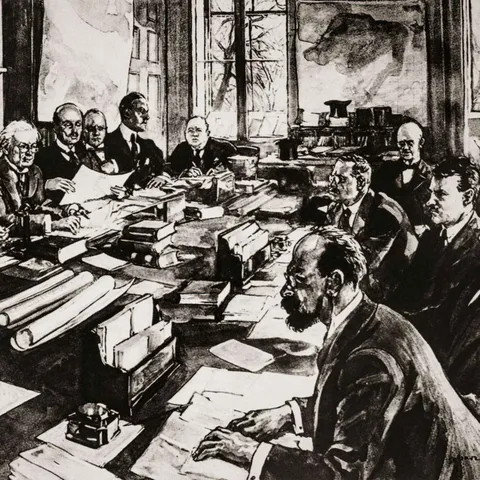
At 3pm, the three Irishmen arrived at 10 Downing Street. The meeting had been postponed an hour, and they sat down with Lloyd George, Birkenhead, Austan Chamberlain and Winston Churchill. Griffith writes that the conference opened with the British delegates in a bad mood. They had a full cabinet meeting previously and apparently had had a rough time. They started by discussing the Ulster issue. Griffith making it clear they wouldn’t agree to anything without hearing from Craig. Collins explained that to agree without hearing from Craig would be to surrender our whole fighting position.
Lloyd George, in full Welsh wizard mode, kicked off the meeting with all kinds of theatrics. He quote, was working himself up into a rage, waving papers in the air and declared, you are trying deliberately to bring about a break on Ulster, because those in Ireland have refused to come within the empire, and you, Mr. Griffith, are letting me down, where you had promised not to do so. There was silence. I said I would not let you down on that, and I won’t, Griffith said, defending himself. I said before I gave a decision on the earlier articles in the document, I must have a reply from Craig, either accepting or refusing the unity of Ireland. Then Chamberlain jumped in. That was inadmissible, unreasonable and contrary to the undertaking not to let Lloyd George down. In fact, it was because of the undertaking not to let us down that we have adopted the attitude we have, and staked thereon our political future.
Remember when I told you you might want to go back and listen to the section on the agreement Arthur Griffith had made with Lloyd George? Well, this would be the time to do it. Throughout this session, the British repeatedly brought up Griffith’s quote, personal assurances. Barton’s notes on the meeting are our primary source, and he actually doesn’t record what the specific assurances the British were talking about. In fact, historian Column Kenny argues that maybe Barton just didn’t know what the hell the British were on about. But we know the British were most likely speaking about the memo that had been passed around on the 13th of November, in which Griffith said he was happy with a boundary commission. But remember, Griffith believed he’d agreed to this on the condition that Craig and the Ulstermen did the same thing. But so far, there’s been no reply from Craig, so Griffith was well within his rights to tell Lloyd George to get lost. The Welsh wizard, however, continued to push the personal assurances angle, while Churchill did what they had agreed, quote, breathing fire and slaughter, argued to deny Ireland a navy.
Eventually, there was a pause in the meeting, and when everyone came back in, things were a little calmer. As Freeman puts it, having raised the temperature, Lloyd George just as unexpectedly lowered it. He became conciliatory. Now this next bit is actually really interesting. At this point, the British walked back on a whole heap of their previous demands. They agreed to the oath Collins had supplied with a few minor tweaks. Churchill backed up on his stance on the navy, and it was agreed Ireland would take control of coastal security in five, not ten years’ time. And even more importantly, though rather dry, the British totally caved on the position of trade. Quote, fiscal autonomy was conceded without a murmur of dissent, leaving the new Irish Free State to impose industry-protecting tariffs and restrict British imports. This is a big deal, and trade wars did follow between the two countries in the 30s.
After all those rounds of concessions from the British, there was another break. And when everyone came back, Lloyd George got serious. He demanded, are you prepared to stand by your agreement, whichever choice Ulster makes? Griffith, it’s said, was a bit shook. He was having his honour questioned and being accused of going back on his word. And that’s a big deal for the stoic, honourable and proud Arthur Griffith. With Lloyd George bearing down upon him, he decided to compromise, agreeing that he personally could go without a response from Craig. But that, quote, it is not fair to demand acceptance or refusal from the other delegates before Craig replied. As we’ve discussed, a lot has been made of Griffith’s personal assurances. Had he gone behind the backs of the other delegates? Had he been outmaneuvered by Lloyd George and did he crack under the pressure? Or did he play the hand he’d been dealt, making the most of what the slippery Prime Minister was offering, all while trying to avoid a war he knew Ireland could not win? It’s impossible to say for certain. All you can do is study the sources and decide for yourself. And all I’ll say on it is I have a hell of a lot of respect for Griffith and everything that he’s done to get the Irish to this point.
In response, Lloyd George replied with the following. I’ve always taken it that Mr. Griffith, you speak for the delegation. You are all plenipotentiaries and that is now a matter of peace or war and you must each of you make up your minds. And then Lloyd George made his infamous ultimatum. I require that every delegate should sign the document and recommend it, for there would be no agreement. We as a body have hazarded our political futures and you must do likewise and take the same risk. He then turned to Biden and in a solemn tone said, those of you who are not for peace must take full responsibility for the war that would immediately follow refusal by any delegate to sign the articles of agreement.
Now, if you think that Lloyd George was laying it on a bit thick, he actually went one further. The Welsh wizard pulled out two letters from his briefcase. You could imagine him placing them carefully down on the table in front of the Irish and sliding them both across. Each letter was addressed to the same person, James Craig. One laid out how the Irish had agreed to recommend the terms of the treaty to the Dáil. Yay, peace, fantastic. The second, as Chamberlain described, said the following, the Sinn Féin representatives refuse the oath of allegiance and refuse to come within the empire. Waving the second letter in the air, Lloyd George made his point clear. If I send this letter, it is war and war within three days. He explained that a special train and then a destroyer ship were on standby ready to deliver one of the two letters. He then asked the delegates, which letter am I to send? Demanding that he had an answer by 10 p.m.
At this point in the negotiation, around seven o’clock, the delegates had been arguing for four hours. They now only had three more hours to make their decision. Churchill describes the scene. The PM stated bluntly that we could not concede no more and debate no further. The Irish must settle now. They must sign the agreement for treaty in the form to which, after all these weeks, it had attained, or else quit. And further, that both sides would be free to resume whatever warfare they could wage against each other. This was an ultimatum delivered, not through diplomatic channels, but face to face, and all present knew and understood that nothing else was possible. The Irishman gulped down the ultimatum phlegmatically.
Griffith replied to Lloyd George softly, I will give the answer of the Irish delegates at nine tonight. But Mr. Prime Minister, I personally will sign this agreement and will recommend it to my countrymen. Lloyd George, maybe a little taken aback, asked, Do I understand, Mr. Griffith, that though everyone else refuses, you will nevertheless agree to sign? Yes, that is so, Mr. Prime Minister. Hearing this, the way Churchill tells it at least, Collins rose looking as if he was going to shoot someone, preferably himself. In all my life I have never seen so much passion and suffering in restraint. The meeting was over.
The Irish left 10 Downing Street, and as camera bulbs flashed and reporters shouted asking whether they’d come back, Collins replied, I don’t know. Churchill writes that we went off and drummed our heels, had some food and smoked, and discussed plans of campaign. No one expected that anyone but Mr. Griffith would agree, and what validity would his solitary signature possess? As for ourselves, we had already ruptured the loyalties of our friends and supporters.
That seems a good enough place to leave it as any for today, but I’ll be back tomorrow with the next episode, so stay tuned. Robert Babbington, Music by Liam Doyle, and additional help from assistant producer Aoife Murphy. This podcast was recorded in the lands of the Wurundjeri people of the Kugan nation. Sovereignty was never ceded.