Episodes Irish Revolution Season 1 — The Revolution
2am on a Tuesday PT2
Transcript
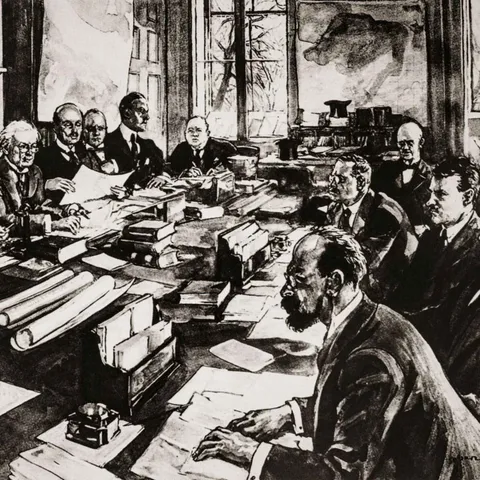
Welcome to the history of Ireland. Now, before we go any further, I think it’s important to look at the actual articles of agreement the Irish delegates were being asked to sign late on the evening of Monday the 5th. Go Google it, the Anglo-Irish Treaty Articles of Agreement, and you can see the whole thing for yourself.
Articles 1 and 2 laid out the quote, Ireland shall have the same constitutional status in the community of nations known as the British Empire, as the Dominion of Canada, the Commonwealth of Australia, the Dominion of New Zealand, and the Union of South Africa. So, Dominion status. It was a far cry from a republic, but the Irish Free State, as it would be called, would have its own parliament and the power to make its own laws. This is huge, and though not a republic, it was a million miles away from anything that had ever been on the table before.
Article 3 said that the Irish Free States would have a representative of the Crown, i.e. something similar to a Governor General. Article 4 was the controversial oath, an oath that would prove so tricky going forward. This is where it had landed. I do solemnly swear true faith and allegiance to the Constitution of the Irish Free State as by law established, and that I will be faithful to His Majesty King George V, his heirs and successors by law, in virtue of the common citizenship of Ireland with Great Britain, with her adherence to, and membership of, the group of nations forming the British Commonwealth of Nations. It’s a mouthful, and even right there in the room, no one was happy with this oath. In fact, like any good compromise, it left everyone very, very unhappy. The British saw it as an overly written bastardisation of a proper oath, and it is wordy. And as for the Irish, well, we know what they felt about any oath to the King. But regardless, this legalese was where the oath had landed.
Article 5 stated Ireland would pay a fair share of the UK’s public debt. Pretty straightforward fiscal stuff, no worries. Article 6 focused on sea defence. The Irish had won the right to its own navy. But quote, the defence by sea of Great Britain and Ireland shall be undertaken by His Majesty’s Imperial Forces. Article 7 built on this, and referred to the infamous treaty ports. Basically, the British would have control of Cove, or Queenstown as it was then known, Breehaven and Lockswilly, even during peacetime. And then during war, the British would be afforded, quote, such harbours and other facilities as the British government may require. The ports annoyed people, as it felt like Britain was still keeping military control of sections of Irish land, which it was. But as we’ve discussed, they were vital to the British because the British were paranoid about anyone attacking them from the coast through Ireland. As mentioned, Churchill was even a little worried about the Americans doing so.
Article 8 gave the Irish Free State the right to, quote, establish and maintain a military defence force. But it couldn’t get proportionally bigger than the British forces. Article 9 just said ships could move freely between ports. Again, pretty straightforward, not that interesting. Article 10 was almost a controversial one. It basically said that the Irish Free State would, quote, pay fair compensation to judges, officials, member of police forces and other public servants. That’s simple enough, but the Irish had fought for one important clarification. This would not apply to the Auxiliaries or the Black and Tans. That would never have gone down well with anyone in Ireland.
Articles 11 through 15 all related to Northern Ireland, that tricky one. Basically, it laid out that Northern Ireland had the right to opt out of the Irish Free State within a month of the new government’s creation. If this happened, which everyone knew it most certainly would, Northern Ireland would continue with the government it had received as part of the Government of Ireland Act. But a Boundary Commission would be organised. Yep, the Boundary Commission. This would involve three people. One appointed by the Irish Free State. One appointed by the Government of Northern Ireland. And one appointed by the British Government. The three appointees would then, quote, Article 16 tried to protect the rights of religious minorities within the new state. Remember, Southern Protestants had been worried about an Irish state for decades. Home rule is Rome rule, and all of that. This was meant to protect them. Then 17 and 18 was kinda just legal stuff about transferring power and getting approval from the British Parliament and the Dáil, or the, quote, House of Commons of Southern Ireland. If there are any international treaty lawyers who have read through these and think I’ve oversimplified things, do let me know. We can go through it. But there you have it.
After years of fighting, and months of negotiating, that was the agreement that was on the table. And it was the agreement that was being furiously discussed back in the Irish headquarters around 9pm on Monday the 5th of December. Collins, though seemingly furious when he left the meeting, had calmed down by the time the Irish delegates returned to their base of operations. He very quickly declared that he would side with Griffith and sign the treaty. Barton and Gavin Duffy refused, leading to, as Erskine Childers described, a long and hot argument. At one point in the middle of this argument, Griffith turned to Gavin Duffy, stating, What could you get better? It seems Duffy didn’t have an answer. And that was the thing. Nobody did. No one had a better solution than what was on the table right there. Maybe De Valera did, with his idea of external association. But he had never come to London to argue its case, and no one had really convinced the British what it meant. So this is what they had.
Barton later wrote that it was a most frightful night, in which the most terrific things were said to Gavin Duffy and to me by Collins and Griffith and Duggan. They called us murderers, stated that we would be hanged from lampposts, that we would destroy all that they had fought for. After this barrage, Childers worried that Barton might flip, and he weirdly mentioned Barton’s wife to keep the man strong. I feel Molly is with us, he said. But this totally backfired, and Barton replied, Well, I suppose I must sign then. And that was it. Gavin Duffy ended up following Barton’s lead. They all agreed to sign.
And at no point did anyone make an attempt to call home and speak to Dev, or any of the rest of the cabinet. This might seem weird, but you have to remember that Dev was on the west coast of Ireland. And even today, West Clare’s phone reception is pretty ropey. In 1921, there would have been just no way to contact him. When he was needed most, Dev was nowhere to be seen. Now to be honest, this probably suited Griffith and Collins down to the ground. They were sick of Dev’s meddling, and really saw this as their only chance to make peace. Remember, Collins, through the IRB, was confident he could get the doll onside. And as Griffith would later argue, If I could have left it to the doll, I would have. But no choice. Letter is going to Craig, we took the decision, and don’t regret it.
Rightly or wrongly, Lloyd George’s theatrics had worked wonders. Many have argued that maybe Lloyd George was bluffing with his two letters, that he wasn’t ready to go back to war. But how could Collins, Barton, Gavin Duffy, or Griffith know this? To them, it wasn’t a risk worth taking. And Griffith, and Collins at least, knew that the IRA could never hold up against the total war that Churchill and Lloyd George had threatened them with.
With all that in mind, at 11.20pm, Griffith, Collins, Barton, and Erskine Childers returned to 10 Downing Street. They were, as Churchill described, superficially calm and very quiet. As they sat down in the meeting room, Lloyd George asked, Whether you, as a delegation, are prepared to accept these Articles of Agreement and to stand by them in your Parliament, as we, as a delegation, would stand by them in ours? There was a long pause. We do, Griffith replied. Mr. Prime Minister, the delegation is willing to sign the agreements. But there are a few points of drafting which perhaps it would be convenient if I mentioned at once. Churchill was amazed by this, later writing that, Thus, by the easiest of gestures, Griffith carried the whole matter into the region of minor detail, and everyone concentrated on these points with overstrained interest, so as to drive the main issue into the background forever. Soon we were talking busily about technicalities and verbal corrections, and holding firmly to all these lest worse should befall.
So, as is often the case, the end to it all was fairly undramatic. The groups argued over minor language details and then waited for the new treaty to be typed up. Then, at either 2.10 or 2.20am, depending on who you ask, on Tuesday the 6th, Griffith, Collins and Barton all signed the treaty. The British followed suit. And for the first time, the delegates all shook hands.
Reporters noted that, The Sinn Féin delegates emerged looking much more cheerful than when they went in. It was realized that if a settlement had not been reached, any possibility of warfare was appreciably further off. They then asked Collins what the news was, to which he replied, not a word. He knew the difficulty ahead, and probably didn’t want to be caught celebrating as he left 10 Downing Street. In fact, in the days that followed, it was announced that Collins wouldn’t pose for any photos, but that he doesn’t mind the cameraman having a pot shot at him. He’s accustomed, he’s accustomed to that sort of thing. After the Irish delegates had left, Birkenhead then appeared, in a crumpled evening dress, smoking one of his inseparable long cigars. Shortly followed by Churchill, who was the one who finally made the announcement to the reporters. Sorry you had such a long wait out here. Agreement has in fact been reached.
Now, there’s one brilliantly Irish thing about all of this that I absolutely love. Keen-eared listeners will note that neither Duggan nor Gavin Duffy had went back to Downing Street that night. So as Barton described, the original document was brought to Hand’s Place, the Irish headquarters, the next morning to be signed by Duggan and Gavin Duffy. But Duggan had already left for Dublin. So what did they do? Well, they only bloody well forged his signature. They cut it out from somewhere else and pasted it right into the agreement. Isn’t that just nuts? Could you imagine what John Hancock would say about that?
But anyway, the next question is, how did the Irish delegates themselves feel about this momentous decision? Well, it’s hard to know. Griffith, for his part, was described by his secretary as being stern, serious, determined, patient. Neither joyful nor depressed. He had done what he had done because he was convinced in his soul that it was the right thing to do. While Gavin Duffy would later say to the Dáil that, He’d really come around, it seems. Breskin Childers, though, on the other hand, described in his diary that the next day he felt desperately dreary and lonely. He was still furiously against the treaty, and as Freeman described, he thought the Sinn Féin delegates had left his world in ruins.
And finally, there’s the famous story about what Collins said after signing the treaty. When they were all signing the agreement, Birkenhead was said to have sighed, Or somewhere else, I guess that maybe it was in a letter that he wrote this. Either way, one of the most historic lines in Irish history might not have actually ever been said. It’s very hard to confirm, but it’s a fantastic line, especially when we know what comes next. So if you’re telling this story and you want to keep it in, look, I won’t judge you. But what I will say is the information that we can confirm is a lot more human. The next morning, he wrote to Kitty Kiernan, complaining that he hadn’t gotten to sleep until 5am. And what he wrote next, while it’s a lot less dramatic, but it feels a little more real. He said this, He said this, The scariest thing about this, and maybe why it doesn’t get as repeated as his more famous line, Is that the first one was true, and this one wasn’t.
The Irish War of Independence was over. Now all that was left was to convince those back at home to back the treaty. And that should be easy, right? Thanks for listening. Subscribe wherever you get your podcasts, and if you’re enjoying it, give us a review on Apple Podcasts or tell your friends. It really helps. You can also support the show, buy merch, and get in touch all through our website, thehistoryofireland.com. Or you can follow us on Facebook or Twitter. It’s always great hearing from you guys. And if I’ve made a mistake, please do let me know. The History of Ireland was written and produced by me, Kevin Dole. Additional research and fact-checking by Robert Bavington, music by Liam Doyle, and additional help from assistant producer Aoife Murphy. This podcast was recorded in the lands of the Wurundjeri people of the Kulin Nation. Sovereignty was never ceded.