Episodes Irish Revolution Season 1 — The Revolution
The Treaty Debates: Part 3
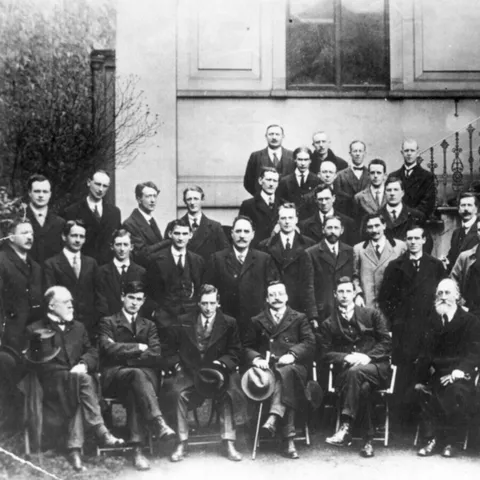
In this episode the Dail finally takes a vote on the Treaty. We look at the speeches that came before and after the vote, and how they set the scene for a nationwide split.
Keen eared listeners may hear some discrepancies in audio, please bear with me as I set up my new studio!
Transcript
Welcome to the history of Ireland. In the last episode, I cruelly left you hanging to see what would happen with the treaty debates after the Christmas break. And I must say, the Christmas break ended up being hugely important. Though people did stick to the promise not to make any speeches. But Irish politics has always been a more local, face-to-face kind of thing. And as historian JJ Lee puts it, many of the TDs, quote, found themselves facing their constituents for virtually the first time.
Dev explained that had the vote been taken on the 22nd, it was thought we might have got a majority of one or two against the treaty. But the press is hard at work throughout the country trying to get the local public bodies, county councils, etc. to pass resolutions in favour of the treaty. And the church is hard at work. You see, many TDs spent the Christmas trying to gauge where their constituents stood. And the constituents themselves used the time to figure out their views.
Across the country, quote, authorities, Sinn Fein clubs, labour bodies, county farmers associations, board of guardians and other such organisations were making choices of their own. And overwhelmingly, they voted in favour of the treaty. In fact, it was noted that of around 361 elected groups, only 14 voted against the treaty.
And as Dev pointed out, Christmas also gave the church a chance to weigh in. The church as an organisation had decided it was pro-treaty almost immediately. And across the country, bishops used Christmas Mass as a chance to make this point clear. Dr Michael Fogarty, Bishop of Killaloe, told his congregation, to vote against the treaty would be an act of national madness. While Dr Michael Brown, Bishop in Cork, argued that it was a choice between tyranny, bondage and slavery, which our forefathers suffered, or a free state with her own parliament invested with full power to rule Ireland, or Ireland’s welfare. A lot to consider over Christmas dinner, ain’t it?
And when the Dáil gathered back on January 3rd, things had definitely shifted. That morning, JJ Walsh, a TD from Cork, stood up and stated, if we were to ask the people of Cork to vote for or against the treaty, we would have 90% voting for it. That is a unity that this country, neither for a republic, nor at any other stage of its history, ever enjoyed. On top of that, at least two TDs, who had been anti-treaty before the Christmas break, had now come round to the other side after speaking to their constituents. Imagine that, politicians listening to their voters. Amazing.
The next day, on Wednesday the 4th, document 2 was put back on the table, though De Valera had changed it up again and now had document 3. He still didn’t officially propose it though, and in the end an infuriated Griffith simply leaked both versions to the press. But the various versions and the lack of substantial differences, or at least differences that anyone but Dev could understand, went against him and both documents were left dead in the water.
What followed was a few long, drawn-out days that involved everything from arguments over the newspapers to how Irish certain TDs were. And none of it brought the Dáil any closer to a decision. On Friday 6th, the 12th day of the debates, things heated up, when Dev, quote, looking deathly pale, rose to his feet and declared emphatically that his cabinet was split. Not only on personalities, but also on fundamentals, and that he could no longer operate on that basis. In a long speech he discussed his fight in 1916, pointing out that the majority were against the volunteers at that point, while at the same time flexing his seniority, and he spoke about how he had pulled Sinn Féin together. But in this same speech, his biographer Ronan Fanning writes, Dev O’Leary plumbed the depths of anti-democratic contempt for majority rule. This was peak republican moralism. Dev stated, Basically, what he’s saying here is, Regardless of what the people think they want or say they want, he knows what they think and what they want. So regardless of what the majority votes, Dev believed he was in the right and would stick to his guns.
The long and short of the speech was this. Dev stated, This caused an uproar. Collins and Griffith argued vehemently against changing the agenda to speak about this new plan of Dev’s to resign. They argued that regardless, Dahl was there to debate the treaty, with Collins describing it as a motion to draw Ed Herring across our path. And generally, it seemed most TDs agreed that Dev shouldn’t resign until after the treaty was voted on. And Dev reluctantly backed down. But he did this under the condition that the treaty vote was held within the next 48 hours. I think Dev knew that the more the debates dragged on, the less likely people were to vote against the treaty. He wasn’t the only one looking to finish things up. And at the mention of 48 hours, many of the members of the Dahl shouted, Tomorrow! Tomorrow! And so that was that. It was decided to take a vote the next day. Saturday, January 7th, 1922.
Things were tense that morning and it really felt like it could go either way. The whip for the pro-treaty side told the Irish Independent, There was no doubt it would be defeated. This might have been a little bit of political theatre, but there were definitely 4 or 5 TDs that could go either way. The final debate kicked off at around 11.30, when Owen McNeill tried to pass a motion to avoid the split. And it went absolutely nowhere. People were keen to get to the endgame. The last remaining TDs spoke, but kept things short. In fact, the Oireachtas website describes how, Some deputies competed to see who could make the shortest contribution, that they might finally bring things to a close. So nothing much happened in the morning. Besides for a consistent rise in everyone’s blood pressure.
Then in the evening session, each of the senior deputies from both sides stood up to make their case. My old pal, Cahill Brewett, didn’t get the memo on short speeches. And beginning at 5pm, he talked for an hour and a half. His speech was a nightmare. Described as personal and poisonous, he tore into Michael Collins. You can go read it on the Oireachtas website. It is all kinds of, well, beside the point. Brewett goes on a long rant that basically argues that Collins created a mystique around himself in the papers. And that Brewett didn’t like this. It’s packed with tidbits like, Mr. Michael Collins does not occupy the position in the army that newspaper men said he occupied. To which the TDs and the Dahl just seemed bemused. There were cries of shame on you. There was laughter. There were requests to just bloody well get on with it. The whole thing was said to have cost the anti-treaty side upwards of two and four votes. And when a vote is this close, that is no small thing.
Once Brewett had finally ended his speech, Griffith stepped up to finish off proceedings. His speech was the polar opposite of Brewett’s. It was powerful, stirring, and got to the heart of the issue. Now, I don’t usually do this, but for the next little section right up until the end of this debate, I’m going to pretty much give you what everyone said verbatim. So get ready for some long quotes, but they’re good ones.
Here’s an excerpt from Griffith’s speech. I belong to the Irish people. I have worked for them because they are flesh of my flesh and bone of my bone. I have never deceived them at all events, whatever I have done. I may have misled them or given them bad advice, but I have never concealed from them anything that is vital to their interests. It is vital for them to know what we are up against and not to be misled and not to believe that we, plenipotentiaries, went away with a mandate for the Republic and came back with something else. I have heard in this assembly statements about the people of Ireland. The people of Ireland sent us here. We have no right and no authority except what we derive from the people of Ireland. We are here because the people of Ireland elected us and our only right to speak is to seek what they want.
I am told that the people of Ireland elected us to get a Republic. They elected us in 1918 to get rid of the parliamentary party. They elected us in 1921 as a gesture, a proper gesture of defiance to the black and tans. They elected us not as doctrinaire Republicans, but as men looking for freedom and independence. When we agreed to enter into negotiations with England, with the object of producing a treaty, we were bound, I hold, to respect whatever the Irish people, the people of Ireland, thought of that treaty. I have heard one deputy saying here that it does not matter what his constituents say. I tell him it does. This was practical nationalism at its best.
He continued, you are trying to reject this treaty without allowing the Irish people to say whether they want it or not. The people whose lives and fortunes are involved. You will kill Dáil Éireann when you do that. You will remove from Dáil Éireann every vestige of moral authority and they will no longer represent the people of Ireland. It will be a junta dictating to the people of Ireland. And the people of Ireland will deal with it. Finally, he finished, I do not care whether the king of England or the symbol of the crown be in Ireland so long as the people of Ireland are free to shape their own destinies. We have the means to do that by this treaty. We have not the means otherwise.
How we use electricity can be smarter, cleaner and greener. At Electric Ireland we can help guide you there. Our Net Zero Hub has all you need to know about smart meter plans, home EV chargers, solar panels, heat pumps and much more. Making your usage clearer, your trips greener, your home cosier and your world brighter. Find our Net Zero Hub at electricireland.ie
I say now, to the people of Ireland, that it is their right to see that this treaty is carried into operation when they get, for the first time in seven centuries, a chance to live their lives in their own country and take their place amongst the nations of Europe. To all of this, Dev responded, before you take a vote, I want to enter my last protest. That document will rise in judgment against the men who say there’s only a shadow of a difference. If everything is in this treaty that seemed to be covered by it, but it is not, I say that the Irish nation will judge you who have brought this treaty. If it is approved, they will judge you by comparing what you got for the Irish people out of it with the terms of an explicit document where there is nothing implied but everything on the face of it. It is the same position exactly as in the case of Grattan and Flood and I suppose the Irish volunteers are to be disbanded next. Dev as prosaic as ever here, isn’t he?
Collins, maybe looking for the last word, responded to Dev, simply saying, let the Irish nation judge us now and for future years. And with that, they all moved in to parliamentary details of the vote. After 13 days of debates over the course of a month, after years of fighting the British, after centuries of oppression, the vote was finally being put forward.
You can imagine that things got quiet in Earlsford Terrace as each member of the Dáil stood up to cast their vote. 121 TDs voted in all. Eoin McNeill as the Speaker abstained. Two men were absent and then there’s the interesting case of Frank Drovan, who resigned rather than cast a vote for the treaty. He refused to vote against the eradication on the grounds it would have flattered the will of his constituents. He also refused to vote for it because of his own morals. Each member who was voting stood up and said either. Is Táil, which means for, or Ní Táil, which means against.
It then took two very, very long minutes to tally up the votes. The Dáil was deadly quiet when suddenly, quote, a mighty cheer was heard outside. The waiting crowd had got the results even before the Speaker had had the totals placed in his hand. And what was it? Well, you probably know it was 64 in favour, 57 against. That means there are only four votes in it. The whole fate of the nation coming down to four votes. The treaty had been approved. And though people cheered outside, one man wrote how inside the chamber there was complete silence. Nobody moved. Nobody cheered. Nobody even spoke. Minutes passed.
Then De Valera stood up. There is one thing I want to say. I wanted to go to the country and to the world. And it is this. The Irish people established a republic. This is simply approval of a certain resolution. The republic can only be disestablished by the Irish people. Therefore, until such time as the Irish people in regular manner disestablish it, this republic goes on. Whatever arrangements are made, this is the supreme sovereign body in the nation. This is the body to which the nation looks for its supreme government. And it must remain that. No matter who is the executive. It must remain that until the Irish people have disestablished it. Basically, Dev was making it very clear that he was going to ignore the result.
Collins then replied. And this response is so long that I’m not going to do it in my usual dodgy Collins Cork accent. He said this. I ask your permission to make a statement. I do not regard the passing of this thing as being any kind of triumph over the other side. I will do my best in the future as I have done in the past for the nation. What I have to say now is whether there is something contentious about the republic, about the government in being or not, that we should unite on this. That we all do our best to preserve the public safety.
Now, in all countries in times of change, when countries are passing from peace to war or war to peace, they’ve had their most trying times on an occasion like this. Whether we are right or whether we are wrong in the view of future generations, there is this. That we now are entitled to a chance. All the responsibility will fall upon us of taking over the machinery of government from the enemy. In times of change like that, when countries change from peace to war or war to peace, there are always elements that make for disorder and make for chaos. That is as true of Ireland as of any other country. For in that respect, all countries are the same.
Now, what I suggest is that I suppose we could regard it like this. That we are a kind of majority party and the others are a minority party. That is all I regard it as at present. And upon us, I suppose, will be the responsibility of proving our mark to borrow a term from our president. Well, if we could form some kind of joint committee to carry on, for carrying through the arrangements one way or another, I think that is what we ought to do.
Now, I only want to say this to the people who are against us. And there are good people against us. So far as I’m concerned, this is not a question of politics, nor never has been. I make the promise publicly to the Irish nation that I will do my best. And though some people have said hard things of me, I will not stand things like that said about the other side. I have just as high a regard for some of them, and I’m prepared to do as much for them. Now, as always. The president knows how I tried to do my best for him.
You can see here, Collins was striving, like really working for unity. He knew what was coming. But Mary McSweeney, our moralist Republican, jumped in to say, let there be no misunderstanding, no soft talk, no ramesh, at this last moment of the betrayal of our country. This is a betrayal, a gross betrayal. The fact is that it is only a small majority. And that majority is not united. Half of them look for a gun, and the other half are looking for the flesh pots of the empire. I tell you here, there can be no union between the representatives of the Irish Republic and the so-called Free State. So you see, not everyone was willing to work together.
Dev then called for a meeting of the anti-treaty side the next day, to try and figure out what the hell they were going to do next. He then finished off the proceedings, saying, I would like my last word here to be this. We have had a glorious record for four years. It has been four years of magnificent discipline in our nation. The world is looking at us now. And that’s where the dull notes for his speech end. Next, simply says, the president here, breaks down. Music by Liam Doyle, and additional help from assistant producer Aoife Murphy.