Episodes Irish Revolution Season 2 — The Civil War
The Funeral of Michael Collins
Transcript
Welcome to the History of Ireland First off, a quick apology for the delay in this episode I spent just over a week fighting off quite a nasty little throat infection And it totally messed with my productivity Back and rearing to go now though In the last episode, we told the story of the death of Michael Collins With Griffith having died the week before The landscape of Irish politics was changed forever The new, fledgling state had lost both its leading figures And safe to say, everyone was feeling a little shell-shocked Collins’ body was taken by sea from Cork to Dublin Where a funeral was held on Monday, August 28th, 1922
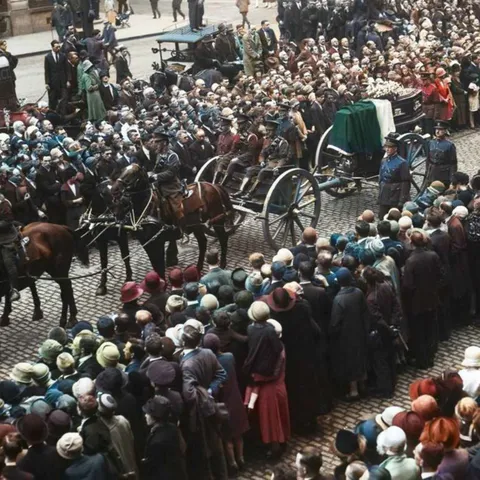
The cotton was actually pulled by horses borrowed from the British As one sergeant wrote In the 17th battery was my subsection wagon team of six black horses These were handed to the Irish Free State Together with a coffin board And drew the gun carriage at Michael Collins’ funeral All the equipment for the horses was handed over with them It was handed over in immaculate condition Log chains and logs burnished Stable heads, collars, leathers soaked And buckles polished Of course, the horses were trimmed out Manes hogged, hells clipped, tails pulled All the spit and polish as it should be I don’t know why, but there’s something amazing About the British soldiers who’d been fighting Collins and the Irish For so long, turning around And giving him nothing but the best equipment for his funeral
And what a funeral it was Over 500,000 people attended Something like a fifth of the entire population of Ireland Collins’ body was left in state in the city hall And everyone, from your average Joe Bloggs To the highest ranking members of the church Came and paid their respects The photos really add quite something Streets packed following the procession As it made its way from the city centre to Glasnevin Cemetery
One newspaper described how The nation today paid its last tribute To the dead soldier chief Never in living memory Have such crowds thronged the streets of Dublin Think of the recent passing of Queen Elizabeth The pomp and spectacle that went with that Honestly, this would have been similar But maybe a less lavish affair The newspaper goes on to paint a dramatic picture The whole enormous throng stood patiently Reverently silent Scarcely a sound was heard And awesome stillness settled On the wonderful crowd of mourners When the trams ceased And the last sound of traffic died out of the streets
At the graveyard, it was Richard Mulcahy For all intents and purposes, Collins’ right-hand man Who gave the eulogy And it really is something I won’t go into the whole thing here But I’ll read you a bit as it’s fascinating to hear What was going through the man’s mind
This is what he said Our country today is bent under a sorrow Such it has not been bent under for many a year Our minds are cold, empty, wordless, and without sound But it is only our weaknesses That are bent under this great sorrow That we meet with today All that is strong in us is strengthened By the memory of that great hero And that great legend Who is now laid to rest Pages have been written by him In the hearts of our people That will never find themselves in print But we lived, some of us With these intimate pages And those pages that will reach history Meagre though they be Will do good to our country And will inspire us through many a dark hour
Finished saying Michael Collins had only a few minutes to live And to speak after he received his death wound And the only word he spoke in these few moments Was Emmet He called to the comrade alongside him The comrade of many fights and many plans And I’m sure that he felt in calling that one name That he was calling around him The whole men of Ireland That he might speak the word of comradeship and love
There’s so much to unpack in here, it’s fascinating For one, you can already see how Collins was being mythologized The young man was becoming a legend That’s what Mulcahy says here And he’s being used to pull the country together
But there is another side to this as well Historians Anne Dolan and Will Murphy Point out that for a lot of these men Most under 40 This was both a political loss And a crushing personal loss Both Griffith and Collins had been close friends With those in the Irish movement for years How could they not be? And now suddenly, both were just gone
I think it’s an important point to make Because it’s easy to think of historical figures dying And succumbing to the pump The newspaper articles And yes, the legend, the myth making But it’s just as easy to forget That these were people who left behind families And friends and loved ones You really do just have to pause and take a moment For Kitty Kiernan, Michael Collins’ fiance Or Maude Griffith, Arthur Griffith’s wife What must they have been feeling at this point? Nothing short of a tragedy
Weirdly, Collins was left in an unmarked grave Until 1939 At which time, Dev Valera Who was in charge at this point, sorry for the spoilers Finally allowed John Collins, Michael’s brother To place the gravestone down But Dev made sure it would only cost 300 pounds And he wanted it to be humble and plain Apparently, only a priest, an altar boy And Collins’ brother Sean Were there to see the grave erected Some say it was Dev being spiteful Others say it was just Dev being typically austere And not wanting to create a fanfare For his own part, Dev would later write That he broke down in tears when he heard of Collins’ death
And on the anti-treaty side There was a mixed and rather complicated reaction To Collins’ death This should have been a major win Imagine how ecstatic one would feel Having killed the leader of the enemy And some did see it as a win One anti-treaty soldier wrote Congratulations on having killed off the two infamies Griffith and Collins How does little Jack feel about M. Collins? Glad, I suppose Liam Lynch, leader of the anti-treaty forces wrote It was a splendid achievement from a military point of view Collins’ loss is one which they cannot fill
But many people, and more than is normal for the death of an enemy Mourned rather than celebrated Dan Breen, the famous republican who kicked off the whole war of independence And was very anti-treaty Admitted in 1968 that Collins’ death was the sadness of my life I reacted like you react when you hear of the death of your mother I cried I didn’t cry when Sean Tracy was killed Collins was the only one who moved me to tears And Collins’ death was the sadness of a civil war When a fellow you like very much But didn’t agree with you Is killed That makes it very sad I cried I never remember crying before or since Except when I got a hammering in school
While Martin Walton, another anti-treaty IRA man Simply wrote Stab Absolute pain I fell back in the bed Unbelievable Utterly unbelievable It’s said that those involved in the ambush Simply quote Departed in silence When they finally heard the news that Collins was dead While later One man, Jim Hurley, who claimed to be there Asked Collins’ brother, Sean How could we do it? We were too young I was only 19 That is the questioning of a man Racked with guilt Not reveling in his enemy’s defeat
Unfortunately though Collins’ death dragged the conflict Into an even bloodier phase And reprisals were quick to occur On Saturday the 26th The weekend after Collins’ death And before his funeral Two anti-treaty soldiers Alfred Coley, 21 And Sean Cole, 19 Were stopped at a checkpoint And caught with revolvers They were bundled into a car And carried off towards Whitehall Where they were shot And their bodies were dumped
Some argue that the men who stopped them Wearing quote A mix of National Army uniforms And plain clothes Were drunk Looking for anyone To unleash their grief upon A similar thing happened to Bernard Daly A grocer’s assistant Who was abducted and shot With his body abandoned in Malhide And this wasn’t just confined to Dublin In Limerick Harry Brazier An anti-treaty IRA man Was arrested at work And also shot While on the 8th of September Timothy Kenefick’s body was found Bearing the horrific signs of torture
Now the Irish Free State Actually tried to blame the IRA For these murders But it was clear They’d been carried out By unsanctioned Irish Free State soldiers In fact Emmett Dalton confirmed that Coley, Cole and Kenefick Were all killed by members of the squad And considering Vinnie Byrne A leader in the squad Wrote at the time of Colin’s death That I’d have shot any bloody diehards I came across It’s hard to see These as anything But knee-jerk reactions To the death of their leader
As historian Brian Hanley puts it They were intensely loyal to Michael Collins And this Over any other factor Had guaranteed their support for the treaty After Colin’s death They were overwhelmed With a desire for revenge But also robbed of the one leader Who could control them As I said This was the start of the war Becoming even more brutal than ever
And if we force ourselves To take a moment to think About what a personal loss It must have been For the friends and family of Collins and Griffith We must do the same For the young lads killed as revenge Alfred Coley Sean Cole Bernard Daly Timothy Kenefick And many more All dead Too young Leaving broken hearted families And Friends As I say This is a point where the conflict Really does move into a darker stage
Now The last thing we need to cover Regarding Michael Collins death And arguably the most important thing Is that of his replacement Who was to fill the power vacuum Left by Collins and Griffith’s death Well to answer that question Let’s introduce William T Cosgrave
Cosgrave hasn’t really popped up in our narrative yet As he mostly kept to the background He was a modest Unassuming man Who had been plugging away In the political wing of Sinn Féin For over a decade Born in 1880 in Dublin Son of a publican Cosgrave was pretty much a career politician He was a founding member of Sinn Féin And acted as Sinn Féin Dublin councillor From 1909 to 1922
He also joined the volunteers in 1913 And was sentenced to death For taking part in the 1916 Rising Luckily for Cosgrave This got commuted To a life sentence in Frongrook And he was eventually let out During the war of independence He became minister for local government And did a mighty job Bringing local councils Over to the republican side In the treaty debates He was pro-treaty And had become an important member Of the leadership Along with Griffith and Collins
Initially people wanted Richard Mulcahy Or Owen McNeill To take the leadership of the country Kevin O’Higgins A politician we’ll discuss in the future Campaigned fiercely for Mulcahy But Mulcahy himself Was having none of it In what really is An amazingly commendable move Mulcahy argued That he could not control Both the government and the army At the same time Mulcahy didn’t want Ireland To slip into a situation Where it was ruled by a military junta
As he put it O’Higgins idea Was that I should be head of the government There was no move to discuss that And as far as I was concerned The position with regard to the army Was that I didn’t believe That the army could be handled By anyone except myself After Collins death Therefore The question of my taking over the government Would be an utter impossibility At that time
You’ve got to hand it to Mulcahy The man had morals This is some Cincinnatus stuff He turned down power When it was right there for the taking For the good of the country Whether he would have gained enough support Is hard to say Most people backed Cosgrave And for good reason He was a highly experienced politician And well liked across the pro-treaty side
I think there was a sense among the TDs at the time That with all the chaos They needed a conservative pro-democratic leader And Cosgrave was their man So on August 30th He became chairman of the provincial government And president of Dáil Éireann
On September 9th The newspaper described him as follows It would be hard to imagine anybody Who is less true to what we used to consider The Sinn Féin type Than Mr Cosgrave It is not only that he does not dress In the regulation way Trenchcoat, legging and slouch hat And the rest of it But he has a thoroughly conservative face
What is ironic Is that the bloodiest time of the Irish Civil War Was not overseen by Michael Collins Who many saw as the leader of a murder gang And instead By this rather conservative career politician But we will explore more about Cosgrave And how the war developed after Collins Next time
Patreon link in the show notes Or visit our website thehistoryofireland.com You can also get in touch through the website Or on Facebook and Twitter It’s always great hearing from you guys And if I’ve made a mistake Please do let me know
The History of Ireland Was written and produced by me, Kevin Dole With music by Liam Doyle And additional help From assistant producer Aoife Murphy
Since January My Future Fund has been helping you invest in your future While you’ve been paying in Your employer has paid in With the state topping it all up It’s already growing With over 400 million euros Saved by 800,000 participants In just six months Continue protecting your future It’s already looking brighter Learn more at myfuturefund.ie