Episodes Irish Revolution Season 2 — The Civil War
The Man Who Wasn't Collins
Transcript
Welcome to the history of Ireland. People did not have a lot of faith in the Irish government, Sands, Griffith and Collins. In September, De Valere declared the government very weak, saying W.T. Cosgrave, the new leader, was a ninny. Liam Mellows, an anti-treaty leader, believed that the Free State seemed to be a bit groggy these days. While one IRA leader even went as far to say, the English will be back in a week. This proved to be rather untrue. And today we’re going to look at what happened, politically, post Collins and Griffith’s death.
You’ll remember that before Collins’ death there had been a growing frustration with the fact that the TDs elected in July had yet to meet. We’ve discussed how some see this as an indication of Collins’ bid to take dictatorial power. But this wasn’t just Collins’ policy. Part of it was due to military tactics. Mulcahy had argued to Collins that not allowing the Parliament to meet would give the military more free reign and prevent, quote, the irregulars in the South feeling that as soon as we came definitively up against them, we hesitated to face them boldly and turned aside the job and called Parliament.
Basically he’s saying the irregulars might think we will ask Parliament how we should act, rather than just acting. Not particularly democratic but I can see the logic. The Parliament, and we’ll get into what it should be referred to in just a second, was supposed to meet on August 24th, two days after Collins’ death. Instead the first meeting of the Irish Free States Parliament occurred on September 9th, just over a week later.
Now as I said there is some confusion around what we should call this collection of politicians. We know the previous government was the second Dáil, or Dáil Éireann. It was technically a republican body and lived a sort of half-life well into the late 20s. But this new body, well technically it couldn’t be called a Dáil. The Irish Free State would not come into effect until the 6th of December.
Currently the government was officially known as the Provisional Government. Both the Free State and the Provisional Government were very different entities to the Republic. And this Parliament needed to reflect this. So it was described as quote, the Parliament to which the Provisional Government is responsible. How’s that for a bit of verbal confusion? It would act as the governing body until the Irish Free State technically came into being at the end of the year.
But annoyingly for us everyone still referred to it as the Dáil, sometimes even the third Dáil. So that’s what we’re going to do for simplicity’s sake. I’ll refer to it as the Dáil as well. But remember technically it wasn’t, it was it’s own weird little thing.
Now this might all seem like pointless political technicalities. But not everyone saw it like that. One TD, Laurence Guinnell, raised quite a stink. He was concerned about partition. As the Dáil started, Guinnell asked about the role.
I have not signed the role, he said. I want some explanation before I sign. I have been elected in pursuance of a decree of Dáil Éireann. I have heard nothing read with reference to that decree. Nothing but an act of a foreign Parliament. I have not been elected to attend any such Parliament. I have been elected as a member of Dáil Éireann. Will anyone tell me, with authority, whether this is it?
For the most part, Guinnell was ignored. While a Ceann Comhairle, or Speaker, was appointed. But Guinnell was not going to be silenced easily. He continued. Oh bosh! Will anyone tell me, with authority, whether this is Dáil Éireann or a partition Parliament? He was interrupted again before asking directly. It is easy to say yes or no. Is this Dáil for the whole of Ireland?
In the end, no one would raise to the bait and declare the Dáil as one for the whole of Ireland. And so Guinnell simply refused to sign the role. Then, because he refused to sign the role, he was kicked out. As simple as that. Guinnell saw this as a huge injustice and the disenfranchisement of his electorate.
But most everyone else, well they saw it as a bit of a relief. One TD pointed out that Guinnell could have been, quote, very much a thorn in our flesh over the next few months. Not a great start, but a good example of how even within the ranks of the politicians, the whole complex situation was not sitting too comfortably.
But once Guinnell had been ousted, it was time to officially elect W.T. Cosgrave as President. But that wasn’t so simple either. Remember, Isaac Griffith had been President of the Dáil, while Michael Collins had been President of the Provisional Government. With both men gone, it became clear that the roles would be folded into each other. But the debate transcripts show quite a bit of confusion over this.
Eventually, Cosgrave spoke to make clear the intentions of the power he was seeking. Already you start to see the restraint and democratic values he possessed. No one was going to accuse him of trying to become a dictator. And this is one of the big reasons he was chosen at this important juncture of Irish history. He said the following, I would like to say a few words, but I do not propose to make an electioneering speech.
If elected to this position, it is my intention to implement the treaty, as sanctioned by the vote of the Dáil and the electorate, insofar as it was free to express an opinion, to enact a constitution, to assert the authority and supremacy of Parliament, to support and assist the National Army in asserting the people’s rights, to ask Parliament, if necessary, for such powers as are deemed essential to the purpose of restoring order and to suppress all crimes, to expedite, as far as lies in the power of the government, the return of normal conditions throughout the country, and, having established their thought on a constitutional basis, to speed the work of reconstruction and reparation.
So you see how much he speaks back to the power of the Parliament, to the people’s will, to getting things back to normal. This is why people liked Cosgrave. He was relatively conservative and very, very pro-democratic. Exactly what the country needed at this point. And, because of all that, he was elected President of the Dáil. With those two roles merging. Starting a country is complicated, alright?
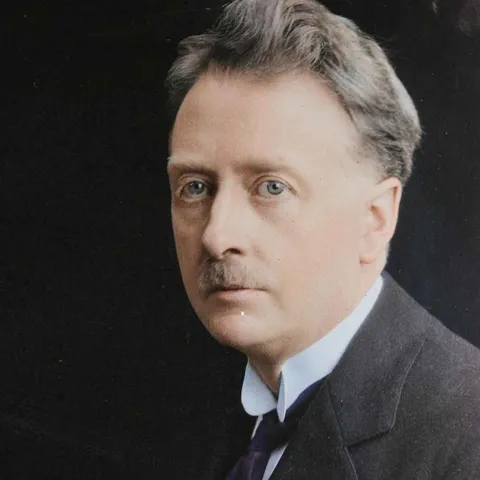
W.D. Cosgrave was now the most powerful person in Ireland. Historian Donald P. Corcoran describes Cosgrave as, quote, a businessman who made up his mind quickly and stuck to it, was unpretentious and witty and spoke briefly and to the point. David Fitzpatrick talks of an unlikely revolutionary and politician, mild, pious, conservative, public-spirited and righteous.
Cosgrave was deeply religious and dressed in quite an old-fashioned manner. In fact, apparently he was quite the dandy, favouring wing collars and formal morning suits. He was also humble, self-effacing and rarely chased the limelight. He once told James Craig that, you know, I’ve been pushed into this. I’m not a leader of men.
But not everyone agreed with Cosgrave’s humble assessment of himself. Churchill had this to say. The void left by the deaths of Griffith and Collins were not unfilled. A quiet, potent figure stood in the background sharing, like Griffith, the dangers of the rebel leaders without taking part in all that they had done. In Cosgrave, the Irish people found a chief of higher quality than any who had yet appeared. To the courage of Collins, he added the matter-of-fact fidelity of Griffith and a knowledge of practical administration and state policy all of his own.
Of course, when Cosgrave heard this, he laughed it off, saying the only reason Churchill liked him so much was that he had asked Churchill about his health after he’d fallen from a pony during the treaty negotiations. So apparently that’s how you win people over. Who knew?
The day the Dáil met on September 9th, the Irish Times also spoke highly of Cosgrave, writing, He is undoubtedly the most capable man in the new Irish Parliament, and that may be said without the slightest contradiction of any of his colleagues. As Premier of the Free State, he has a formidable task before him, but in one way he is almost the ideal choice, because he has no violent extremist past to live down, and with him the problem of saving face does not arise.
Many of these quotes come from the book Saving the State, Fine Gael from Collins to Varadkar, by Stephen Collins and Ciara Meehan. A book I imagine is a riveting read for a certain kind of political nerd, and by its title might not be the most politically unbiased, but still has a wealth of information about Cosgrave.
I’ll take one more quote that they highlight, to hopefully give you a tangible sense of this man who now ran the country. A poet friend of Cosgrave, Podrick Column, wrote the following around the time that Cosgrave was elected President. He speaks leaning forward, his hands on the barrier before him, his delivery becomes like a series of pistol shots, each word shot out, each word reaching its mark. He is sociable, as becomes a Dublin man, and abundantly witty. His wit is a Dublin wit. It is founded on a very exact estimate of character. He can reveal character in a mordant phrase, before his humour, before the phrase that springs up in his speech. Pretentiousness of all kinds falls away.
I find it fascinating to see how often Cosgrave’s humour and lack of pretensions are mentioned again and again. The lad really must have been all kinds of witty. If nothing else, it became clear that Irish democracy was now in a safe pair of hands.
And I think that speaks to something that gets overlooked. This wasn’t as much a transfer of power. Cosgrave had been working with Collins and Griffith beforehand. When we focus on the great man version of telling history, and think about Collins and Griffith as leading figures who die leaving a huge gap, we forget that a lot of the time these people were working in groups, with a huge amount of support, and with people like Cosgrave in the wings helping them out.
So when they go, will things continue as they had? If nothing else, it became clear very quickly that Irish democracy was now in a safe pair of hands. The messy threads of power were slowly being tidied up, and democratic backing for the executive secured.
Cosgrave may have been a conservative, careful man, but he helped put the country on a solid democratic footing that was vital to keep things under control. Even if his style of leadership maybe wasn’t as revolutionary as some people would have wanted. Cosgrave was the epitome of the establishment and good old-fashioned politics. Whether that was for better or worse, well I’ll leave that for you to decide.
Keeping the country under control was one of the main focuses of the Dáil and Cosgrave’s cabinet over the rest of 1922. The Free State government under Cosgrave acted decisively and brutally. Cosgrave saw his goal as nothing less than protecting the democracy of the fledgling state. As he put it, I am not going to hesitate, and if the country is to live and if we have to exterminate 10,000 republicans, the three millions of our people are bigger than this 10,000.
With that in mind, next time we’ll explore the introduction of the Army Emergency Powers Resolution, and see how Cosgrave began stamping out the anti-treaty IRA. Thanks for listening. Subscribe wherever you get your podcasts, and if you’re enjoying it, give us a review on Apple Podcasts or tell your friends. It really helps.
If you want to go further, you can support the show, get ad-free listening and bonus content on our Patreon page. Simply follow the Patreon link in the show notes or visit our website, thehistoryofireland.com. You can also get in touch through the website or on Facebook and Twitter. It’s always great hearing from you guys, and if I’ve made a mistake, please do let me know.
The History of Ireland was written and produced by me, Kevin Doyle, with music by Liam Doyle and additional help from assistant producer Aoife Murphy.