Episodes Irish Revolution Season 2 — The Civil War
The McMahon Murders
Transcript
Welcome to the History of Ireland Last episode we looked at how the border of Northern Ireland was drawn up Way back in 1916 If you got nothing else from that episode I hope it made you realise how uncertain Northern Ireland as a polity really was in the early 1920s Even that term, polity Bit of a nothing term In fact, polity is defined as An identifiable political entity Which, as political definitions go Is as close to a shrug of the shoulders and a confused face as you’re going to get
This uncertainty fuelled Northern Irish policy in its formative years As led exclusively by the Unionists They felt besieged from all sides Under attack from the IRA and unsupported by the British government Westminster, remember, desperately wanted to believe the Anglo-Irish treaty would just make the Irish question go away So they could focus on what they saw as more important issues Like, you know, holding on to the last vestiges of an empire that was falling apart at the seams And that uncertainty around their position is what I believe Led the Ulster Unionists to lean into the aggressive and draconian measures of 1922 and beyond They were backed into the North East corner of Ireland With nowhere to go and as they saw it, not enough options They needed to protect their way of life and their power in the region And so they did
Historian Patrick Buckland highlights this uncertainty when he writes For the first few months of 1922 There was some confusion as to who actually governed Northern Ireland Who was properly in power? The regional government that had been brought in in June 1921? Or Westminster? Well the answer was kind of both Depending on what you were talking about To sum it up simply, the Northern Irish government was in charge of anything local While Westminster was meant to take charge of anything international Often those two things will overlap And when Westminster interfered in what the Unionists saw as local matters Well it created a real sense of frustration
Initially though, there was hope And this manifested itself in the form of the First Craig Collins Pact On the 21st of January 1922 With the ink on the Anglo-Irish treaty still fresh Michael Collins and James Craig were brought together at the behest of Winston Churchill Surprisingly, as soon as the groups had all gathered Craig asked for time alone with Collins And quite quickly the two came to a draft agreement As Collins put it, it was agreed that We ourselves could deal with the question of the boundaries Without help or interference from any British authority We both agreed that a commission on the boundaries Would be bound to cause lasting bad feelings
On top of this, Collins agreed to have the Belfast boycott lifted While Craig promised to ensure Expelled Catholic shipyard workers were given back their jobs And they agreed to work on a better system Of addressing all Irish issues than had been previously laid out Whereas they put it, quote To create a more suitable system than the Council of Ireland For dealing with the problems affecting all Ireland
And all of this went down wonderfully The Cork Examiner reported that The prospects of a really united Ireland Were never brighter than they are at the present moment And though the process may be gradual It decidedly looks as if friendship and goodwill Will displace prejudice and feuds in better times coming While Collins himself wrote The result of our meeting has been that North and South Will settle outstanding differences between themselves We have eliminated the English interference And Craig told his cabinet That this agreement by interference Brought about two very important results One, the treaty was no longer inviolate And that further amendment would be possible in the House of Commons And two, that Mr Michael Collins Had recognised the government of Northern Ireland
He also pointed out that Collins made it clear that he wanted a real peace And that he had so many troubles in Southern Ireland That he was prepared to establish cordial relations with Northern Ireland To abandon all attempts to coerce But hoping to coerce her into a union later He finished stating that We were able to put our joint names to a document Which is an admission by the Free State That Ulster is an entity of its own And that, for the unionists at this point Was a big deal Remember, everything about Northern Ireland was uncertain
Unfortunately though We know this positivity was short lived And that this First Craig Collins Pact As it became known Barely lasted a month With the civil war beginning to kick off down south Collins was unable to stop the Belfast boycott Or even stop IRA activity up north In fact, some would argue That he didn’t even try And we’ll explore some of that as we go on
And then what really acted as a death knell For this first pact Was the violence that broke out Throughout February and March First there was a clash of IRA and Ulster police On a train at Cologne station And a number of unionists were kidnapped Craig then demanded Churchill Send in 5,000 men to rescue them But Westminster was having none of it With Churchill explaining Violent measures would do more harm than good And might entail the resignation of the Irish provisional government Thus creating chaos and leaving the extremists in control
And then even worse from a unionist point of view The Lord Lieutenant in Northern Ireland Basically the King’s representative Actually released a number of IRA prisoners Only just about being talked down by Craig The way the unionists saw it Dealing with the IRA was a local law and order matter And though Westminster had say over international policy and the like Crime and punishment was an internal matter Where the Northern Irish government should have control But well obviously Freeing nationalist prisoners Was kind of a bit of an international issue now As it helped stabilise relationships between Britain And the new Irish Free State Which though not technically created at this point Was all but a real entity Confusing right?
And things only got worse All of this was followed in March By one of the most widely reported and shocking acts of violence Of the period in Belfast These were the McMahon murders Which took place on the 24th of March 1922 Before we get into them we need to introduce a few people First
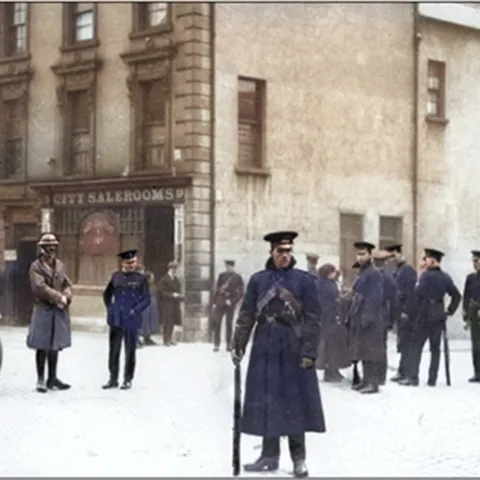
That means it’s time for a quick refresher On the Ulster Special Constabulary This is a group similar to the Black and Tans Who had been set up to augment the main force of the RIC In Northern Ireland The A Class, B Class and C Class With the B Class or B Specials Becoming the most notorious These B Specials were an unpaid volunteer force Who served on a part time basis And had the legal right to carry weapons They were made up solely of Protestant Unionists And if they sound like a terrible idea Well they kind of were These B Specials carried out atrocity after atrocity Throughout the War of Independence You can jump back to episode 38 A Summer of Riots For a recap on some of that lovely business By 1922 they had become firmly entrenched in Northern Ireland And were for all intents and purposes Waging a war against the Northern IRA While carrying out various acts of violence Against the local Catholic population So that was the Ulster Special Constabulary
Next we have to introduce Owen McMahon McMahon was one of the wealthiest Catholics in Belfast Running a large and popular pub in the city He was quite the man about town Director of the local football club And president of the cycling club With business ties to middle class Protestants In fact he and his family lived in Thorndale An affluent Protestant neighbourhood Politically he was much more of a moderate nationalist And had very little time for the IRA and republicanism
Now on March 23rd Two Specials officers were shot dead By the IRA while patrolling Great Victoria Street It was a cold callous murder Typical of the time Where the IRA and Specials were tit for tatting Stopping violence left right and centre In fact James Craig had literally called for the USC To undertake a quote system of reprisals And in response to the death of the two officers Well that’s exactly what they did
It was early in the morning on March 24th About 1am When five or so men hammered on the door Of the McMahon family’s large Victorian style home They broke in just as Owen McMahon and his wife Had been running downstairs to see what the commotion was The assailants who most everyone would agree Were B Specials Gathered up McMahon and his sons and took them to the living room While his wife, daughter and niece Were sent upstairs to the drawing room Owen McMahon and his five sons Aged 30, 24, 25, 15 and 12 As well as the lodger who had been staying with them Were told to say their prayers Then They were sprayed with bullets
Can you imagine being the mother and daughter upstairs Hearing as the gunfire ripped through the living room down below John the 30 year old Dived for cover The 12 year old played dead There were only two who survived Everyone else was killed John the eldest wrote Four of the five men were dressed in the uniform of the RIC But from their appearance I know they are specials Not regular RIC One was in plain clothes No one was ever charged A Free State Government report named As the leader
As Rowan McGreevy puts it The McMahon family would appear to have been targeted For no reason Other than they were a prominent Catholic family in Belfast And I think The brutality of the attack Coupled with the McMahons standing as safe Respectable nationalists McGreevy also writes That there seems to be little doubt That the attack was principally designed To send out the unambiguous message That even a Catholic Of own McMahons social standing Was not off limits And the message was received loud and clear The news spread all over the world From thousands upon thousands of people Both Catholics and Protestants alike
In fact the murders became so high profile That Lloyd George brought Michael Collins and James Craig Together again To try and sort out a second pact To bring some kind of peace to Northern Ireland Next episode we’ll examine that second pact Explore what Collins was up to in Northern Ireland And introduce the Special Powers Act And if I’ve made a mistake, please do let me know
History of Ireland was written and produced by me, Kevin Doyle With music by Liam Doyle and additional help from assistant producer, Aoife Murphy
It’s already growing with over 400 million euros Saved by 800,000 participants in just 6 months Continue protecting your future It’s already looking brighter Learn more at myfuturefund.ie