Episodes Irish Revolution Season 2 — The Civil War
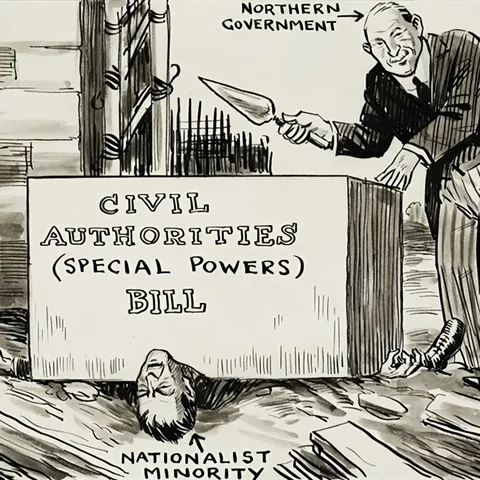
The Special Powers Act
Transcript
Welcome to the History of Ireland. Over the last few episodes, we’ve explored the chaos occurring in Northern Ireland throughout 1922. And it was out and out chaos. The IRA would attack the specials. The specials would attack the IRA. Civilians would get injured and the violence continued to get worse and worse. As historian Marie Coleman writes, the interlinked nature of all these events illustrated the tit-for-tat nature of the spiraling violence in the North and the extent to which civilians were among the collateral damage.
And I do think that is important to stress. Civilians. As continued to be the case in Northern Ireland for the rest of the 20th century, civilians were the victims, stuck in the middle between nationalist and unionist forces. And this may have changed over time and I definitely won’t get into the more modern history. But in 1922, it was clear those civilians who were affected worst were mostly the Catholic community. Who, as we know, were now the minority in this new Northern Irish polity.
Again, it’s hard to stress strongly enough how concerned the unionists were about the very existence of the Northern Irish polity and their connection to Great Britain. The Border Commission hung over them, coming for them. As historian Brendan O’Leary puts it, the Ulster Unionist Party leadership regarded the Commission as an existential threat. And because of this, they did everything in their power to strengthen the unionist position in Northern Ireland. In this episode, we’re going to look at the ways in which they did this. Most notably, the Special Powers Act, which O’Leary describes as one of the most draconian pieces of legislation ever passed in a liberal democracy.
Obviously, I do not agree with or condone anything the unionist leadership did at this point in Northern Irish history. But it is important to try and understand their worldview and where they were coming from. As they saw it, they had been abandoned by Westminster, attacked by the Catholic South, and their very way of life and the existence of their culture was under threat. Their home, their power, their history was all up for grabs. So to combat this and defend themselves, they brought in sweeping legislation designed to entrench their position and their power. It was legislation that paved the way for decades of discrimination, violence, and conflict.
But what was the Special Powers Act? Well, first of all, that wasn’t really its name. In fact, it was officially known as the Civil Authorities Special Powers Act and was passed on April 7th, 1922. It was based off the Restoration of Order in Ireland Act of 1920. Jump back to episode 42 for a refresher on that bad boy.
The Special Powers Act, we’ll continue calling it by its nickname if that’s okay with everyone, gave the Northern Irish civilian executive powers that had originally been intended for British military authority during the War of Independence. It involved 35 regulations that allowed the government and police the power to impose curfew, close pubs, prohibit public meetings, ban military drilling and uniforms, and make it very, very difficult to own firearms, explosives, or petrol. It also allowed the Northern Irish police, as historian Laura Donoghue put it, virtually unlimited power to search for and seize contraband and to detain those suspected of subversive activity. And it banned making statements that, quote, were intended or likely to cause disaffection to his majesty. Don’t want to insult the king.
And still, they didn’t feel like that was enough. And it went even further. Gave police the right to, quote, take all such steps and issue all such orders as may be necessary for preserving the peace and maintaining order. All such steps. Basically, they could do whatever the hell they wanted. And still, worse again, it allowed the government to intern people without trial, just lock them up, without having to prove any kind of guilt. And it even banned any inquests. So if the security forces somehow managed to find something they weren’t allowed to do under these rules, and maybe, you know, illegally kill someone, well, there was no way to hold them accountable.
There’s no two ways about it. This was a sweeping piece of legislation designed to crack down hard on IRA activity throughout Northern Ireland. And make no mistake, it was aimed at the IRA and at Catholics. As O’Leary puts it, these extraordinary powers were used to repress Republican rather than Loyalist violence, which rarely elicited any response. In fact, the odd time that the law was used to ban Loyalist activity, a ban that Loyalists often would just ignore, the Northern Irish government actually apologized for the inconvenience.
Now, admittedly, these draconian measures were highly effective. As Donoghue puts it, from a peak of 80 actual and 58 attempted political murders in April 1922, within five months, the number had plummeted to one actual and 11 attempted political murders. So basically, IRA violence fell off a cliff towards the middle of 1922. Now, this was helped by the fact the Civil War tore apart any semblance of IRA unity in the South, leaving the Northern Irish IRA at the complete mercy of a stronger force in the form of the B Specials and the newly created Royal Ulster Constabulary. This was an armed police force that was set up on June 1st.
And it was meant to be short-term. That’s why it was called the Special Powers Act. These were not meant to be long-term powers. They were meant to be special powers that would be used to stop IRA violence and were needed to restore peace at a time of huge unrest. Maybe framed like that, well, you could sort of justify it. Maybe. But the Unionist leadership were looking for any and all tools available to them to maintain control in the area. And as part of that, they reinstated the act again and again, renewing it annually until 1928, then renewing it for five years until 1933, and then finally saying, to hell with it, let’s just make it permanent. And so this draconian piece of legislation stayed on the books right up until 1973.
To justify this, the Unionist leadership in Stormont changed their reasoning for why the act existed. First, they used the chaos in Northern Ireland as the reason they needed such harsh measures. And as I said, you could make a case for this with so many civilian lives at stake. But as is often the case with governments, they shifted their language and reasoning to shore up their own power. By 1933, they were using the fact that Northern Ireland was mostly peaceful as an excuse to keep the act on the books. As James Craig put it, the government are not yet satisfied that those malcontent in our community have yet learned the lesson that Ulster will not stand for further outbreaks or disorder. Although peace prevails throughout the province and law and order have rapidly improved in recent years, it is desirable to avoid as far as possible the yearly debates which have taken place on this particular measure during recent years.
That’s getting a little ahead of ourselves and a little out of the remit of this episode. The Special Powers Act worked and hundreds of IRA members and innocent Catholics were locked up throughout the 20s. But the new Northern Irish government didn’t stop there to ensure it maintained control and could fend off the risk of a boundary commission that would only be a few years away. To ensure Protestant Unionist control they ended up rejigging the entire political system. You see, many of the county councils along the newly established borders actually declared their loyalty to Dáil Éireann rather than the Northern Irish government. This would have really benefited anyone trying to use the boundary commission to reduce the territory of Northern Ireland. And so Craig and the Unionists began to dismantle any structure that would allow Republican-Catholic majority councils to exist. Or really, for Catholics or Republicans to have any power at all.
First of all, he replaced proportional representation with the conventional British winner-takes-all system. Now you could say that was just Unionists trying to be closer to Britain but actually proportional representation had been brought in after moderate Unionists campaigned for it all through the 1910s. It had been brought in around 1920 but Craig got rid of it because he knew that the British system would make it harder for Catholics to get elected. Then he appointed a man by the name of John Leitch to reorganise electoral districts. Basically gerrymandering the entire Northern Irish political map to ensure there were as few majority-Catholic areas as possible. Admittedly, this bid to disenfranchise Catholics was actually helped by the fact that many nationalists boycotted elections or stuck with the good old tradition of parliamentary abstentionism.
The result of this was that by 1924 nationalists held just two councils. As O’Leary puts it, the nationalist minority, permanently deprived of government office and its benefits, had little stake in maintaining the system. Which is a recipe for disaster if ever there was one.
Now, Westminster could have stepped in to curb some of the more dramatic instances of discrimination against the Catholic minority in 1922. They could have forced the unionist governments to enshrine more protections for the minority. But they were desperate for the Northern Irish experiment to work and they didn’t want to disrupt Northern Ireland any more than they had to. We’ve already seen how Craig’s cabinet threatened to resign due to the aborted Craig Collins Act. So, Westminster basically left the unionists to their own devices, turning a blind eye to Northern Ireland. Something, some would argue, that Westminster has been guilty of doing over and over again.
Obviously, to say Northern Ireland is complicated is a huge understatement. And over the 20th century things only got more and more complicated. Now, I won’t claim to be an expert on this area and I’m sure some of my own biases have crept in here. That’s why I’m trying to stress as much as I can that the unionists were reacting to a campaign of violence that had lasted years at this point. Tagging their way of life and their unique position in the world. The Belfast boycott, the IRA bombings, the war of independence. These were violent times. But I do think the laws passed in 1922 by unionists and James Craig and arguably decisions they made as far back as the first Home Rule Bill created an entrenched approach to power that did nothing but ensure conflict would continue. And we could continue talking about Northern Ireland for months. In fact, there are many great podcasts on the topic and even more amazing books. But for now, I’m going to leave it there. Next episode, we’ll return to what was happening in the Irish Free State in late 1922 and highlight that unionists were not the only people to bring in draconian laws in the name of peace.
Thanks for listening. Subscribe wherever you get your podcasts and if you’re enjoying it, give us a review on Apple Podcasts or tell your friends. It really helps. If you want to go further, you can support the show, get ad-free listening and bonus content on our Patreon page. Simply follow the Patreon link in the show notes or visit our website, thehistoryofireland.com. You can also get in touch through the website or on Facebook and Twitter. It’s always great hearing from you guys. And if I’ve made a mistake, please do let me know.
The History of Ireland was written and produced by me, Kevin Doyle, with music by Liam Doyle and additional help from assistant producer Aoife Murphy. This podcast was recorded in the lands of the Wurundjeri people of the Kulin Nation. Sovereignty was never ceded.