Episodes Irish Revolution Season 2 — The Civil War
Roadside Murders
Transcript
Welcome to the History of Ireland. For the last few episodes, we’ve been focused on Northern Ireland during 1922. Now, I’d like to jump back down south and see what was happening towards the end of that same year. No doubt James Craig and the like would only be overjoyed by my splitting of the narrative in this manner. But I promise there’s no political spin how I’ve divvied up this story, it was just simply the easiest way to break down a complex narrative for both myself and you, my Earthwild listeners.
When we last left this story, the Emergency Powers Act had just been passed and violence was increasing on both sides of the conflict. Remember, that’s different from the Special Powers Act which was passed up in Northern Ireland. Today, we’re going to look at poor Tadhg Kennefic who will help us understand what that violence really looked like in this civil war.
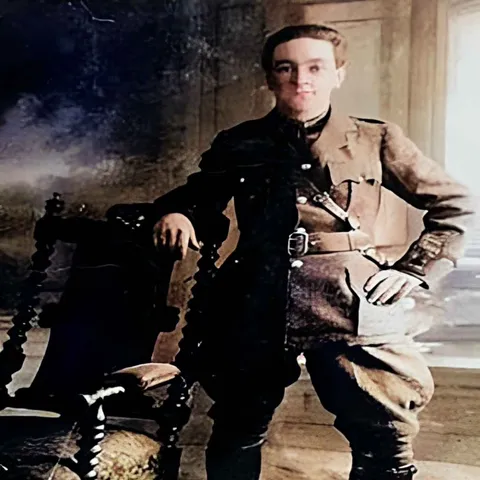
Tadhg Kennefic was a 29 year old from Cork who had joined the Irish Volunteers back in 1917. He fought as part of the Cork IRA throughout the War of Independence and then once the treaty was signed, like so many others, he sided with the anti-treaty forces and began serving as a signaller with the Cork IRA Brigade. So throughout the summer of 1922 and into the autumn, Kennefic would have been out and about in the countryside of Cork fighting against the Free State forces.
But on September 8th 1922, Tadhg received word that his mother had died and so he needed to make it back to Cork City for the funeral. He got a lift in a lorry from Ballinceri but that broke down around peak. So now the two lads, Kennefic and his lorry driver, got a lift from another lorry driver, Seamus Cotter. I don’t know why but I just think that is so very Irish.
As they were driving to Cork, they were stopped by about 30 Free State troops outside a small village called Dripsey. Imagine this large military truck full of soldiers coming up behind the three lads in the lorry. They were pulled over and asked to step out. Kennefic recognised some of the troops and some of the troops recognised Kennefic. The lad turned to the men giving him a lift and said, I’m done as these know me.
The lorry driver later described it like this, I was about 6 or 8 yards from these men. They called him back, not by name. I next saw him walk along the road as if a prisoner. I do not know what became of him. I never saw him alive again. You see Kennefic probably fought with these lads and they knew he had chosen the anti-treaty side. So they recognised him immediately.
Anti-treaty sources describe what happened to Kennefic next. Be warned, this is gruesome stuff. The poor 29 year old was quote, dragged behind the back of a Free State truck while his hands were tied together. Then he was beaten with an inch of his life with the soldiers rifle butts, before finally being shot and having his body dumped in a field by the side of the road.
The Free Staters then returned to Dripsey and many people in the town noticed they had left with Kennefic in tow and returned without him. So a search party was sent out to find the poor lad. It didn’t take them long to come across his remains. One witness described the scene like this. Two or three others looked at the condition of the body, which appeared to be dead. He was lying on his side, his head was all battered, his face was all blood and his clothes were disarranged as if he had been searched again. And his hat was thrown on the ground beside him.
A doctor was then called and he describes the scene as well. It gets even worse. I saw the face all battered and made an examination. Shock and haemorrhage due to lacerations caused by bullet wounds in the head. One an entrance wound over the right eye and an exit wound in the left temple. Several marks on the face and two teeth broken.
Now the anti-treaty sources say Emmett Dalton, a Free State commander and the man who had led the bombing of the Four Courts, had ordered the atrocity that befell Kennefic. But it should be said that Dalton’s biographer argues these accusations need to be treated with caution. Regardless, the aftermath of the attack is a fascinating look at the split nature of the country at this time.
An inquest was held into Kennefic’s death, which is why we have such a detailed account of what happened to him. And remember, there were many other attacks like this, they just weren’t as well documented. The jury brought a verdict of willful murder against the officer, Emmett Dalton, in charge of the Free State troops in Cochford on the morning in question and Richard Mulcahy as Minister for Defence.
In the Dáil, a Labour TD asked if any attempts would be made to bring Dalton or the men to justice and even asked if Mulcahy himself would face charges for this guilty verdict. Mulcahy disagreed, saying, The inquest was held under the auspices of irregulars, armed to the teeth, and before a jury that was apparently selected by irregulars. The coroner, in directing the jury, pointed out that they had heard only one side of the case. This was inevitable under the conditions. An adjournment was suggested but not agreed to. Under the circumstances, no action has been taken to bring the so-called guilty troops to justice.
What a mess! A jury accuses the government and government forces of murder. The government argues the jury was intimidated by anti-treaty forces. And nothing is done for Kennefic. Both sides had a point. This was the most brutal form of violence. 30 men ganging up on a lad headed to a funeral. But was it a fair inquest if the jury was either made up of or intimidated by anti-treaty IRA? Maybe they were right to throw out the findings. Maybe this was just a necessary part of gaining back control of the country. Maybe. It’s hard for me to back that argument.
And even harder still when you learn that Dalton banned any more inquests in Cork, stating, owing to the acts of terrorism to the civil population, and more particularly jurors, no inquests are to be held in future in the county unless written authority for the holding of the same shall be first given by me. In the end, for me, you just have to feel sorry for Tadhg Kennefic.
When we rage against the British and the Black and Tans, although it’s important to remember we the Irish carried out equally horrible acts of violence against each other. It’s hard to acknowledge but you can’t escape the reality. What was done to Kennefic was brutality in its worst form and personally I don’t see how it helped reunite the country or bring any kind of peace.
Historian Andy Billenberg has spent a long time categorising these roadside killings as they’re known, which he distinguishes from the quote official executions carried out by the government, which we’ll cover later. He has this to say on the subject of Kennefic’s murder. There were very few official executions in Cork during the civil war, but there were a lot more of these types of unofficial roadside executions. It was claimed by the Free State in the press that Kennefic was shot trying to escape, but that is just not credible. I would say it is one of the worst of the unofficial killings. It wasn’t just that he was reportedly dragged behind a lorry, there were so many factors. It was vengeful and unnecessary. To shoot him was one thing, but to subject him to such a savage death it was so heroic, it stands out.
What’s even sadder is what Kennefic’s daughter had to say on the subject. As growing children we could always understand the cause for which he fought, but could never understand the reason or the manner of his death. I’m sure that even at this stage it would be a great tribute to my father and his comrades if the relevant authorities were to issue an explanation and apology for his brutal murder.
It makes me think of my grandmother Weardley who was a huge lover of history, but stopped with Irish history by around 1900. She would never talk about the Civil War, never think about the Civil War. You can see why, for someone who was born in that era, for any of us it’s really tough stuff to get your head around. Kennefic and the men who killed him would have fought together against the British, they would have been on the same side, and the animosity shown to someone who disagreed over the treaty is breathtaking.
And nobody wins in these situations, as the next short little story I’ll tell illustrates. Because quickly I want to speak about another roadside murder carried out on October 6th. Two teenagers, Eamon Hughes and Brendan Hollohan, they were out sticking up anti-treaty posters when they were picked up by Free State soldiers. The next morning they were found by a farmer on the side of the monastery road in Glendalkin with 16 gunshot wounds between them. Though there is little proof, one man, Charles Dalton, is often accused of organising the murder. It should be said I’m almost sure he has no relation to Emmett Dalton.
I mention these murders and Charles Dalton because of what happened to him. Charles had been part of the Irish Volunteers and then the IRA since he was 14. As one contemporary put it, Dalton was a mere schoolboy when he commenced his career as a gunman and by 1939 Dalton was a patient in St Patrick’s Grange Gorman Hospitals. With doctors writing that his impressions and hallucinations all referred back to those early years, that he was hearing voices which accused him of murder and that his own active part preyed on his mind and conscience so that in the following years he has gradually lost his reason.
This is a man suffering from extreme PTSD. He was a child, a young man, asked or encouraged to do horrible things in a way that he thought was bettering a cause. And yes, it’s important to call out the complexities of painting a perpetrator of violence as an equal victim. Historian Anne Dolan in her essay Trauma and the Legacy of Violence, where I learn about Dalton, calls this out very well.
Obviously Dalton survived the war and Amy Hughes and Brendan Holland didn’t. Their lives were cut short. But Dalton’s life was ruined as well. And it’s just a strong and poignant reminder that in any war, but in especially a civil war, all sides suffer. What can feel like beautiful righteous violence to be celebrated and carried out in the name of independence against British oppressors, well the very same act feels indefensible and horrible in the context of a civil war. And at the end of the day, does it really matter? It all ends up with broken young men and bodies lying in the dirt.
The History of Ireland was written and produced by me, Kevin Dole, with music by Liam Doyle and additional help from assistant producer Aoife Murphy. This podcast was recorded in the lands of the Wurundjeri people of the Kulin Nation. Sovereignty was never ceded.