Episodes Irish Revolution Season 2 — The Civil War
Best Friends & Executions
Transcript
Welcome to the History of Ireland. After a nice seasonal detour into the world of Halloween, today we’re back into the depths of the Irish Civil War. When we last left our story, it was the evening of December 7th. The Irish Free State had officially been created the day before. But the country was in no mood to celebrate. Instead, the politicians of the new government were in shock. That morning, T.D. Podrick O’Malley and Sean Hales had been shot by anti-treaty IRA on the orders of Liam Lynch. The country waited to see how the one-day-old Irish Free State would tackle this attack on the people’s representatives.
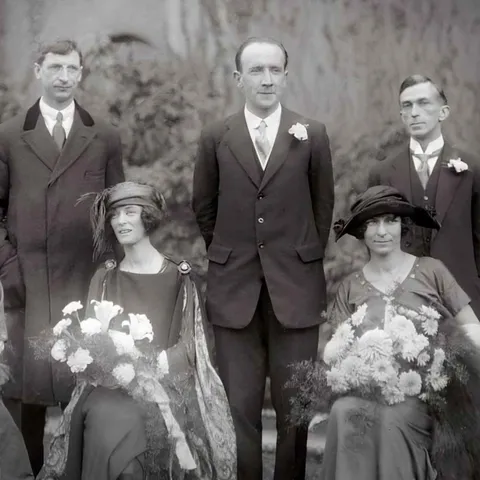
Before we go into what happened, bear with me as we take a quick flashback to October 27th, 1921. Just over a year before the events we’ll discuss today. We’re jumping back in time to attend a wedding. It’s the height of the War of Independence but still the leaders of the movement had time to celebrate the nuptials of Kevin O’Higgins and his wife Bridget. O’Higgins had risen up the ranks of Sinn Féin. First as W.T. Cosgrove’s assistant and then a member of Dev’s cabinet. He was a fairly hardline Republican but would reluctantly go on to accept a treaty, arguing, I would have gone back to war rather than recommend a settlement involving allegiance if the treaty had not been signed. But I faced the political situation and realized that some of the biggest personalities in our movement had considered this the last ounce that could be got from England and who, knowing the situation better than I do, attached their names to that document. And in fairness to him, after making this decision, he stuck firmly to it, becoming the Irish Free State’s Minister for Justice. You’ll have heard me mention him a few times to date.
There’s a photo of him from his wedding day, wearing a nice suit with a white flower on the lapel, standing beside his wife who was sitting down in those long, flowy, very Irish-style dresses of the time. To O’Higgins’s left stands Eamon de Valera, the President at the time, and to O’Higgins’s right stands Rory O’Connor. O’Connor and O’Higgins had met during the Revolution and fast became friends. They were both hardlined, dedicated Republicans with a talent for organization. O’Connor was O’Higgins’s best man and he was to give a toast at the wedding. It started like this. The toast is a long one. Some things don’t change, it seems. But it’s not your usual best man speech Instead, it speaks to the trials and tribulations of a country at war. It’s all about the 1916 Rising and the War of Independence. He finishes it with I toast the men of 1916, to the memory of our holy dead, to the long life and happiness of the beloved living, and to the full culmination of their dearest wish, the liberty and untrampled liberty of Ireland.
I share this because, firstly, it’s just fascinating to see how all-encompassing the conflict was. Even at a wedding, the last speech was not dedicated to the bride and groom. No, it was dedicated to the liberty of Ireland. Secondly, I share it because it’s very sad. O’Connor spoke of the long life and happiness of the beloved living. But he’d be dead by the end of the very next year, by the order of the groom.
You’ll remember O’Connor had been one of the leaders of the anti-treaty forces who took the forecourts. More extreme at the time than even Liam Lynch. Lynch had abandoned O’Connor and the pro-treaty forces had arrested him. He’d been locked up along with Liam Mellows, Joe McKelvie and Richard Barrett for the majority of 1922, missing most of the Civil War. On December 7th they were all in Mountjoy Prison. Mellows was a well-known veteran of the Easter Rising, McKelvie a Northern IRA man, and Barrett was a quote, much liked and capable leader of the West Cork IRA.
As the four men sat in Mountjoy Prison, Rory O’Connor’s best friend, Kevin O’Higgins, was sitting at the Dáil cabinet. As Minister for Justice, it kind of fell to him to decide what to do about the murder of Sean Hayes and Padraig O’Malley. It was late, close to midnight. The cabinet ministers had had a long day. You could imagine them gathered around a large table, the excitement of declaring the Irish Free State a distant memory. Instead, they were shaken by the murder of two elected officials and determined to do something.
Richard Mulcahy, Commander-in-Chief of the Free State Army, was said to have suggested a reprisal. Specifically, the executions of four leading anti-treaty IRA men who’d been captured in the Four Courts, Mellows, McKelvie, Barrett, and O’Connor. One by one, the cabinet voted in favour, until, or so the story goes, there was only one vote left to cast, that of Kevin O’Higgins. The Minister for Justice and Rory O’Connor’s best friend asked, Is there no alternative? You have to imagine he would have been distraught at the idea of executing O’Connor. Yet, he agreed, and the decision was made unanimously.
The next day, the four anti-treaty leaders were taken from their cells to a holding area. Apparently, Rory O’Connor believed they were to be deported. Historian Gerard Shannon tells it that O’Connor had sewn two gold guineas into his coat, coins that O’Higgins had given him as a gift. But we know they were not to be deported, and instead were handed a typed notice. It said this, You are hereby notified that, being a person taken in arms against the government, you will be executed as a reprisal for the assassination of Brigadier Sean Hales, TD, and as a solemn warning to those associated with you who are engaged in a conspiracy of assassination against the representatives of the Irish people.
They were brought to mass before their execution, but Mellows initially refused to take the Eucharist as a sign of protest against the bishops turning on the anti-treaty IRA. But he wasn’t totally bitter, and he wrote to his mother around the same time, hoping that no one would try to avenge them. He wrote, Let no thought of revenge or reprisal animate Republicans because of our death. We die for truth.
They were then delivered to the prison yard. As some tell it, Barrett sang as the four men were led to their deaths. Shannon describes the moment vividly, saying, The firing squad of ten were to have specific targets, but in one account it was said most turned their rifles on the much hated Rory O’Connor, whose coat was said to have gone alight due to the sheer amount of gunfire. But maybe because they focused so much attention on Rory O’Connor, McKelvey and Barrett, they didn’t die straight away. The two men fell to the ground wounded. The officer in charge had the grim task of finishing them off. He started with Barrett. Then as he came to McKelvey, the injured man, I imagine wounded and struggling to breathe, coughed, Give me another. The officer shot him. McKelvey replied, And another. The officer agreed. McKelvey finally died.
Now notice the steps involved in this execution. They were handed a notice, taken to mass, and then brought out to the firing squad. There was no trial, no jury, no real sentencing.
In the Dáil, on the morning of the 8th, there was a fierce debate about the executions. It’s not possible to share it all here, but go search for it, it’s well worth a read. I’ll put it up on Patreon. But I’m going to pull a few choice quotes, for you to get the idea of the tension that was occurring.
The opposition leader, Thomas Johnson of the Labour Party, opened up the arguments, giving an impassioned speech. Here’s a rather long excerpt from it, but I think it sums up everything very well. He said, Today we read in the evening papers, that the execution took place this morning, in Mount Joy jail, of the following persons, Rory O’Connor, Liam Mellows, Joseph McKelvie, and Richard Barrett, as a reprisal for the assassination, on his way to Dáil Éireann, on December 7th, of Brigadier Sean Hales. It was a horrible, dastardly thing, the assassination of Sean Hales. Murder most foul, as in the best it is. But this reprisal, is most foul, bloody, and unnatural. We thought it well not to try them, and not to bring them to the courts, and then, because a man is assassinated, who is held in honour, the government of this country, announces apparently with pride, that they have taken out four men, who were in their charge as prisoners, and as reprisal for that assassination, murdered them.
These men, unless with the convenience of the government, could not have been engaged in any conspiracy, and they have been in your charge for five months. Any other four prisoners, convicted of any offence whatever, might be taken out by the government of the country, and shot, as a reprisal for any other offence, committed by any other person. I do not know whether anyone in this doll, has any thought for the good name of the new state. I wonder whether any member of the government, who has any regard for the honour of Ireland, or has any regard for the good name of the state, or has any regard for the safety of the state, will stand over an act of this kind.
Two days have elapsed, since there was a formal proclamation, announcing the birth of this new state. It was hoped that the course of law, would be in operation henceforth. It was hoped that there would be some rehabilitation, of the idea of law. And almost the first act, is utterly to destroy in the public mind, the association of the government, with the idea of law. I am almost forced to say, you have killed the new state, at its birth.
Richard Mulcahy replied, saying, The action was taken this morning, was taken as a deterrent action, taken to secure, that this country shall not be destroyed, and thrown into chaos, by the toleration of any group of men, acting together for the destruction, one by one, or in groups, of those single representative people, that are the keystone of our government, and of our society here.
But really, it’s O’Higgins who gave the clearest argument, in favour of the executions. He said this, Such as it is, it was done coldly, it was done deliberately, simply looking the whole situation in the eye, and in the belief, that only by that method, would representative government, or democratic institutions be preserved here. It was once punitive, and deterrent. The members of the Parliament of Ireland, must be kept free, and safe, to perform their duties, as members of the Parliament of Ireland. When one strikes at a representative man, the crime is peculiarly hard.
He continued, moving on to speak, about the importance of force in government, which, is an interesting take. When a man has his hand on your throat, and his knee on your chest, you do not lie there, and tell yourself, that force settles nothing. The safety, and preservation of the people, is the highest law. It is at any rate, the only law. For laws are not made, or written down in a book, to guide men, when a state of war exists. For war is anarchy, and there are no rules, and no laws, to guide men. Ultimately, all government, is based on force. If human nature, were other than what it is, no doubt one could devise, some other method. But, we are not able to devise, any other weapon, to meet the situation, that exists here, except force.
And finally, he finished, with the saddest moment of all, declaring, hoping, willing it to be true, that the act, carried out, was a calculated decision. The right decision. He said, There was never an act done, through personal vengeance, and never an act done, through hot blood. We have no higher aim, than to place the people of Ireland, in the saddle in Ireland, and to let them do their will. But we will not acquiesce, to gun bullying. And we will take very stern, and drastic measures, to stop it. Personal spite, great heavens, vindictiveness, one of these men, was a friend of mine.
And you have to believe, O’Higgins thought, he was doing the right thing. He wanted to ensure, that Ireland survived, this civil war. And this, the murder of his best friend, seemed to be, the only course of action. But I have to say, though maybe a little over dramatic, I think I agree, with the Labour leader, Johnson, above all the others, when he said, you have killed, the new state, at its birth. It is such a shame, a truly horrible thing to consider, that while the bloody ink, was still dry on the constitution, we had abandoned the rule of law, and were executing men without trial. What the anti-treaty IRA did, not only across the country, but also in the act of murdering Hale, was, abhorrent. I believe, they were firmly in the wrong, working without a mandate, and terrorizing the country. But at the same time, you have to hold a government, to a higher standard, and with these executions, the new Irish free state, well they were no better, than the anti-treaty IRA.
Historian Sean Enright, points out that, the Mountjoy executions, marked a pivotal moment, in the abandonment of the rule of law. Hours before the execution, were carried out, General Richard Mulcahy, ordered the creation, of army committees, that would substantially replace, military courts, expedite the trial process, and make convictions, easier to obtain.
Maybe, you could argue these murders, were the only way, to bring the civil war to an end. But the civil war, was far from over. In the next episode, we’ll see how it spilled out, into 1923.
Thanks for listening. Subscribe wherever you get your podcasts, and if you’re enjoying it, give us a review on Apple Podcasts, or tell your friends. It really helps. If you want to go further, you can support the show, get ad free listening, and bonus content, on our Patreon page. Simply follow the Patreon link, in the show notes, or visit our website, thehistoryofireland.com You can also get in touch, through the website, or on Facebook and Twitter. It’s always great hearing from you guys, and if I’ve made a mistake, please do let me know.
The History of Ireland, was written and produced by me, Kevin Doe, with music by Liam Doyle, and additional help, from assistant producer, Aoife Murphy. This podcast was recorded, in the lands of the Wurundjeri people, of the Kugan nation. Sovereignty was never ceded.