Episodes Irish Revolution Season 2 — The Civil War
The Death of Liam Lynch
Transcript
Welcome to the history of Ireland Historian John Regan argued that Liam Lynch’s order to assassinate politicians was The first and last military initiative that the anti-treatyites formulated which had any real chance of advancing the war in their favour A policy of assassination such as Lynch proposed could undermine the regime Not by defeating the army, but by circumventing it But after the death of Sean Hales, there were no real follow-up assassinations of Free State politicians Which Gerard Shannon, a historian who has written a fantastic biography of Lynch argues that this showed Lynch had reservations about his own orders and that the rank and file were slowly facing an erosion of trust in Lynch’s vision for the conduct of the fighting
Many, many people on the anti-treaty side wanted to surrender Or at least engage in some kind of truce by the beginning of 1923 But Liam Lynch was determined to carry on the fight And though in private, as we’ve seen, Lynch had reservations It’s said he had a habit of putting on a good face for his subordinates Pushing on the anti-treaty movement by sheer force of will Many believe that he was the only thing keeping the anti-treaty forces together And still fighting And by March 1923, Lynch didn’t have long for this world
Lynch knew that he couldn’t beat the Free State But he did believe he could push the Republican movement forward On December 28th, he wrote the following to the sidelined de Valera We cannot hope to completely overthrow the enemy unless the unforeseen happens What I hope for, and am definite will secure Is to bring the enemy to the position of bankruptcy He will then realize his general position And have to stand with us in upholding our independence He is certainly in a better position now than here through for In putting our national ideals up to the common enemy The idea being, I think, that the Free State would be forced to join Back with the anti-treaty forces and demand full independence from Britain I’m not quite sure I follow the logic, however And by the threat of assassinations, by 1923, there was no way for this to occur And that was becoming increasingly obvious
In early January, Lynch complained that regional leaders of the anti-treaty IRA Were not sending him enough information Resulting in, quote, the ridiculous position of not knowing how we stand in this area He then continued, in these circumstances, it is impossible for the GHQ To direct the situation effectively Deal with areas which are not making effective use of the resources at our disposal Or strengthen the weak areas
But then on the flip side, the rank and file were not happy with anti-treaty leadership One man, the IRA’s director of chemicals, wrote in late January about, quote The almost complete out-of-touchness with affairs of the IRA leadership We’ve discussed this before But this fragmentation is one of the dangerous side effects of having a guerrilla army Yes, you get a decentralized force that can strike anywhere But that decentralization is a double-edged sword Making it very hard to control things Local leaders would carry out their own attacks, not sending information to leadership And, in the case of Tom Barry, some were even trying to engage in peace talks
Barry spent much of January discussing peace talks with his men And brought the proposal to Lynch Lynch firmly turned it down As Shannon describes, Lynch was furious with Barry And in a fit of particular high emotion, admitted privately that he felt like having Barry killed A sure sign that the stature of the one-time leader of the West Cork Flying Column Had greatly diminished in Lynch’s eyes
Then soon after, as we discussed in the last episode Liam Deasley was captured and called for the anti-treaty IRA to surrender Can you imagine what it would have been like for Lynch? Your top commanders dropping like flies around you Giving up on your ideals as you struggle to hold the whole movement together Lynch’s response to D.C. had been I am to inform you officially that the proposal contained cannot be considered
Lynch was forced to go on a bit of a PR mission Quelling fears that D.C. was right And even had to contact the American wing of the anti-treaty IRA He knew that D.C.’s capture and call for surrender would put a huge dent in morale And wrote to one leader saying D.C.’s documents and subsequent efforts have had an effect on morale of our forces mainly in the South But when our position all over the country is explained to officers, everything will go ahead as usual I am satisfied the South will stand firm and act with the rest of the country My view on the position has not changed since my previous communications to you
Then in a public letter to the anti-treaty forces he wrote The army has withstood all efforts to break it by force in the field It is today in a much stronger military position than at any period in its history Now that there is an example of Lynch’s public optimism And refusal to admit that the IRA were struggling
As the chaos we discussed last episode unfolded in Kerry over March 1923 The IRA executive, i.e. the top dogs and leaders of the anti-treaty IRA Were meeting in Waterford The first meeting occurred on March 23rd And had been delayed about three weeks Arguably delayed because Lynch knew that the executive wanted to surrender As he had explained to a friend, he would not be coerced into a surrender position Interestingly there was also a debate about whether De Valera should be allowed to attend this meeting Which is kind of crazy considering he was meant to be the president of the republican government In the end it was agreed he could come along but not get a vote It’s a great example of how very sidelined Dev was at this point in the conflict He really had no control
Gerard Shannon writes about this meeting that was held on the 23rd Saying it was in a grim atmosphere that the much delayed executive meeting took place With severe differences of opinion among the IRA leadership Further complicating matters were the National Army raiding parties in the area Which resulted in the meeting having to be moved to a different secret location around the Nye Valley Frank Aiken the deputy chief of staff proposed that the anti-treaty forces Be empowered to enter upon negotiations with the Free State There was a vote and it resulted in a tie with Lynch abstaining
Three days later a second meeting was held This time it was Tom Barry who put forward a proposal That said in the opinion of the executive Further armed resistance and operations against the Free State government Will not further the cause of independence of the country The result was five votes in favour and six against With Liam Lynch voting no Those who had voted alongside Lynch did so because he assured them That the IRA would secure a large supply of ground artillery in the next few weeks Lynch believed that if he could get these weapons It would quote make it easy to make terms with the enemy Those who voted alongside Lynch quote stated they did so Because they wished to see whether the artillery would come or not Lynch assured them the guns would come within the next three weeks And so another meeting was organised in Cork for April 10th But that meeting never happened
Lynch and the other leaders were hiding around the Knockmealdown mountains On the border of Waterford and Tipperary about 20km from Arraglen But the Free State army knew the meeting was happening And the anti-treaty IRA were in the area As one Free State general put it It was the result of good intelligence work in Dublin A small piece of information picked up in a raid in Dublin Pieced together scraps of information That something important was happening in the south GHQ ordered a large operation That resulted in the capture of the irregular leaders And the ultimate collapse of a regular opposition This meant the area was crawling with Free State troops And they swept the countryside of Tipperary, Waterford and North East Cork In search of the anti-treaty IRA leaders
At around 4am on April 10th the alarm was raised Frank Aitken described it like this It was a much bigger roundup than we expected There must have been at least 6000 staters on the warpath that day The anti-treaty leaders fled through the Knockmilldown mountains Frank Aitken, Sean Hyde, Tom Barry, Liam Lynch and a few others Hyde described the escape vividly Several times when each of us came close to being hit Earth and bushes splashed around it There was one occasion when a blast of gunfire Rained rocks and soil along an area between us and the boys in front The men were armed with little more than revolvers While their pursuers had long range rifles This running gunfight lasted about 20 minutes As the men tried to escape
At one point they came across a particularly difficult piece of terrain Remember it was dark, probably cold And the Knockmilldown mountains would have been overgrown and treacherous to traverse That’s why they were hiding there in the first place As the men made their way through this particularly difficult spot Sean Hyde reached down to help Lynch through There was a pause in the gunfire and a single crack shot out Lynch was hit He knew the others wouldn’t be able to carry him through the mountains And beg them to leave him And so they set an act of contrition and escaped across the mountain Aitken would later write that it was the hardest thing that any of us ever had to do None of us could understand why out of six of us he was hit Or why we were not all killed It was just God’s will
We have a great description of what happens next Written by a Free State Lieutenant by the name of Lawrence Glancy I’ll read you out pretty much the whole thing because it’s amazing Fire was again opened upon us from the other side of the hill We were compelled to take cover at the enemy’s side of the rocks For a moment I thought we were surrounded But suddenly I heard a voice ring up on the hill in the direction where Captain Taylor and the remainder were Stop firing! Stop firing! Those are Glancy and his party It was our own men who opened fire at us So when the fire ceased I said, come on lads, follow me And we all ran as fast as we could up the hill When we got near to where the man was lying One soldier was some twenty yards in front of me So I said, keep that fellow covered with your rifle as you approach him And keep spreading lads, don’t bunch in together
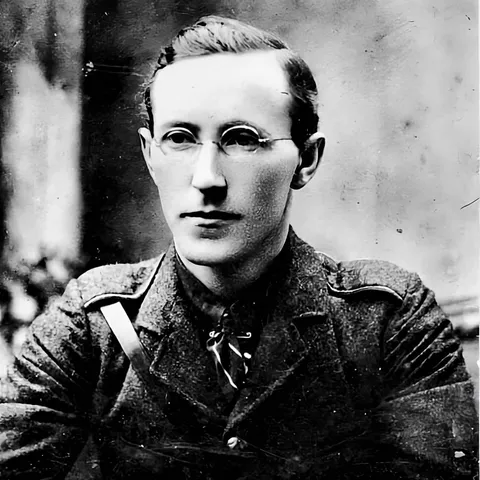
As the soldiers approached the man who was lying on his back With a top coat folded into a bundle for a pillow under his head I had a revolver in one hand and a rifle in the other I approached at a run when the soldier who was standing there covering him with his rifle said We have Dev, we have Dev sir The glasses which he wore made the soldier think we had Devilera But I knew Mr. Devilera by sight and said, no, it’s not Dev Who are you? The man answered, you didn’t get Dev, it’s Liam Lynch this time Get me a priest and a doctor, I’m dying He was a big, sallow complexioned man, rather pale faced, wearing glasses As he spoke I dropped on one knee beside him and said Are you the bloody Chief of Staff of the Irregulars? He answered, I am General Liam Lynch, Chief of Staff of the Irish Republican Army Get me a priest and a doctor, I’m dying I said, where are your guns? And proceeded to search him He answered, my friends have taken my guns He then gave a moan of pain I searched his pockets to quickly make sure he had no guns and said, where are you hit? And he said, touching the lower part of his stomach with his hand Oh there, oh there
Clancy continues, explaining how they brought Lynch off the mountain We had at this time procured a pony and trap from a small farmer at the foot of the mountain to convey Lynch to Newcastle Well, having reached the latter place, I phoned Clonmel informing the military authorities our capture And requested an escort ambulance and doctor as soon as possible Having obtained a glass of brandy for poor Lynch and a mattress and blankets from a local publican We placed him in a comparative comfort after his ordeal of the morning and the day I felt happy myself
As I sat in the adjoining room the soldier who was mining Lynch looked in and said The prisoner wants you sir I went into him and he said to me, it is getting dark I replied, it’s not three o’clock yet, are you comfortable? You’re only here an hour or so yet Lynch replied, I thought it was getting dark I must be dying I want to ask you to do a couple of little things for me When I die, to tell my people I want to be buried with Fitzgerald of Firmoy You think of that? I assured him I would and asked was it the hunger striker who had died
Now here, I’ll interrupt here to explain that Lynch was talking about Michael Fitzgerald Who had been the first man to die of hunger strike in Cork jail in 1920 Anyway, back to Clancy’s retelling Yes, Lynch replied, the greatest friend I ever had on this earth Are you one of the old crowd? Lynch asked I replied that I was And said I had two brothers killed during the town war With smoking guns in their hands And I was tried by field general court martial, Victoria Barracks For murdering his majesty’s military forces and police Lynch raised his hand and said Shake hands I’m glad one of the old crowd got me And with that the tears began to stream down his face My hand clasped in his, I too sobbed God bless you, I will pray for you And you sometimes think of poor Liam Lynch and say a little prayer for me All this is a pity It should never have happened I’m glad now I’m going from it all Poor Ireland, poor Ireland
Now, to my little things I want to tell you what to do with them My gold watch and fountain pen to my brother Brother Lynch, he’s a Christian brother My silver watch to my sister, Mrs. Green of Mitchelstown My silver fountain you may keep for yourself As a small token of appreciation For the way you treated me from the time I fell into your hands God bless you and the boys who carried me down the hill I’m so sorry for the trouble I caused you and them Once again we clasped hands and parted with tears in our eyes Lynch added, I will live until about ten o’clock tonight
As it happened, Liam Lynch was taken to St. Joseph’s Hospital in Clonmel And died at nine p.m. that night And with his death, really the one person holding the anti-treaty forces together was gone And the door was open for an end to the Irish Civil War
You can also get in touch through the website Or on Facebook and Twitter It’s always great hearing from you guys And if I’ve made a mistake, please do let me know The History of Ireland was written and produced by me, Kevin Dolan With music by Liam Doyle and additional help from assistant producer Aoife Murphy This podcast was recorded in the lands of the Wurundjeri people of the Kulin Nation Sovereignty was never ceded