Episodes Irish Revolution Season 2 — The Civil War
The End of the Irish Civil War
Transcript
Welcome to the History of Ireland. The month of April really did see the last spasms of the anti-treaty forces’ attempts to try something that would destabilise the free state enough to maintain the republicans’ relevance. An example of this was the quite odd amusement order, which I just want to touch on before we go any further. It declared, quote, It is ordered that a time of national mourning be proclaimed. All sport and amusement be suspended. All picture houses and theatres and other places of public amusement be closed, especially horse riding, hunting, coursing, dancing and outdoor sports. Anyone refusing this order will be treated as an enemy of the republic. This saw anti-treaty forces across the country trying to blow up cinemas, disrupt games of golf and even release a bunch of hares from a greyhound track. And the theatres, in a move that was fair enough, shut their doors, though the free state had to intervene and force them to stay open, sending soldiers to protect the theatre-goers. It really was the anti-treaty at an all-time low, specifically targeting civilians in a bid to coerce the public into siding with the anti-treaty side.
And though Liam Lynch, who had given the order in March, died on April 10th, attempts at blowing up cinemas and train stations continued right up until the end of April. But it really was the last gasps of a dying army. And as we discussed in the last episode, with Lynch’s death, the iron will holding the anti-treaty in the field all but disappeared.
In fact, on April 20th, the anti-treaty leaders met in Tipperary, Frank Aiken, Tom Barry, Tom Crofts, P.J. Rutledge and Sean McSweeney. As we know, their last meeting had been disrupted when free state troops chased them across the Knockmealdown mountains and Lynch was killed. With Lynch’s death, a new chief of staff was needed and their choice shows how the leadership was feeling since the loss of Lynch. The man they put in charge was Frank Aiken.
From our map, Aiken had been involved in the Republican movement and the IRB since as far back as 1914. Through 1922, he had pushed for truce between the pro and anti-treaty sides repeatedly. After the bombing of the four courts, he had even written to Mulcahy asking for a truce and had remained relatively neutral for much of the year. But in the end, he sided with De Valera and the anti-treaty side. But he was no militant Republican and not nearly as aggressively determined as Liam Lynch. He also had a much better relationship with Dev than the more military minded Lynch and immediately brought together the Republican government and the army council. He proposed that the two groups be empowered to make peace and as historian Brian Hanley explains, it was agreed that if the free state accepted their proposals, they would accept majority rule.
And so Aiken began working with De Valera to bring about a ceasefire. This is significant because it gave the reins of the anti-treaty movement basically back to Dev who had been sitting watching worriedly for the last year or so as the military wing had well and truly ran the shop. So a week later on April 27th, Aiken gave the order to suspend all offensive operations. While Dev gave what his biographer Ronan Fanning described as a proclamation of political principles on which peace could be negotiated. It laid out three points. One, that the sovereign rights of the nation are indefeasible and inalienable. Two, that all legitimate government authority in Ireland is derived exclusively from the people of Ireland. Three, that the ultimate court of appeal deciding disputed questions of national policy and expediency and policy is the people of Ireland. Now that’s classic Dev language if ever I’ve heard it and it all seems a bit rich coming from a group of people who had basically been acting against the majority vote since the last election. But anyway.
So Dev met with two southern unionist senators Andrew Jameson and James Douglas who acted as kind of go-betweens for the negotiations. When Douglas asked Dev if he was in control of the movement, which is a very fair question considering the chaos that was going on at the moment. Dev replied that he was now in a position to decide on behalf of the whole republican party and in a stronger position than he had ever been before. He then identified the oath of allegiance as the only barrier to republican participation in the Dáil. Douglas would later describe Dev’s demeanour saying his whole bearing is that of a defeated man. A man very anxious to explain how much worse things would have been if he had not been with them and seemed extra anxious to apologise for himself. He is trying to get his followers to hold together as a constitutional party.
But the anti-treaty IRA and Devilair didn’t really have a leg to stand on at this point. They were well and truly kind of beat and so it really didn’t matter to the government what the anti-treaty IRA’s concerns were or their demands. The free state government simply demanded a full surrender with no changes or weakening of the treaty. Their response to Dev’s proclamation was quote all political issues shall be decided by the majority vote of the elected representatives of the people. And quote the people are entitled to have all illegal weapons taken into the custody of the executive government.
Now you might hear those two different quotes and be a little confused as to what they were arguing about. Dev was basically saying that the people would have the final say on everything that was happening. While the free state was saying the people’s elected representatives would. And arguably it’s much of a muchness but there was a difference here. Dev’s phrasing meant that the IRA was kind of in the right, they could still keep fighting, they were a bit of the people. And it meant they didn’t have to deal with the king, no power came from the king. It was a slight watering down of the treaty but one that seemed important to Dev. But the free state were having none of it. They would not water down the treaty, they would not water down the power of the door. They really wouldn’t listen to anything Dev was saying at this point.
So where did this leave Aitken, Dev and the anti-treaty IRA? Well they didn’t want to be seen to be surrendering without having gained anything. But there was no way for them to fight on effectively. And the free state, well they weren’t willing to budge. So what the hell was there to do? This is where Dev and Aitken came up with one of those classic Devalera-esque formulas. And on May 24th they coordinated two messages to be sent out.
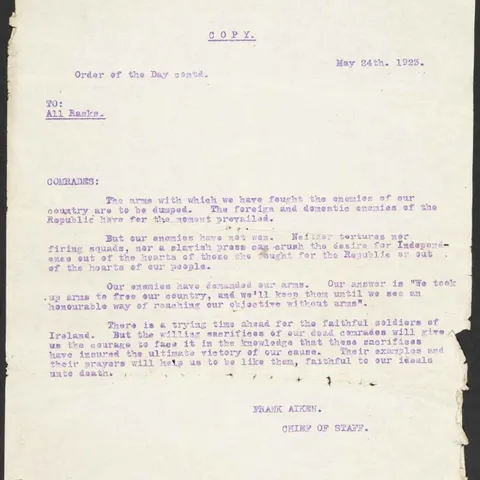
Aitken wrote the following to the anti-treaty IRA. Comrades, the arms with which we have fought the enemies of our country are to be dumped. The foreign and domestic enemies of the Republic have for the moment prevailed. But our enemies have not won. Neither tortures nor firing squads nor a slavish press can crush the desire for independence out of the hearts of those who fought for the Republic or out of the hearts of our people. Our enemies have demanded our arms. Our answer is we took up arms to free our country and we’ll keep them until we see an honourable way of reaching our objective without arms. There is a trying time ahead for the faithful soldiers of Ireland. But the willing sacrifices of our dead comrades will give us the courage to face it in the knowledge that these sacrifices have ensured the ultimate victory of our cause. Their examples and their prayers will help us to be like them, faithful to our ideals unto death.
Then de Valera followed it with the following. To all ranks, from the President. Soldiers of Liberty, Legion of the Rear Guard. The Republic can no longer be defended successfully by your arms. Further sacrifices on your part would now be vain in continuance of the struggle in arms unwise in the national interest. Military victory must be allowed to rest for the moment with those who have destroyed the Republic. Other means must be sought to safeguard the nation’s rights. Do not let sorrow overwhelm you. Your efforts and the sacrifices of your dead comrades in this forlorn hope will surely bear fruit. You have saved the nation’s honour and kept open the road to independence. Laying aside your arms now is an act of patriotism, as exalted and pure as your valour in taking them up.
Seven years of intense efforts have exhausted our people. Their sacrifices and their sorrows have been many. If they have turned away and have not given you the act of support which alone could bring you victory in the last year, it is because they are weary and need a rest. Give them a little time and you will yet see them recover and rally again to the standard. They will then quickly discover who have been selfless and who selfish, who have spoken truth and who falsehood. When they are ready you will be, and your place will be once more as of old with the Vanguard.
The sufferings which you must now face unarmed you will bear in a manner worthy of men who were ready to give their lives for their cause. The thought that you still have to suffer for your devotion will lighten your present sorrow and what you endure will keep you in communion with your dead comrades who gave their lives and all these lives promised for our Ireland. May God guide every one of you and give to our country in all times of need sons who will love her as dearly and devotedly as you.
Now you’ll notice in neither of those statements is the phrase surrender used and it was not agreed to give weapons over to the Free State. You’ll also notice Dev there saying that the people haven’t turned against you or it wasn’t that they didn’t support you, they were just tired. A kind of maybe clever way of trying to keep it clear that they were still acting in the people’s interest and still acting democratically even though they clearly weren’t. So instead they were simply dumping arms and ceasing hostilities for the present. They weren’t giving up, they were just taking a break.
It could be argued that this is a genius bit of face saving and psychologically it allowed the hardline military types of the anti-treaty IRA to stop fighting and put their trust back in the political process. But you could also argue that this half surrender, this failure to actually call a proper end to the fighting would leave the door open for anyone to take back up arms in the name of the Irish Republican Army and feel justified in doing so. Which as any historian of the island of Ireland knows is exactly what happened.
Regardless these two proclamations are seen by most as the last word on the Irish Civil War. Conflict would continue a little bit and the Free State would spend the remainder of 1923 cracking down on anything it saw as lawlessness. But for all intents and purposes the Irish Civil War was over. Next episode we’ll examine the aftermath of the war and make plans for the future of our little podcast.
And bonus content on our Patreon page. Simply follow the Patreon link in the show notes or visit our website thehistoryofireland.com You can also get in touch through the website or on Facebook and Twitter. It’s always great hearing from you guys. And if I’ve made a mistake please do let me know. The History of Ireland was written and produced by me Kevin Doherty with music by Liam Doyle and additional help from assistant producer Aoife Murphy. This podcast was recorded in the lands of over 100 people of the Kugan nation. Sovereignty was never ceded.