Episodes Irish Revolution Season 2 — The Civil War
The Battle of Dublin
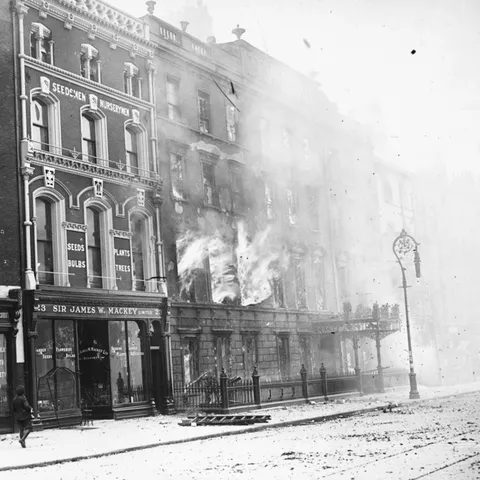
After the Four Courts was blown to smithereens fighting continued for several days in and around Dublin. In this episode we imagine what it must have been like for those hold up in the hotels, shops and homes transformed into military bases — and what it must have been like for those attacking them.
The image shows the Gresham Hotel in flames.
Transcript
Welcome to the history of Ireland The forecourts was in smithereens Rory O’Connor and his anti-IRA men who’d been stationed there Were all arrested And the civil war was well on its way But what’s often glossed over when talking about the forecourts Is that fighting wasn’t contained to that complex of buildings alone In fact, fighting broke out across the city And continued for days after the fall of the forecourts The conflict became known as the Battle of Dublin And that’s what we’re going to be exploring today
When the Free State Army started surrounding the forecourts Anti-IRA forces elsewhere in Dublin Quickly began to barricade themselves all over the city On June 29th, on O’Connell Street Cahill Brewer and a man named Oscar Traynor Began to create a new base of operations In a number of buildings on the east side of O’Connell Street All in all, they took 14 buildings And it quickly became known as The Block
Joined by Traynor and Brewer You had the who’s who of anti-treaty forces The garrison, around 100 strong Included people like Countess Markievicz Sean T.O. Kelly, Austin Stack and even De Valera Yeah, these were the heavy hitters Soon, Brewer was named Commandant And began to lead the forces A mix of IRA, Common and Mon And even some Irish Citizens Army led by Markievicz
The first order was to fortify the block Unfortunately, the building at the centre of the block A hotel named The Hammond Had a big, wide entranceway And the anti-IRA forces had nothing to defend it with So what did they do? 30 men were sent across the road To the city tramway offices Which helpfully was packed with luggage Bags, trunks and the like That could easily be used to create a makeshift wall
The next job was to connect the buildings of the block To do this, they began digging holes in the walls To create connecting tunnels One man described it like this Between all the houses, shops and hotels in the block It was possible to move freely From Lipton in Earl Street to Gresham Hotel This meant that we, the occupying troops Were supplied with the necessities Even luxuries of life in abundance We had deep mattresses, thick blankets Joints of lamb, boxes of chocolates Turkish or Egyptian cigarettes Or choice of any other brand we wanted It must have been such a strange juxtaposition The chaos of breaking through the walls As the deafening roars of the guns bombing the forecourts Contrasted with, well, the very height of Irish luxury
And all the while there were snipers from both sides Placed on buildings all over the city And mines planted throughout the streets One reporter wrote How snipers became active on the roofs of houses All around the area And again the tragic spectacle was witnessed Of ambulances passing to and fro With wounded to the hospitals The mines were placed by anti-treaty IRA forces Outside their bases of operation In the hope of destroying the deadly armoured cars Being used by the Irish Free State Army One commander noted how his men Gradually worked themselves into a frenzy Hoping that next time A mine would blow the car to blazes
Civilians had rubbernecked on the first day of the fighting But things started to quiet down As the days dragged on This was a war Breaking out in the middle of the country’s biggest city And civilians were terrified Here’s the testimony of one hotel owner Whose hotel was taken over by Traynor and his men They established their headquarters in the dining room First thing they did Was to knock all the glasses out of the doors and windows They sandbagged the windows And stuck guns between the bags They allotted different rooms to their various purposes They cleared out all visitors About forty Giving them barely time to pack their bags They cleared out the staff But I refused to go We were not allowed to pass through the rooms they occupied I can’t remember How we put in our time during the occupation I was halfway out of my mind Thinking of all the money I owed to the bank Which financed the purchase of the place And now I saw the possibility Of the whole place going up in smoke This was the reason I refused to leave Although they pointed out the risk I was running by staying They had the doors barricaded with my good tables and furniture
Whether you side with the pro or anti-treaty side here I do think it’s important to Consider these poor civilians in the middle of all this This hotel owner, Annie Farrington Well, she was one brave cookie to stick at the fighting And try to protect her poor business
Once the forecourts had fallen The Free State began working through the streets Slowly but surely Dislodging anti-IRA forces throughout the city The fighting was intense Imagine constant gunfire Exploding mines The fear of snipers And all sorts flying back and forth Between the streets for days But it really was a case To quote a more musical rendition of another revolution That the anti-treaty IRA were outgunned Outmanned, outnumbered and outplanned
And that’s as good a moment as any To take a moment and talk about How the Irish Free State Army Slowly developed over the course of 1922 So let’s pause the dramatic battle of Dublin And do a little flashback To the foundation of the Irish Free State Army Obviously, the original thinking Was that the IRA would simply become The Irish Free State Army Once the treaty was signed And the Free State created This, well as you can guess Proved a little difficult As it very quickly became clear That the main force the Irish Free State Army Would be fighting was The IRA But remember, not all the IRA was anti-treaty And the Free State did have a pool of men To recruit from
The first batch came from Dublin IRA men Loyal to Collins Including members of the squad On January 31st 40 men were decked out in green uniforms And took over the British garrison At Beggars Bush It then took the rest of the year To slowly build up and prepare this new army One of the reasons Collins, Griffith and the like Were slow to attack anti-treaty IRA Is because they were still bloody well Putting together this new Free State Army Some argue that if Rory O’Connor And Liam Lynch had attacked earlier They may have stood a much better chance Instead, the Free State Army Had time to build itself up And prepare for the oncoming war
By the time of the Battle of Dublin The Free State Army had about 8000 men Which wasn’t too bad Plus they were decked out With the very best weaponry The British was willing to give them Interestingly at this point They still refer to themselves confusingly As the IRA While they refer to the anti-treatyites As Irregulars This kind of couldn’t continue though As the new Irish state wasn’t a republic And the name kind of made the British Well just a little bit squeamish Around the time of the Battle of Dublin They began to be known as the National Army For clarity’s sake though We’re going to stick to Free State Army If that’s ok with you
So the Free State Army began to surround the block As they had done with the Four Courts As one man inside the block put it All except Brewer Seemed at a loss as to what they should do Or even where they should be Brewer wanted to get out in the streets And hit the Free State with guerilla tactics That had worked so well against the British But Traynor, well he didn’t want to put Civilians needlessly at risk And instead they started to retreat Deeper into the block
On Sunday the 2nd of July Pro-treaty forces began to take bits of the block Only to find them deserted One man who gives a great account of the whole time John Pinkman describes it like this It was a dangerous nerve-wracking task As we searched for the hole in the wall That would lead into the next building The holes would be made in the walls by the irregulars Who’d torn away the bricks Until they’d made gaps large enough To permit them to crawl from one house to the next Along the entire length of the block Between Parnell Street and Findlayder Place As we made our way through the buildings We sometimes found ourselves being shot at from behind And realised we had bypassed the irregulars Sometimes we even fired an arrow at our own lads As we raced from room to room Searching frantically for those holes Torn in the brickwork
Can you imagine how stressful this would have been? Slowly working your way through each room Shouting clear Then having shots fired from behind you Because you’d missed something Or jumping as you turned around a corner Shot your pistol Only to realise you were shooting at your own men This was tense, horrible fighting Pinkman describes at one point How they found a sniper ahead of them He was resting on some pillows With his rifle aimed out of the window And his fingers closed around the trigger They froze Terrified that anyone who stepped forward Would be shot through the head They shouted for the man to surrender But nothing Silence Would someone dare to step forward? Eventually they had to Turns out The man was dead already He’d been shot through the head It just happened that his corpse was lying there Still holding his rifle
They’d been working through the block for hours at this point And at 2am on Monday 3rd It was time for a full scale attack on the block As one onlooker described A vigorous attack on the position of the irregulars This was made by armoured cars And machine gun lorries One armoured car took up its position Just at the Metropole Another at the corner of Talbot Street And a third on the other side of Nelson’s Pillar From here they poured in rapid fire on the positions With machine guns and rifle grenades The Irish Free State Army put out a statement Saying The Dublin Guards enveloping movement in the O’Connell Street area Is near completion The irregulars now only occupy that part of O’Connell Street Stretching from the Tramways Company’s office To find later place This block of buildings is now completely surrounded
Inside the block Kathleen Barry and some other women Tried to lighten the mood By making cocktails for the men Though no one was too impressed And the women were told To take it out to the Free Staters Where it could prove legal No good deed, am I right?
Even if the cocktails were no good The defences were And it was proving increasingly difficult To unwedge the anti-treaty forces from the block Fighting lasted all day and long into Tuesday morning The Irish Times wrote The gunners appeared to pick out particular objectives in the hotels Upon which they poured a withering fire Which was occasionally returned by the garrison Machine guns were brought into operation While smoke bombs and grenades Were frequently hurled by the attackers The withering machine gun fire Soon became too much for those inside And white flags slowly started being raised In the different spots around the block
The Cochle Brua himself refused to surrender It became clear there was no way he or his men Would leave the block Until they really had no option So the eighteen pounder guns That had been used on the forecourts Were rolled in and pointed directly at Gresham Hotel The Cochle Brua and the Anti IRA were now hiding
Now just a quick clarification Last episode I described these eighteen pounders as heavy guns And they were big in the context of the Irish war But as pointed out by helpful listener John Moore These were standard field artillery of the time And field artillery are the smallest of the battlefield guns So really in the grand scheme of things They were actually small enough But you know I imagine They didn’t feel all that small to those in the Gresham
The eighteen pounder descended on the Gresham Joining the machine guns The photos of the damage are crazy One reporter describes how on Wednesday morning In every house lay the litter of the combat Such as empty cartridge cases Live cartridge cases Cartridge cases which had jammed in a Lewis gun Rifles fitted with auxiliary capture firing Missiles and bombs Amidst the damage He does also include this great tidbit Describing how They were tired soldiers Taking a hasty rest Or brewing a cup of tea He continues At eleven thirty I saw approaching the armoured lorries Which made the first attempt Into one of the breaches They flung about a dozen bombs A few minutes later A more successful attempt was made Another minute And the unused rifle cartridges Began to explode with the heat One by one at first And then in continuous succession As if two or three machine guns Were firing from the building
Brewer inside Quote Remained undaunted Comforting the wounded Encouraging the defenders Never allowing his own nerve to slacken For a moment With the Gresham now on fire Brewer retreated to another hotel The Granville Quickly the guns turned on that hotel And by five pm It too was on fire Eventually Brewer had no choice But to order his men to surrender At seven pm Waving a white flag The anti-treaty forces Came out of the hotel One woman in the group Remembers seeing Brewer praying As we were marching out I passed through what had been The Turkish baths And saw Cahil Brewer Kneeling on a mat Confessing to one of the friars I shall never forget that sight It was his last confession
Knowing he was about to be arrested Brewer tried to make a break for it A fireman described how As they broke down the back doors Of the Granville Quote A low-sized smoke-stained man Rushed out with a revolver drawn It was Brewer He sprinted down Thomas Lane Only to find his way blocked By a group of Irish Free State men Halt, the leading officer would have said But Brewer Bloodied Tired But as always stubborn And determined Refused He continued towards them When a volley of shots were let off Brewer fell to the ground A bullet had caught his femoral artery Linda Kearns, a Cumann na mBan member Stayed with him Holding the severed artery between her fingers And he was rushed to the hospital Where he died Two days later
Now listeners will know I’ve never liked Brewer all that much He romanticized violence Was an inefficient Jealous minister for defense And let his personal opinions Get in the way of his politics This dramatic last stand Was kind of right up his alley But it should be said That he, along with others Like Traynor Led the men at the Battle of Dublin Bravely Brewer died standing up For the Republic he believed in And there’s something commendable In that
Brewer’s death and the surrender of Granville Marked the end of the Battle of Dublin Almost a week of intense fighting Bombing and violence But sadly The Civil War was only getting started Brewer may have been one of the first Big high profile figures To die in the Irish Civil War But unfortunately He would not be the last
Thanks for listening Subscribe wherever you get your podcasts And if you’re enjoying it Give us a review on Apple Podcasts Or tell your friends It really helps If you want to go further You can support the show Get ad free listening And bonus content On our Patreon page Simply follow the Patreon link It’s always great hearing from you guys And if I’ve made a mistake Please do let me know The History of Ireland Was written and produced by me Kevin Doyle With music by Liam Doyle And additional help from assistant producer Aoife Murphy