Episodes Irish Revolution Season 2 — The Civil War
The Bombing of the Four Courts
Transcript
Welcome to the History of Ireland. If you took a historian and forced them to definitively give a date for the start of the Irish Civil War, well, they would argue for a few moments, speak about slow descent into conflict, skirmishes in Limerick, unrest across the country. And eventually, they give you the date of June 28th, 1922. This was the day that the new Irish state finally made a move against the extreme wing of the anti-treaty IRA, who had been occupying the forecourts in Dublin for over two months. This is when the whole war started. And it started with one hell of a bang.
As we mentioned last week, the assassination of Sir Henry Wilson had enraged the British, and they were putting immense pressure on Collins and the rest of the provisional government to act against the anti-treaty IRA, who the British, most likely incorrectly, blamed for Wilson’s murder. Lloyd George wrote to Collins saying, The ambiguous position of the Irish Republican Army can no longer be ignored by the British government. Still less can Mr Rory O’Connor be permitted to remain with his followers and his arsenal in open rebellion in the heart of Dublin, organising and sending out from this centre enterprises of murder, not only in the area of your government, but also in the six northern counties and in Great Britain. His Majesty’s government cannot consent to a continuance of this state of things.
Lloyd George then instructed McCready to prepare a full-scale assault on the forecourts using tanks and aircraft as well as field artillery. McCready was not too fond of this, believing it would backfire on the British, and that the cabinet had descended into panic with the death of Wilson. I think he’s totally right on both fronts. Can you imagine the Irish reaction if the British had attacked at this point? I honestly think we might have slipped back into the war of independence. And as for the panic, well let’s just say, Churchill spent the night of Wilson’s murder locked up in his attic with a revolver and a barricade across the door.
And in fact, Churchill went even further than Lloyd George’s private letter and did so publicly, announcing that if through weakness, want of courage, or some other even less credible reason, a band of men typing themselves the headquarters of the Republican executive was not brought to an end, and a speedy end, we shall regard the treaty as having been formally violated, and we shall resume full liberty of action in any direction to any extent that may be necessary. Or as he put it more simply directly to Collins, we had reached the end of our tether.
But the provisional Irish government was still slow to act, and what tipped things over the edge was actually when the IRA kidnapped Ginger O’Connell, a general of the new Irish National Army. Now, this seems to be a poor time for the IRA to be poking the bear like this, and I’m not really sure whether their kidnapping of O’Connell was the smartest move at this point, nor really was their motive. You see, the provisional government had arrested a Leo Henderson, an anti-treaty leader who’d been organising dissent up in the north. Because of this arrest, Ernie O’Malley led men to kidnap O’Connell, hoping they could swap one for the other. This idea, well, it never really worked, and the kidnapping of O’Connell pushed Griffith to make a move against the four courts.
An Irish cabinet meeting was held on the 27th of June, where it said Collins was reluctant to agree to attack the four courts, but that he was won over, or well, outvoted, by Griffith and the rest of the cabinet. And so, all throughout the 27th, the provisional government’s new Free State Army began coalescing around the four courts, which as we know, the anti-IRA were using as their headquarters. O’Connell Street, Westmoreland Street, Nassau Street, Dame Street, Abbey Street and Henry Street were soon packed with army lorries, cars and troops. The four courts hotel and Bridewell Prison were set up as a base of operation, and snipers were placed on buildings surrounding the courts. And then, most importantly, two 18-pounder field guns were set up across the lithy, pointing directly at the four courts. These were borrowed from the British, and were bigger than anything that had been used in the Irish War of Independence. These were big old boys, and not to be trifled with. A World War I veteran, Emmett Dalton, was put in charge. Though, he and his men only received two hours of instructions on how to use the bloody things, and initially they were only given ten shells for each gun. I wonder, did Dalton spend the night frantically reading a manual or some such thing?
So the Irish Free State were relatively ready. Were the anti-treaty IRA? Well, not really. If you don’t know the four courts, they are actually a series of buildings, rather than just one big one. They’re right by the river, and yeah, smack bang in the middle of Dublin. They’re really beautiful old buildings, you should check them out. But the anti-treaty IRA only had about 180 men garrisoned there, and despite having been in the four courts for several months at this point, well, they’d done very little to fortify the buildings. They had tried to barricade windows with sandbags, but just didn’t have enough. And they’d been working on tunnels between the buildings, but this hadn’t been finished yet. They did their best by digging trenches and laying mines, but they were grossly underprepared. And as they sat and watched the Free State Army prepare itself, this became more and more clear.
Ernie O’Malley, who was in the four courts, described a situation like this. Across the river in the darkness, men were moving into position. We could see the dark shadows advancing. Armored cars purred their gentle throttles. Heavier lanceers drove up and down. Their troops entered the four courts hotel. And the adjoining buildings which fronted part of the courts. They opened the bridewell gates opposite the headquarter blocks across the street and marched in. We could hear them as they prepared the position inside. Our position was being slowly surrounded. Houses commanding the courtyards and the windows facing the yards were now occupied. The state were taking advantage of the fact that we did not want to open fire on them. The courts was already a trap.
Despite their militarism and what could be described as their radical republicanism, as Ernie O’Malley mentions, they refused to fire the first shot. You can understand why. The men they would be shooting at had been their brothers in arms literally only a few months previously. And more practically, if they shot first, well they might lose any moral high ground and the propaganda value that came with it. But this refusal to shoot really let them at the mercy of the free state. And things did not go down well.
At 3.40am a letter was handed into the four courts. It read, The officer in charge, four courts. I, acting under the order of the government, hereby order you to evacuate the buildings of the four courts and to parade your men under arrest without arms on that portion of the quays immediately in front of the four courts by 4am. Failing compliance with this order, the building will be taken by me by force and you and all concerned will be held responsible for any life lost or any damage done. By order, Thomas Ennis, OC, 2nd Eastern Division.
With the ultimatum given, it said that the anti-treaty IRA leaders sat on a polished marble under the four courts huge dome and discussed their next move. It was decided that they would ignore the order and not even reply. And so, at 4.10am, as the sun rose on a long Irish summer’s day, people across Dublin woke to the sound of heavy artillery being fired by Irishmen at Irishmen. The idea was to bomb them into submission while causing as little casualties as possible. One Free State soldier explained, it was generally believed that the besieged garrison, many of whom had never been exposed to an armed attack of any sort, would be overawed by the firing of the field guns and the knowledge that they were hemmed in by armed and experienced troops of the National Army and that the affair would all be over within a matter of hours. The affair would all be over within a matter of hours, probably before the next morning.
Throughout the day, the buildings were bombed and gunfire was traded back and forth. But there was a real reluctance on both sides to kill and casualties remained surprisingly low. Cumann na mBan, who were anti-treaty, were actually allowed come and go as they pleased. Providing supplies and medical support to those inside the forecourts. There’s even one story in which a Free State soldier handed a Cumann na mBan woman ammunition, quote, for the boys inside. I’m not sure why, but that honestly strikes me as one of the most Irish things imaginable. One nurse was stopped by the Irish Free State forces when an officer became a little suspicious as she moved through the cordon. This is because it turned out to be an anti-treaty leader, Tom Barry, dressed in his wife’s clothes trying to make a run for it. Unfortunately, his drag just didn’t cut it and he was arrested.
Speaking of anti-treaty leaders, it should be mentioned that Liam Lynch was in Dublin at the time. But remember, he didn’t totally agree with Rory O’Connor and ended up refusing to come to his aid. He clearly saw that the forecourts were a lost cause and it was decided for all anti-treaty leaders in Dublin to disperse to their respective home counties or areas of operation.
The next day, on Thursday, after a full 24 hours of bombardment, Emmet Dalton changed his approach to the big guns. Two things were hampering progress. One was the lack of proper explosive rounds. Two was the lack of experience. After an errant shell crashed in the Kilmainham hospital, Dalton found one gunner, quote, with his gun canted up as he tried to hit a sniper in the dome of the forecourts. He was using an 18-pounder like a rifle and shells were going right through the dome and landing on the Royal Hospital. But even if they had had the most experienced gunners, it became very clear that only an infantry attack would end the fighting.
With this in mind, Collins met with General MacReady and asked for high explosive shells so that they could breach through the walls of the forecourts. The British were more than happy to provide and these arrived early on Thursday afternoon. In fact, Churchill and MacReady were ready to go even further. They suggested supplying planes painted green but flown by British pilots and 60-pound howitzers. Collins seemed to think this was overkill and turned them down. With the new ammunition, the gunners were ordered to fire two breaches in the walls of the buildings. With the breaches made, the Free State charged into the courts. On the Church Street side, the Free State was successful, capturing the record officers and arresting 33 anti-treaty IRA men. However, on the Western side, they were held off and so the fighting carried on into Friday.
On Friday morning, a ceasefire was agreed so that all the wounded could be carried out of the building and treated. It seems that at its very beginning, the Civil War remained, well, civil. Though, as we’ll see as the year went on, this civility will be replaced by pure brutality. Once the wounded were taken away after the ceasefire, the shelling and shooting actually intensified. The forecourts was becoming less and less tenable as a base of operations. The men inside had spent two days under constant pressure and they were hungry, tired, and knew it was only a matter of time before they were all captured.
One final dramatic event made it clear that surrender really was the only option. Now, before the fighting occurred, the forecourts was being used to store petrol and paraffin oil. There’s some debate as to why it was there. Some of it would have been on its way up to the north to support fighting there. But, others argued that a lot of it had been placed in the forecourts by the IRA leaders in case they wanted, you know, to set the whole place ablaze. As it happened, it seemed they never gave the order for a fire to be lit. But, between the shelling, the gunfire, and the mines, the petrol was eventually ignited. Obviously, the fires were bad. Further putting pressure on the beleaguered men inside. But, as the heat rose around them, and the fires worked their way through the building, something a lot bigger was about to happen.
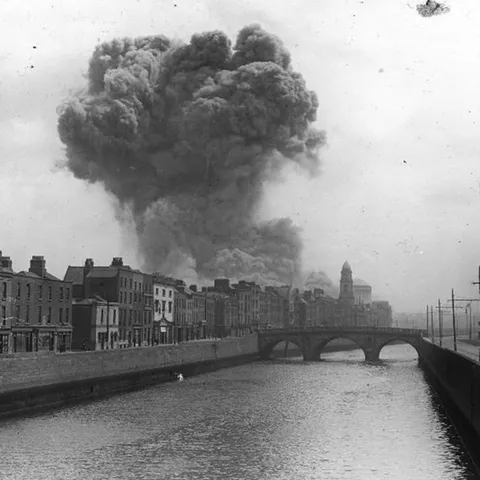
On the western side of what was known as the headquarter block, the anti-treaty IRA stored around two truckloads of gelganite, a highly explosive material used to make those landmines and hand grenades. No prizes for those who can guess where this is going. The fire found its way to this side of the building, and around 12.30 in the afternoon, the rising temperatures caused the unstable gelganite to explode. And boy, was it an explosion. It was huge, the biggest ever seen in Dublin, and black smoke shot up into the sky. You could see it from nearly anywhere in the city. Moira Comerford, who was in the courts, described how, the shock blew me back the full length of my arms, then forward again, while dust and fragments scattered everywhere. While a newspaper reported that a few minutes later, fragments of legal documents urged into the sky by the explosion were rained in several parts of the city. The explosion took place under the offices of the probate and land judge courts, completely demolishing that wing of the building and throwing myriads of forms and documents into the sky.
The explosion shook everyone. Soon after, it was decided that the anti-treaty IRA would surrender. One soldier described the scene like this, Liam Mellows, Joe McKeeley, Ernie O’Malley, with tears in their eyes, addressed the men, stating that to save the lives of such men, they had decided to surrender. They informed the men that surrender was no dishonor and while they were compelled to surrender their guns, they would never surrender their principles. It was only by joint appeal that the men were held in check. So, at 4pm on June 30th, after over 60 hours of fighting, the anti-IRA forces occupying the forecourts formally surrendered. They marched out looking quote, bedraggled, with faces black, with dust, with fatigue, but undaunted.
Many of the Free State Army were furious over the explosion. They believed that the anti-treaty IRA caused it deliberately. One of the commanders, General O’Dailey, was said to have wanted to shoot them all on the spot. But quote, his fellow officers calmed him down and the defeated garrison was marched away. And that was it. The forecourts were now back in control of the Provisional Government, or at least whatever was left of them.
Overall, as mentioned, the casualties were shockingly low. Seven men died on the pro-treaty side with 70 wounded, while only three died on the anti-treaty side. But despite the lack of casualties, the loss at the forecourts had a huge effect on the anti-treaty IRA. They lost a majority of their leadership and all but completely lost their hold on Dublin over the next few days. Though Liam Lynch didn’t agree with a lot of the men, they were his allies at this point and suddenly a huge majority of senior officers who were anti-treaty were now locked up.
A less discussed and maybe slightly more boring loss, but not an unimportant one, was the paperwork destroyed in the fighting work. I know, I know, who cares? But similar to the burning of the customs house, the destruction of the forecourts also destroyed priceless records, some over 700 years old. And these things were so important as the Irish state tried to set itself up. And suddenly they were gone and the people who suffered were the public. At 7pm, a few hours after the fighting, the forecourts dome collapsed. It was a sad but fitting end to a dramatic conflict that made it clear that the civil war had well and truly started.
If you want to go further, you can support the show, get ad-free listening and bonus content on our Patreon page. Simply follow the Patreon link in the show notes or visit our website, thehistoryofireland.com You can also get in touch through the website or on Facebook and Twitter. It’s always great hearing from you guys and if I’ve made a mistake, please do let me know. The History of Ireland was written and produced by me, Kevin Doan, with music by Liam Doyle and additional help from assistant producer Aoife Murphy. Thank you for watching!